Yuan-Ruble Trading Surges as America’s Rivals Rebuff Dollar
(Bloomberg) -- The emerging multi-polar world now includes foreign-exchange markets -- as China and Russia, the biggest challengers to U.S. supremacy, boost direct trading between their currencies.
Monthly volumes on the ruble-yuan pair have surged 1,067% to almost $4 billion since the start of the war in Ukraine as the two nations seek to reduce their reliance on the dollar and boost bilateral trade to overcome current and potential U.S sanctions. The spike coincides with a rally in the ruble to a five-year high against the yuan.
That's a sign Russians are increasingly turning to Chinese goods to replace stalled Western imports and international brands that have vanished from store shelves. For China, it creates the latest boost for the internationalization of the yuan just when growing tensions with the U.S. are slowing that process.
“The main players in the yuan-ruble market are corporations and banks, but there is also a growing interest from retail investors,” said Yuri Popov, a currency and rates strategist at Sberbank CIB JSC. “The volume on the Moscow Exchange's spot market has surged. This is due to sanctions concerns, as well as the intentions of Russia and China to encourage the usage of national currencies in bilateral trade.”
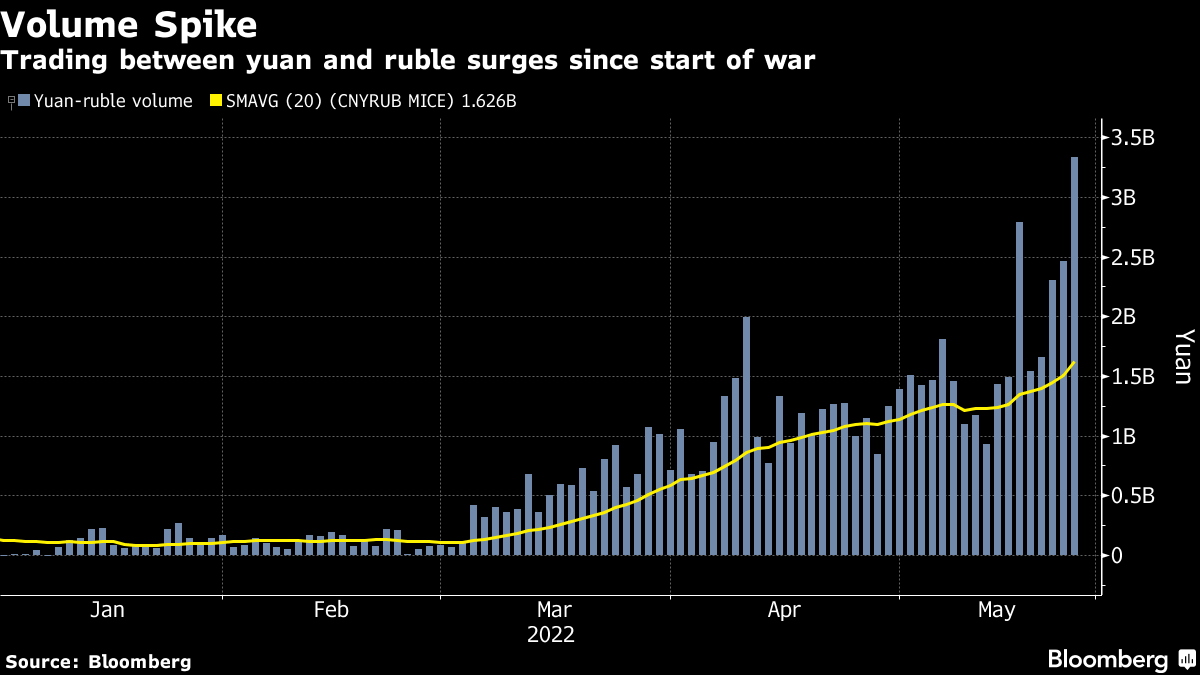
About 25.91 billion yuan ($3.9 billion) have been exchanged for rubles in the Moscow spot market so far in May, according to Bloomberg calculations. This is almost 12 times the volumes in February, the month Russia invaded Ukraine.
“The ruble-yuan trading is bound to go up more on yuan globalization, and the war just accelerated it,” said Stephen Chiu, a strategist at Bloomberg Intelligence in Hong Kong. “Russia will trade more in yuan and hold more yuan reserves.”
Meanwhile, volume in the dollar-ruble pair sank to the lowest level in a decade, based on its 20-day moving average. The ruble rallied 118% against the greenback between early March and late May even as most traders deserted the pair amid capital controls and forced dollar sales that made it a dysfunctional market.
De-risking From Dollar
Efforts by Russia and China to pursue non-dollar transactions are part of a broader derisking strategy gaining popularity among several emerging markets.
Saudi Arabia plans to price some oil contracts in the yuan, while India is exploring a rupee-ruble payment structure. Global central banks are diversifying reserves, sparking a drop in the dollar's share in the holdings to 59% in the last quarter of 2020, the lowest in 25 years, according to the International Monetary Fund.
The crippling sanctions on Russia for its invasion of Ukraine have highlighted China's own vulnerability to US action. Any geopolitical dispute between them could isolate China's economy from the dollar-dominated financial system, while pushing other nations and foreign investors to prune yuan holdings.
For Russia, the purpose is immediate survival. The nation depends on China more than on the US to keep its trade flowing. The world's second-biggest economy accounts for a quarter of all the merchandise Russia imports, while the US accounts for less than 11%.
“Russia has a very weak domestic manufacturing industry; so the sanctions mean that it will necessarily have to rely more on China for machinery and consumer goods,” said Alvin Tan, the head of Asia currency strategy at RBC Capital Markets in Singapore. “At the same time, Chinese buyers are being enticed by discounts on Russian commodity exports.”
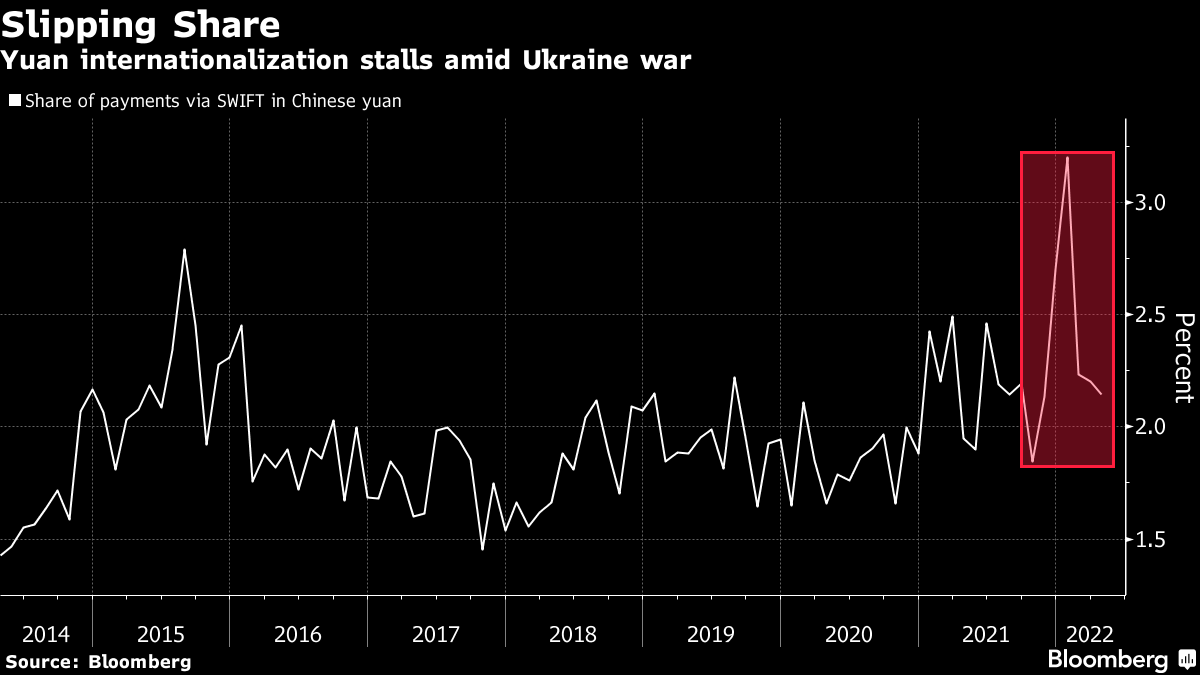
Despite recent shifts, the dollar remains the world's most favorite medium of exchange and the main trading pair for most currencies including the ruble. In fact, after Russia's central bank signaled last week that it wants a weaker currency, daily ruble-dollar volumes recovered to normal levels. As for China, the share of yuan in international transactions remains minuscule, falling further since the war started.
“Larger central banks may be more reluctant to hold the yuan due to potential Western sanctions risk and the corresponding need for China to reimpose capital controls on foreigners,” Gene Frieda, a strategist at Pacific Investment Management Company LLC, wrote in a note last month. “The yuan should continue to attract reserve flows from smaller countries that China dominates as a trade partner.”
More stories like this are available on bloomberg.com
©2022 Bloomberg L.P.

-
One Battle After Another: India's Corporate Dynasties Battle For Control

2026 could go down as Corporate India's year of succession wars, governance battles and family fault lines.
-
Rs 50-Lakh Gold In Bank Locker, Rs 3 Lakh Of Protection: The Gap Most Families Don't Know About
The RBI ties a bank's liability to the annual locker rent and families who want to insure their jewellery face a separate question about how to prove what was inside.
-
The More Food Turns Into Fuel, The Harder It Is To Read Agricultural Markets | The Reason Why
A policy designed to reduce dependence on imported fuel can create new pressures elsewhere in the food economy.
-
Your iPhone Costs 12 Grams Of Gold, A Car About 100. What Does Your Life Weigh?
Measured in rupees, almost everything looks more expensive than it did a generation ago. Measured in grams of gold, a lot of it has become cheaper.
-
Gold Is Rs 22,000 Cheaper Than A Month Ago. Should You Buy Amid The Wedding Season?
Gold's potential slide to $3,500 could save around Rs 4,700 per 10 grams, but a soft inflation print could just as easily push prices back up. One way to split the risk is to buy in parts, some now and the rest after the Fed's Dec. 9 decision.
-
AI Agents Are Gaining Power. Who Governs Them?
Artificial intelligence agents promise to transform productivity by moving machines from assisting decisions to executing them. But as organisations delegate greater authority to these AI-agents, they must first establish who controls that authority and who remains accountable when things go wrong.
-
Why Swapping Your Old Gold Can Trigger A Rs 5 Lakh Tax Bill, And How You Can Avoid It Legally
Swapping old gold for new is taxed as a sale and a fresh purchase. Getting your own gold remade can cut most of that bill, though it has its own costs.
-
The AI Trade is Done. The Real Opportunity for Investors Starts in 2027 | Unhedged Position
As pureplay AI stocks plunge and circular, capex-led financing unwinds, 2027 is set to be a year of reckoning for AI companies. Yet the bust clears the way for a better opportunity for investors in 2027 -- shifting the spotlight from AI builders to the companies using AI.
-
Leadership As Mission: Why The Age Of AI Demands More Human Leadership
Debjani Ghosh examines how AI is changing leadership, arguing that its success must be measured by its impact on people and the accountability of those guiding its use.
-
We May Need Another Tukaram Mundhe To Fight Air Pollution | The Reason Why
Developers may install basic measures such as sprinklers and green nets, resume work, and continue violating rules when this equipment stops working.









