Wall Street Traders Are Too Scared To Fight The AI Rally
(Bloomberg) -- For a lesson in the perils of being a skeptic on Wall Street when everyone else is a buyer, consider Rob Arnott, who made a sensible case five months ago that Nvidia Corp. had become a bubble.
“A textbook story of a Big Market Delusion” is how the venerable founder of Research Affiliates called it, citing extreme valuations after the shares quadrupled in just a year.
Since his September warning, however, the ‘bubble' has gotten around $800 billion bigger — and the greatest risk right now is getting left behind in its wake.
“Never short-sell bubble stocks when they're on a roll,” Arnott said this week. “But that doesn't mean you have to own them.”
Wall Street isn't deaf to the risks that gather when just a handful of high-valuation stocks dominate the market leader board, and Arnott's view could ring true eventually. Yet after the world's most valuable chipmaker smashed expectations with its blowout report Wednesday, the AI party is one nobody can afford to miss.
Short interest is nearly nonexistent among tech behemoths. Analyst price targets are surging. Positioning from hedge funds to retail traders is getting more aggressive.
“Right now, there's no bear case,” said Alec Young, chief investment strategist at data platform Mapsignals. “You don't get a move like this in a company this big if the bears have a leg to stand on.”
For active managers, the pressure is getting more intense by the day to ride the upward momentum across tech-powered indexes like the S&P 500 and Nasdaq 100, both of which just rose for the 15th time in 17 weeks. In turn, the Nasdaq 100's price-earnings ratio climbed above 30 times and its multiple to sales reached 5, figures with few precedents outside the late 1990s dot-com craze and its aftermath.
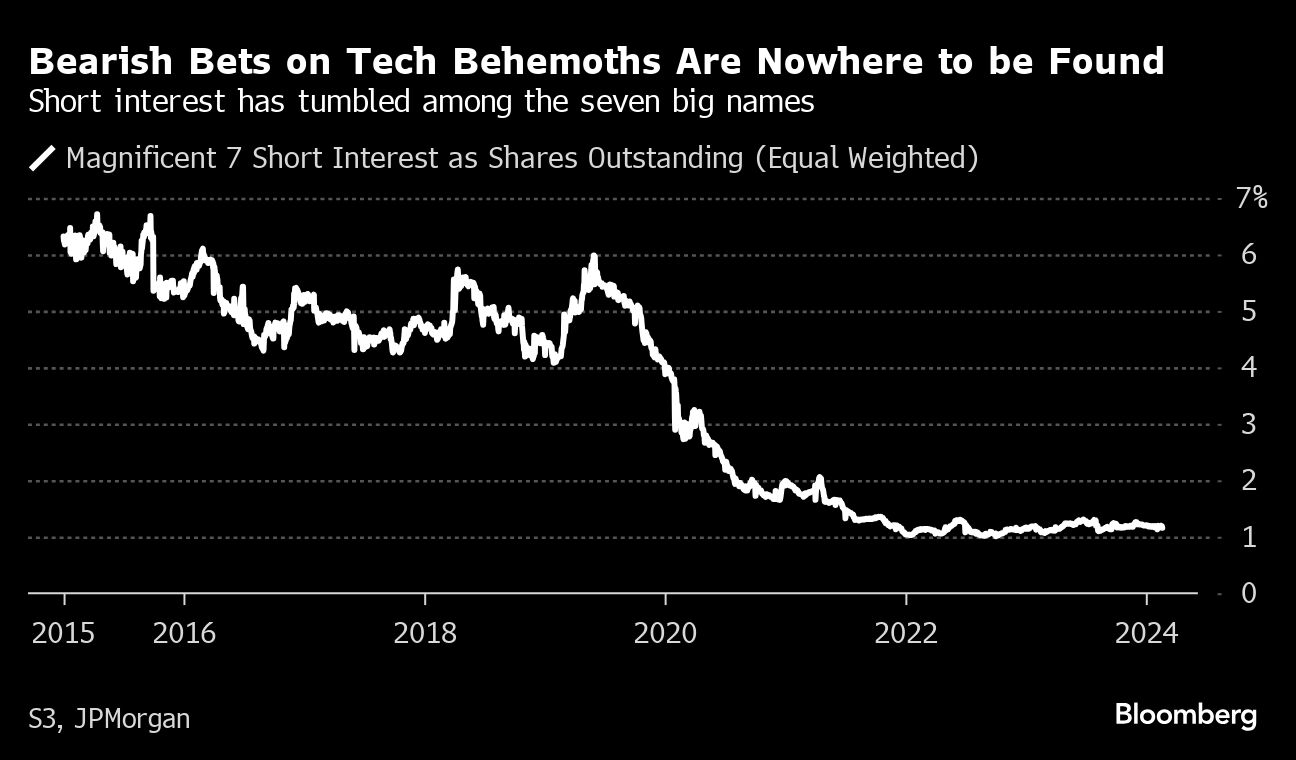
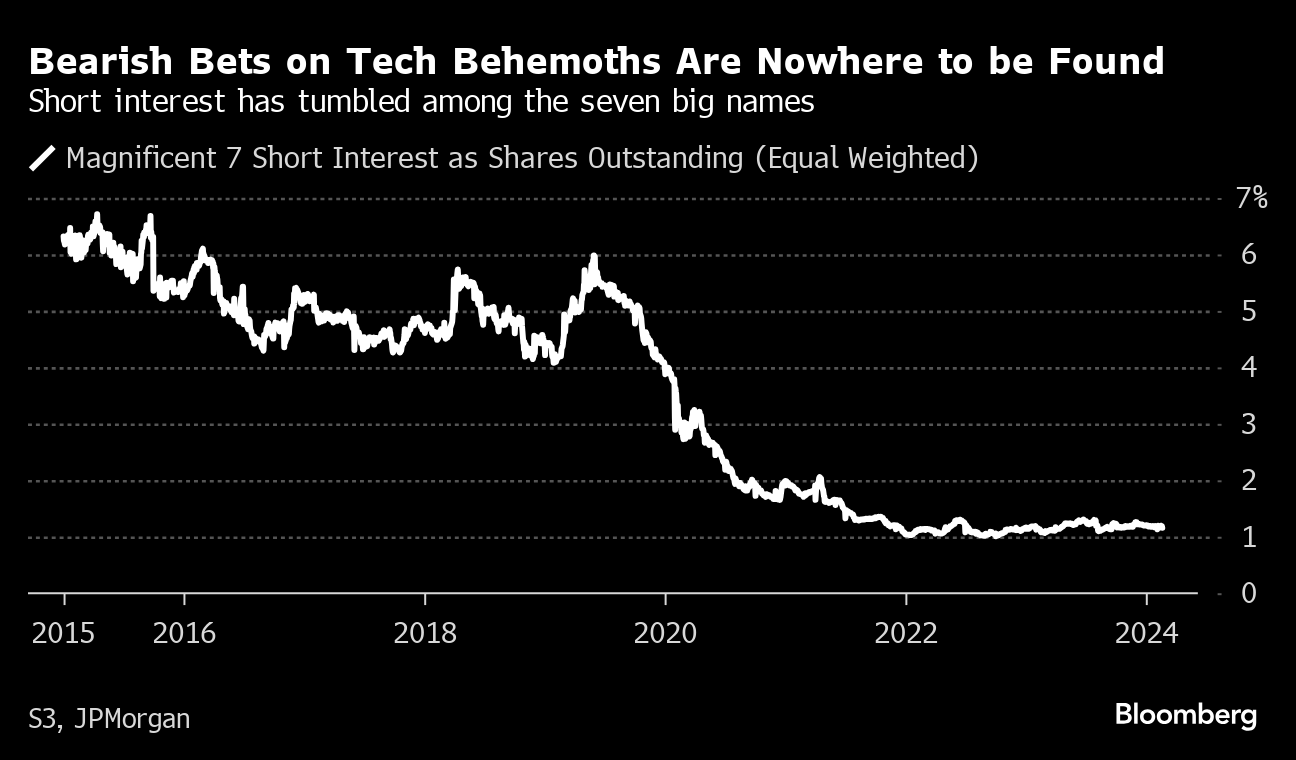
Owing both to the pace of earnings gains and the futility of betting against them, the Magnificent 7's meteoric rally hasn't been accompanied by any increase in bearish bets. Short interest has tumbled to just 1% of the group's outstanding shares, hovering around the lowest level since at least 2015, according to estimates from JPMorgan Chase & Co. strategist Nikolaos Panigirtzoglou. Thursday's 16% surge in Nvidia rung up about $3 billion in paper losses for those still holding bearish wagers, according to an analysis by S3 Partners LLC.
Among hedge funds, the latest 13F reports revealed another increase in the share of ownership of the group. Retail traders are also driving the action, with demand for bullish options reminiscent of the pandemic-era trading boom.
Yet even amid a record-breaking rally, Nvidia has seen its valuation narrow since the middle of 2023 thanks to its earnings growth.
“It definitely was the most important stock on earth,” said Goldman Sachs Group Inc. tactical specialist Scott Rubner, speaking of Nvidia. “These market cap gains have brought back animal spirits to the retail traders with activity on the message boards and call options at the highest level since March 2020.”
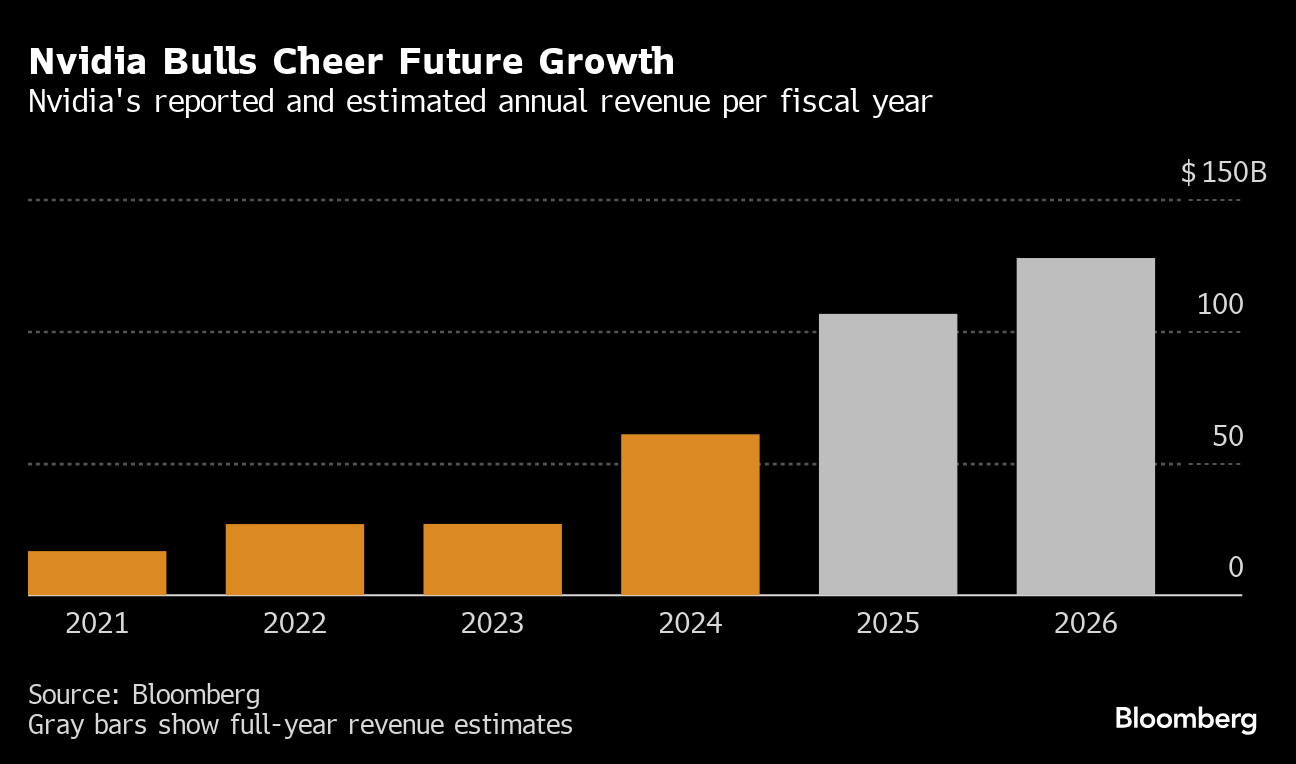
The chipmaker reported a 486% year-over-year gain in earnings per share excluding certain items in its fiscal fourth quarter. The company also said it expects first quarter revenue of about $24 billion, handily beating analyst estimates.
In turn, bulls rushed to boost their price targets — the average is now about $863, implying a more than 9% upside, according to data compiled by Bloomberg. At the top end, Rosenblatt Securities boosted its target to a Street-high $1,400 from $1,100, more than 75% higher than were shares currently trade.
“I'm actively looking for ways where Nvidia could go wrong and I'm having difficulty finding any real hole in the story,” said Shana Sissel, CEO at Banrion Capital Management LLC, who has been holding positions in Nvidia since 2017. “I wish I bought some at $650.”
While Nvidia boosted major indexes, the gains were lavished in a select handful of equities yet again. Less than 70% of stocks on the New York Stock Exchange advanced, while S&P 500 cored a 1.7% weekly gain. That's bad news for those who have been betting on a broadening of the rally soon enough.
Ken Mahoney, CEO of Mahoney Asset Management, is not worried about bloated valuations, but still cut exposure to the Nvidia to cash out on some of his gains.
“Just to be prudent, we took about 20% off the table,” Mahoney said. “We also know that if in the days and weeks ahead if there's a slowdown or the stock comes back a little bit, we will have some money to redeploy.”
--With assistance from Isabelle Lee.
More stories like this are available on bloomberg.com
©2024 Bloomberg L.P.

-
One Battle After Another: India's Corporate Dynasties Battle For Control

2026 could go down as Corporate India's year of succession wars, governance battles and family fault lines.
-
Rs 50-Lakh Gold In Bank Locker, Rs 3 Lakh Of Protection: The Gap Most Families Don't Know About
The RBI ties a bank's liability to the annual locker rent and families who want to insure their jewellery face a separate question about how to prove what was inside.
-
The More Food Turns Into Fuel, The Harder It Is To Read Agricultural Markets | The Reason Why
A policy designed to reduce dependence on imported fuel can create new pressures elsewhere in the food economy.
-
Your iPhone Costs 12 Grams Of Gold, A Car About 100. What Does Your Life Weigh?
Measured in rupees, almost everything looks more expensive than it did a generation ago. Measured in grams of gold, a lot of it has become cheaper.
-
Gold Is Rs 22,000 Cheaper Than A Month Ago. Should You Buy Amid The Wedding Season?
Gold's potential slide to $3,500 could save around Rs 4,700 per 10 grams, but a soft inflation print could just as easily push prices back up. One way to split the risk is to buy in parts, some now and the rest after the Fed's Dec. 9 decision.
-
AI Agents Are Gaining Power. Who Governs Them?
Artificial intelligence agents promise to transform productivity by moving machines from assisting decisions to executing them. But as organisations delegate greater authority to these AI-agents, they must first establish who controls that authority and who remains accountable when things go wrong.
-
Why Swapping Your Old Gold Can Trigger A Rs 5 Lakh Tax Bill, And How You Can Avoid It Legally
Swapping old gold for new is taxed as a sale and a fresh purchase. Getting your own gold remade can cut most of that bill, though it has its own costs.
-
The AI Trade is Done. The Real Opportunity for Investors Starts in 2027 | Unhedged Position
As pureplay AI stocks plunge and circular, capex-led financing unwinds, 2027 is set to be a year of reckoning for AI companies. Yet the bust clears the way for a better opportunity for investors in 2027 -- shifting the spotlight from AI builders to the companies using AI.
-
Leadership As Mission: Why The Age Of AI Demands More Human Leadership
Debjani Ghosh examines how AI is changing leadership, arguing that its success must be measured by its impact on people and the accountability of those guiding its use.
-
We May Need Another Tukaram Mundhe To Fight Air Pollution | The Reason Why
Developers may install basic measures such as sprinklers and green nets, resume work, and continue violating rules when this equipment stops working.









