Everything Wall Street Got Wrong In 2023
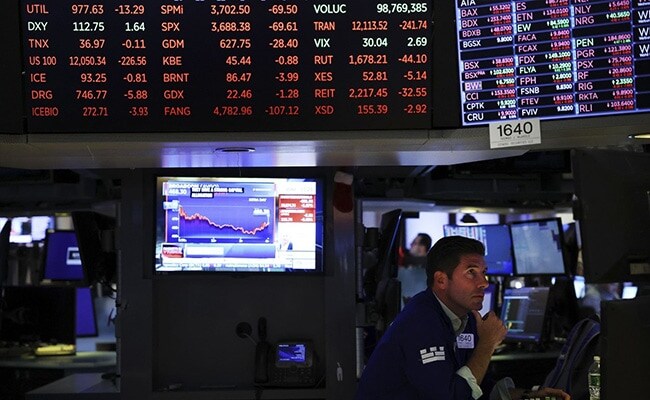
(Bloomberg) -- All across Wall Street, on equities desks and bond desks, at giant firms and niche outfits, the mood was glum. It was the end of 2022 and everyone, it seemed, was game-planning for the recession they were convinced was coming.
Over at Morgan Stanley, Mike Wilson, the bearish stock strategist who was rapidly becoming a market darling, was predicting the S&P 50O Index was about to tumble. A few blocks away at Bank of America, Meghan Swiber and her colleagues were telling clients to prepare for a plunge in Treasury bond yields. And at Goldman Sachs, strategists including Kamakshya Trivedi were talking up Chinese assets as the economy there finally roared back from Covid lockdowns.
Blended together, these three calls — sell US stocks, buy Treasuries, buy Chinese stocks — formed the consensus view on Wall Street.
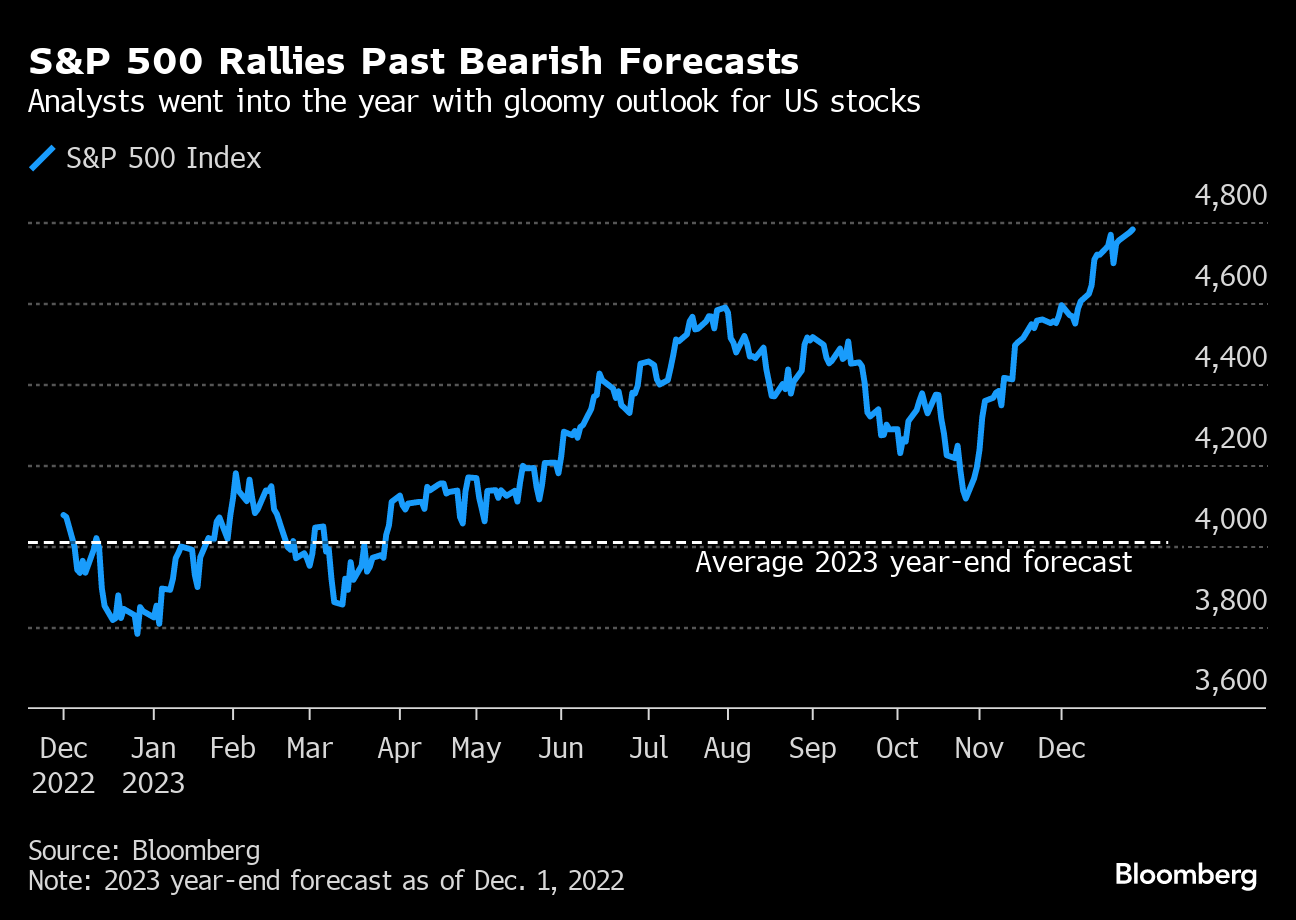
And, once again, the consensus was dead wrong. What was supposed to go up went down, or listed sideways, and what was supposed to go down went up — and up and up. The S&P 500 climbed more than 20% and the Nasdaq 100 soared over 50%, the biggest annual gain since the go-go days of the dot-com boom.
It's a testament in large part to the way the economic forces unleashed in the pandemic — primarily, booming consumer demand that fueled both growth and inflation — continue to bewilder the best and brightest in finance and, for that matter, in policy making circles in Washington and abroad.
And it puts the sell side — as the high-profile analysts are known to all on Wall Street — in a very uncomfortable position with investors across the world who pay for their opinions and advice.
“I've never seen the consensus as wrong as it was in 2023,” said Andrew Pease, the chief investment strategist at Russell Investments, which oversees around $290 billion in assets. “When I look at the sell side, everyone got burned.”
Money managers at shops like Russell came out looking alright this year, generating returns in stocks and bonds that are slightly higher on average than the gains in benchmark indexes. But Pease, to be clear, didn't fare much better with his forecasts than the stars on the sell side. The root of his mistake was the same as theirs: a nagging sense that the US — and much of the rest of the world — were about to sink into a recession.
This was logical enough. The Federal Reserve was in the midst of its most aggressive interest-rate-hiking campaign in decades and spending by consumers and companies seemed sure to buckle.
There have been few signs of that so far, though. In fact, growth actually quickened this year as inflation receded. Throw into the mix a couple of breakthroughs in artificial intelligence — the hot new thing in the world of tech — and you had the perfect cocktail for a bull market for stocks.
The year started with a bang. The S&P 500 jumped 6% in January alone. By mid-year, it was up 16%, and then, when the inflation slowdown fueled rampant speculation the Fed would soon start reversing its rate hikes, the rally quickened anew in November, propelling the S&P 500 to within spitting distance of a record high.
Through it all, Wilson, Morgan Stanley's chief US equity strategist, was unmoved. He had correctly predicted the 2022 stock-market rout that few others saw coming — a call that helped make him the top-ranked portfolio strategist for two straight years in Institutional Investor surveys — and he was sticking to that pessimistic view. In early 2023, he said, stocks would fall so sharply that, even with a second-half rebound, they'd end up basically unchanged.
He suddenly had plenty of company, too. Last year's selloff, sparked by the rate hikes, spooked strategists. By early that December, they were predicting that equity prices would drop again in the year ahead, according to the average estimate of those surveyed by Bloomberg. That kind of bearish consensus hadn't been seen in at least 23 years. Even Marko Kolanovic, the JPMorgan Chase strategist who had insisted through much of 2022 that stocks were on the cusp of a rebound, had capitulated. (That dour sentiment has extended into next year, with the average forecast calling for almost no gains in the S&P 500.)
It was Wilson, though, who became the public face of the bears, convinced that a 2008-type crash in corporate earnings was on the horizon. While traders were betting that cooling inflation would be good for stocks, Wilson warned of the opposite — saying it would erode companies' profit margins just as the economy slowed.
In January, he said even the downbeat Wall Street consensus was too sanguine and predicted the S&P could drop more than 20% before finally snapping back. A month later, he warned clients the market's risk-reward dynamic “is as poor as it's been at any time during this bear market.” And in May, with the S&P up nearly 10% on the year, he urged investors not to be duped: “This is what bear markets do: they're designed to fool you, confuse you, make you do things you don't want to do.”
Wilson declined requests to be interviewed for this story.
Similar resolve had taken hold among bond mavens. Yields on Treasuries surged in 2022 as the Fed put an end to its near-zero interest-rate policy, pushing up the cost of consumer and business loans. It was all happening so fast, the thinking went, that something was bound to break in the economy, driving it into recession. And when it did, bonds would rally as investors rushed into haven assets and the Fed came to the rescue by reopening the monetary spigot.
So Swiber and her colleagues on BofA's rate-strategy team — like the vast majority of forecasters — predicted solid gains for bond investors who had just been dealt their worst annual loss in decades. The bank was among a handful of firms calling for the yield on the benchmark 10-year note to drop all the way to 3.25% by the end of 2023.
For a moment, it looked like that was about to happen. Something indeed broke: Silicon Valley Bank and a few other lenders collapsed in March after suffering massive losses on fixed-income investments — a consequence of the Fed's rate hikes — and investors braced for an escalating crisis that would throttle the economy. Stocks swooned and Treasuries rallied, driving the 10-year yield down to BofA's target. “The thought was that this would be a tailwind to this view for a harder landing,” Swiber said.
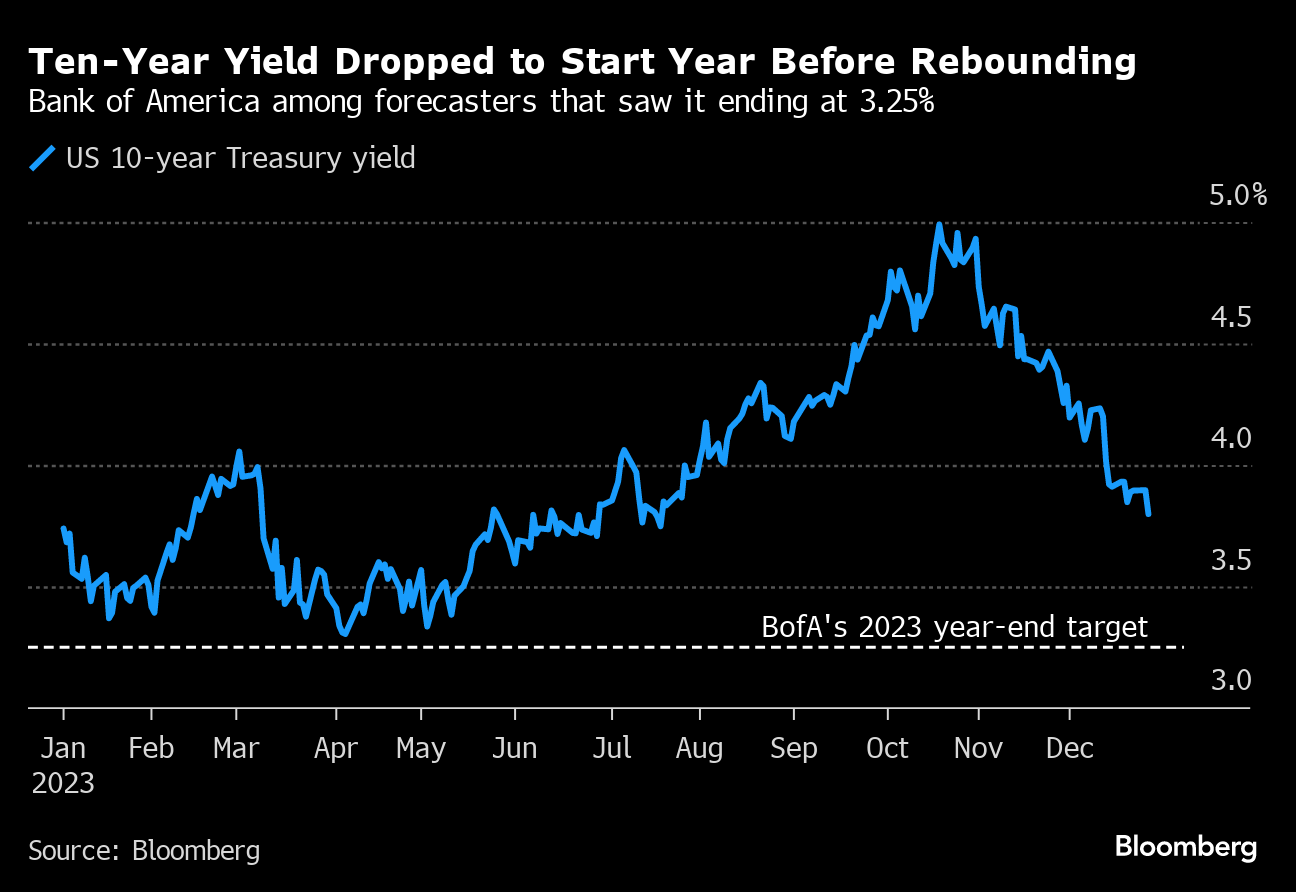
But the panic didn't last long. The Fed managed to quickly contain the crisis, and yields resumed their steady climb through the summer and early fall as economic growth re-accelerated. A late-year rebound in Treasuries pushed the yield on the 10-year note back down to 3.8%, just about the same level it was at a year ago.
Swiber said the year has been humbling, not just for her but “for forecasters across the board.”
At the same time, Wall Street was being handed another humbling in markets overseas.
Chinese stocks gained during the last two months of 2022 as the government ended its strict Covid controls. With its economy unleashed, strategists at Goldman, JPMorgan and elsewhere were predicting China would help propel a rebound in emerging-market stocks.
Goldman's Trivedi, the head of global currency, rates and emerging-markets strategy in London, concedes things haven't gone as expected. The world's second biggest economy has faltered as a real-estate crisis deepened and fears of deflation grew. And rather than pile in, investors pulled out, sending Chinese stocks tumbling and dragging down returns on emerging-market indexes.

“The boost from reopening faded very quickly,” Trivedi said. “The net positive effect from reopening was smaller and you did not see the same kind of growth rebound that you had in other parts of the world.”
Meanwhile, the US equity market continued to defy naysayers.
By July, Morgan Stanley's Wilson acknowledged he'd remained pessimistic for too long, saying “we were wrong” in failing to see that stock valuations would climb as inflation receded and companies cut costs. Even so, he was still pessimistic about corporate earnings, and later said a fourth-quarter stock rally was unlikely.
When the Fed held rates steady for a second straight meeting on Nov. 1, however, it set off a furious rally in both stocks and bonds. The advances accelerated this month after policymakers indicated that they're finally done hiking, prompting traders to anticipate several rate cuts next year.
Markets have repeatedly erred in expecting such a sharp pivot in the past couple years, and they could be doing so again.
For some on Wall Street's sell-side, doubts are creeping in. At TD Securities, Gennadiy Goldberg, now the head of US rates strategy, said he and his colleagues “did some soul searching” as the year wound down. TD was among the firms predicting solid 2023 bond gains. “It's important to learn from what you got wrong.”
What did he learn? That the economy is far stronger and far better positioned to cope with higher interest rates than he had thought.
And yet, he remains convinced that a recession looms. It will hit in 2024, he says, and when it does, bonds will rally.
--With assistance from Ye Xie, Sujata Rao-Coverley and Matt Turner.
More stories like this are available on bloomberg.com
©2023 Bloomberg L.P.

-
Love, Sex Aur Dhokha: The Audacious Plot To Spy On Jensen Huang

A Taipei dinner, a Singapore chip buyer and a suspected Chinese asset: inside the alleged spy operation that got close to NVIDIA's Jensen Huang.
-
Ten Things I Learnt This Samvat
Patience can be a trap. Cheap stocks can stay cheap. Leverage can wipe you out. What did Samvat 2082 teach us? Niraj Shah writes on 10 lessons from the year gone by.
-
Talking Points This Week: Tech Nerves, FII Buying, And A Faraway Banking Shock
The global markets are not shining this Diwali. The exception in the large markets is, India.
-
Midterm Rally Lasted A Day. The Hard Reality Of A Divided US May Last Two Years | Opinion
Between a contested AI boom, a debt ceiling that arrives in 2027 and a president with every incentive to act alone, the next two years may prove more volatile than the first day's rally suggests.
-
Blue Wave Will Derail the AI Trade but Won't Dismantle the AI Era | Unhedged Position
The Democrats' sweep of the US Congress will see politics collide with economic forces both over the long and short term.
-
It's Time To Take The GST Council's Bet On Trust Global
Payment records can prove India's services exports, and clear, proportionate rules can bring foreign digital sellers into the tax net.
-
Opinion | India at 38: From Innovation Overperformer to Innovation Powerhouse
India now has 453 VC-backed deep science startups, 18 of them late-stage, after 117 percent growth since 2020. Laurus Labs, at USD 9.3 billion, is the most valuable deep science company in any middle-income economy outside China.
-
Navigating Energy Crossroads: S Jaishankar's Call For Diversified Supply Chains At G20 Ministerial Meeting
As geopolitical fault lines continue to test maritime trade routes and commodity flows, Jaishankar's message remains pertinent: true economic resilience requires open markets, protected transit lines, and a genuine commitment to multilateral cooperation rather than coercion.
-
Indians Are Travelling, But Not Every Journey Is A Holiday | The Week In Whys
Pilgrims, patients and working women are the real travellers, and the system hasn't quite caught up with them.