US Stocks Snap Five-Day Drop As Dollar Retreats: Markets Wrap

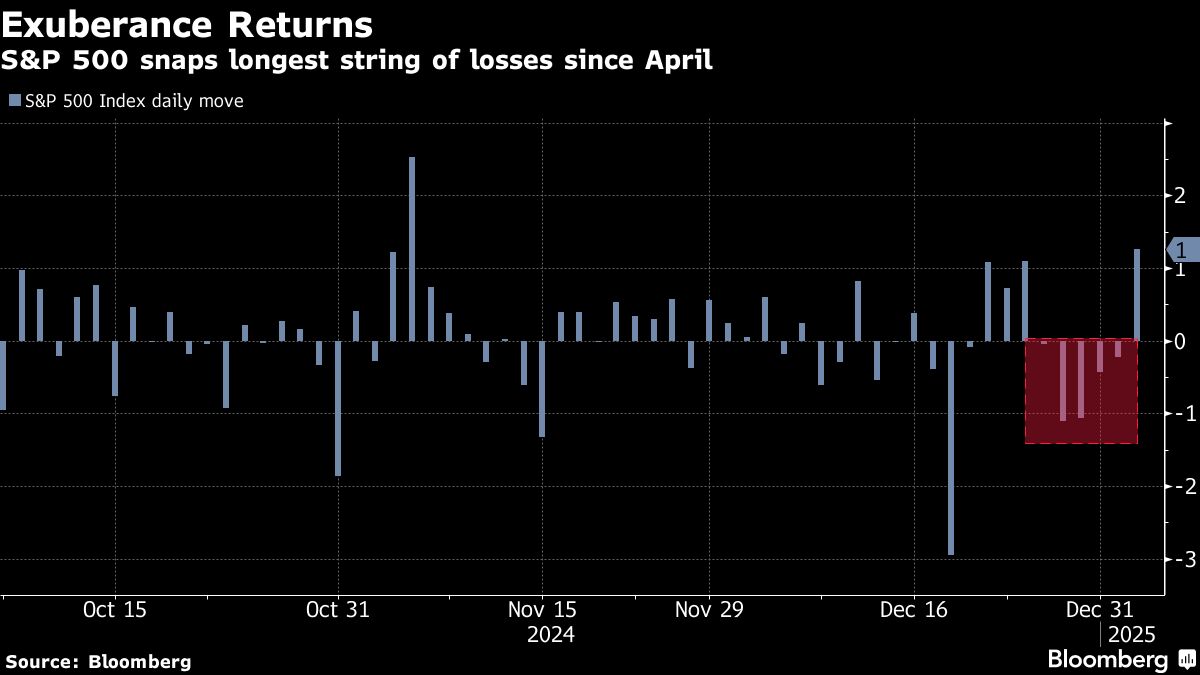
Investors have finally been induced to buy the dip in US stocks. After a five-day drop that shaved more than a trillion dollars off share prices, Wall Street put the longest equities losing streak since April behind it.
The Nasdaq 100 clawed back losses on Friday, climbing 1.7% while the S&P 500 rose 1.3%. The gains managed to put a dent in the week's selloff after an end of December rout had stretched into the first trading day of the year. Traders shrugged off warnings about slowing earnings growth for the tech stocks dubbed the Magnificent Seven and continued to snap up shares of AI juggernaut Nvidia Corp.
“For as long as retail investors continue to pour money into the AI theme, the AI led boom in stock markets is likely to continue,” JPMorgan strategists led by Nikolaos Panigirtzoglou told clients. To track the mood of day traders they advised watching flows into Invesco's Nasdaq-tracking exchange-traded fund (QQQ) and a fund from GraniteShares, which provides twice the daily returns of Nvidia (NVDL).
Stocks reached session highs in the afternoon as the reelection of Mike Johnson to House speaker suggested Republicans will be able to coalesce behind the president-elect's business-friendly deregulatory agenda. Bond yields pushed higher with the benchmark 10-year touching 4.6% after Richmond Fed President Tom Barkin suggested his preference was to keep rates restrictive for longer.
Earlier data showed US manufacturing rose at a modest pace in the final month of 2024. The Institute for Supply Management's gauge hit 49.3, topping estimates, but remained below 50, a level that indicates economic expansion. New orders rose to the highest since the start of last year. Treasuries dipped after the report while stocks held onto gains.
Investors sieving through data to find signs the world's largest economy was still going strong had to weigh that against the prospect of slower and shallower interest-rate cuts after Federal Reserve Chair Jerome Powell's hawkish pivot in December.
Vital Knowledge's Adam Crisafulli said the ISM readout was incrementally positive but “but it will reinforce worries about hawkish policy and elevated yields.”
Such concerns saw volatility reemerge this week as the S&P 500 notched intraday gains in the previous two sessions, only to close lower. Lighter holiday trading amplified the moves.
Second Term
Investors are also contemplating Donald Trump's return to the White House in 17 days.
“We really need to see more of that clarity on Jan. 20 for markets to have greater conviction,” Laura Cooper, global investment strategist at Nuveen, said on Bloomberg Television. “US exceptionalism will continue to be the dominant theme at least in the first half of the year, regardless of what some of those policies that come through are.”
Louis Navellier sees “growing concern regarding the plethora of changes being proposed by the incoming Trump 2.0 administration.”
“The sabre rattling about tariffs brings inflation risks. The deportation of many thousands of illegal immigrants may cause labor disruptions,” the chief investment officer of Navellier & Associates wrote in a note.
The dollar drifted lower after setting a two-year high Thursday.
Among individual stock movers, Freddie Mac and Fannie Mae traded near eight-year highs on plans to release the mortgage giants from government supervision. United States Steel Corp. fell 6.5% after President Joe Biden blocked Nippon Steel Corp.'s proposed purchase of the company.
Biden's decision to block the $14.1 billion sale of US Steel to Nippon Steel killed a high-profile deal that sparked a political firestorm and tensions between the US and Japan. Biden announced his formal decision on Friday after the case was referred to him by a US security review panel, ahead of a deadline early next week.
“U.S. Steel will remain a proud American company — one that's American-owned, American-operated, by American union steelworkers — the best in the world,” the president said in a statement.
Shares of drinks makers declined after the US Surgeon General said labels on alcohol products like beer and wine should carry warnings of their links to cancer. Constellation Brands Inc. slumped as much as 2.3% and Molson Coors Beverage Co. lost nearly 5%. In Brussels, Anheuser-Busch InBev NV, the maker of Budweiser beer, fell 2.8%.
Chinese stocks extended the worst start to the year since 2016, reflecting worries about the growth outlook. The yuan fell to breach the psychological milestone of 7.3 per dollar for the first time since late 2023. The nation's 10-year government bond yield slipped below 1.6% for the first time ever.
“There's been many false dawns in China in recent months and it looks as though it's unraveling again,” said Kenneth Broux, a strategist at Societe Generale. “We've seen three big days of selling which is not really conducive to sentiment.”
In commodities, WTI crude extended a climb into the fifth day reaching $74 a barrel. Gold lodged its best weekly gain since November.
Some of the main moves in markets:
Stocks
The S&P 500 rose 1.3% as of 4:05 p.m. New York time
The Nasdaq 100 rose 1.7%
The Dow Jones Industrial Average rose 0.8%
The MSCI World Index rose 1%
Currencies
The Bloomberg Dollar Spot Index fell 0.1%
The euro rose 0.4% to $1.0308
The British pound rose 0.4% to $1.2429
The Japanese yen rose 0.1% to 157.28 per dollar
Cryptocurrencies
Bitcoin rose 1.2% to $98,261.76
Ether rose 4.4% to $3,602.51
Bonds
The yield on 10-year Treasuries advanced four basis points to 4.60%
Germany's 10-year yield advanced five basis points to 2.43%
Britain's 10-year yield was little changed at 4.59%
Commodities
West Texas Intermediate crude rose 1.2% to $74 a barrel
Spot gold fell 0.7% to $2,638.43 an ounce
This story was produced with the assistance of Bloomberg Automation.
© 2025 Bloomberg L.P.

-
'Never Seen This Level Of Negativity': Sandeep Tandon Says The Next Rally May Be Closer Than You Think

Veteran investor Sandeep Tandon says foreign selling is easing, large-caps are due a comeback and mid-caps are crowded, while he turns positive on gold, power and pharma this Diwali.
-
Indians Stay With Family, Not In Hotels | The Reason Why
India still lacks enough clean, reliable and affordable hotels for budget-conscious travellers.
-
The Economic Imperative: Analysing The Material Driving Force Behind India-Canada Strategic Reset
This economic complementarity is further reinforced by deep institutional investment ties and talent mobility, which form the bedrock of the bilateral framework.
-
Medicine Pricing: Where Must Profit Stop?
India must confront excessive margins, hidden incentives and regulatory gaps that threaten the integrity of medicine.
-
Why Amazon And Flipkart Are Struggling To Beat Meesho In India's Smaller Cities
With 274 million users and lowest-cost logistics, Meesho is defending its value commerce crown against giants like Amazon and Flipkart.
-
High US Salaries, No Green Card Certainty: The Financial Calculation Facing Indian H-1B Families
The suspension of PERM processing at eight technology employers does not cancel existing H-1B visas. What it does is force a question many Indian families have been avoiding: is the US salary worth tying your career and family plans to one employer?
-
Swiggy vs Eternal: Food Delivery's Two Rivals Are No Longer In The Same Race
Eternal is building a private AI assistant, dark.ai. Swiggy is still working out how to make Instamart pay, with an operating loss of Rs 895 crore in the July-September quarter while Blinkit stayed profitable.
-
Where You Live Shapes How You Get To Work | The Reason Why
Two-wheelers are the most popular way to get to work in India, accounting for nearly 43% of workplace commutes.
-
Unhedged Position: Can India See An Indonesia-Style Time Correction?
The Nifty is trading below levels it first clocked in 2024. Is there, then, as I have suggested in the headline, potential that the current time correction drags on painfully for the next three-five, even ten years?
-
Navigating Friction And Energy Realities: An Analysis Of Marco Rubio's October Visit To India
Occurring at a critical juncture marked by stalled trade negotiations and escalating geopolitical pressures over global energy supplies, the visit offers a profound window into modern US-India relations.










