U.S. Stocks Approach Record High on Economic Data; Oil Slumps  
U.S. Stocks Approach Record High on Economic Data; Oil Slumps  
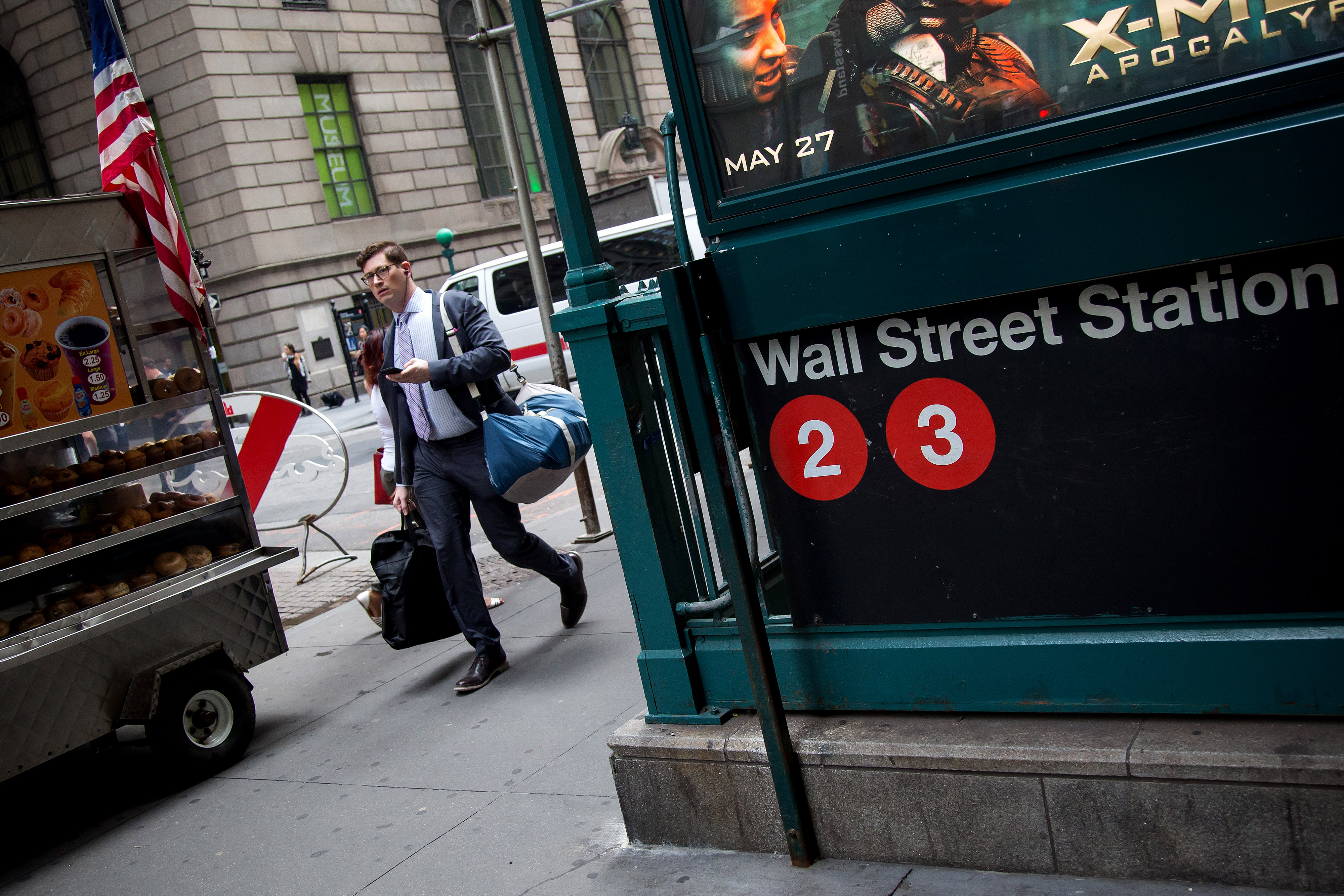
A pedestrian walks past the Wall Street subway station near New York Stock Exchange in New York, U.S. (Photographer: Michael Nagle/Bloomberg)

(Bloomberg) -- U.S. stocks approached a record after an increase in consumer spending underscored the strength of the world's largest economy as traders assessed the outlook for interest rates. The dollar rose, while oil slumped.

The S&P 500 Index rebounded from a three-day slide, and the dollar rose against most of its major peers. The extra yield that 30-year bonds offer over two-year notes shrank to the lowest closing level since 2007, indicating traders are betting on higher borrowing costs. Oil sank amid doubts that producers will agree on a deal to stabilize the market when suppliers meet in September. Brazil's Ibovespa extended the world's biggest gain this year on speculation President Dilma Rousseff will be permanently removed from office.

Traders pushed up the value of American equities after a report showed consumer spending rose for a fourth straight month in July, bolstered by stronger income gains. The data highlighting strength in the world's largest economy followed disappointing retail sales and sluggish growth figures. The monthly jobs report due this Friday may provide more clues on whether policy makers will have room to boost interest rates after Federal Reserve Chair Janet Yellen said the case for a hike is getting stronger.

“There are good indicators that incomes are improving and consumption is going to continue to stay strong, which points to a resilient U.S. economy,” said Brian Jacobsen, chief portfolio strategist with Wells Fargo Funds Management LLC, which oversees $242 billion. “The big question is whether inflation is going to break higher or continue like this -- it puts more emphasis on Friday's employment report. It's still a pretty murky picture right now.”

Fed fund futures indicate a 36 percent chance that the central bank will raise rates next month, up from 22 percent Aug. 19 and zero in late June after the U.K. voted to leave the European Union. The odds of an increase by December have risen to 60 percent from a low of 8 percent reached June 27.

Stocks

The S&P 500 rose 0.6 percent at 2:52 p.m. in New York, halting the longest slide since June. Wells Fargo & Co. and Facebook Inc. contributed the most to the gauge's advance. Herbalife Ltd. climbed after billionaire Carl Icahn bought more than 2.3 million shares in the embattled nutrition company, a high-profile target of fellow billionaire activist investor Bill Ackman.

The Stoxx Europe 600 Index retreated 0.2 percent, paring earlier losses. A gauge of auto makers posted the biggest decline, while sliding oil prices dragged energy producers lower. The volume of shares changing hands was 73 percent lower than the 30-day average as U.K. markets closed for a holiday.

Japanese shares led gains among the biggest equity markets after central bank chief Haruhiko Kuroda reiterated a pledge to boost stimulus if needed.

The MSCI Emerging Markets Index fell 0.5 percent as Turkish and Russian shares slumped. The Ibovespa jumped amid optimism that Acting President Michel Temer, who will stay on as the nation's leader if the Senate decides to impeach Rousseff, will be able to restore confidence in Latin America's biggest economy.

Bonds

The extra yield that 30-year bonds offer over two-year notes shrank to 1.40 percentage points. History suggests that a Fed rate increase supports longer-maturity bonds more than short-dated obligations as higher borrowing costs help stem inflation and keep the economy from overheating.

The two-year Treasury yield fell three basis points, or 0.03 percentage points, to 0.81 percent Monday, according to Bloomberg Bond Trader data. The 30-year yield fell seven basis points to 2.22 percent. The yield on the benchmark 10-year notes slumped seven basis points to 1.56 percent.

Yellen's speech on Friday put the spotlight on Friday's August labor report, which is projected to show employers added 180,000 jobs, following a gain of 255,000 in July. The monthly labor force number has exceeded expectations the past two readings, pointing to renewed vigor in the employment market.

“They're likely to tighten in September, at least as long as the jobs number comes in OK,” Michael Pond, head of global inflation market strategy at Barclays Capital Inc. in New York, said on Bloomberg Television. “Hawkish Fed rhetoric has certainly increased recently. It'll take a decent number, like 200,000, for them to go.”

Currencies

The Bloomberg Dollar Spot Index, which tracks the currency against 10 peers, gained 0.1 percent. The dollar added 0.1 percent to $1.1189 per euro, and rose 0.1 percent to 101.96 yen.

The dollar's advance trimmed its loss this year to about 4 percent. Currency investors' sentiment has shifted back and forth in recent weeks on how aggressive the Fed will be at a time when central banks in developed economies increase stimulus measures.

“Dollar appreciation is likely to resume over the balance of the year,” Atul Lele, who manages $2 billion as chief investment officer of Nassau, Bahamas-based Deltec International Group, wrote in a note to clients. “The factors that are contributing to the strong cyclical and secular U.S. dollar outlook remain,” including economic growth and the nation's divergent monetary policy from other central banks.

The MSCI Emerging Markets Currency Index fell 0.6 percent, with South Korea's won sliding 1 percent. The rand slipped to a six-week low against the dollar as increased political risk in South Africa weighed on the currency. Brazil's real advanced.

Commodities

The Bloomberg Commodity Index dropped for a fourth day as the dollar's advance curbed the appeal of raw materials as an investment.

West Texas Intermediate crude for October delivery 1.4 percent to $46.98 a barrel on the New York Mercantile Exchange.

Oil entered a bull market Aug. 18, less than three weeks after tumbling into a bear market, as prices surged partly on speculation that discussions among members of the Organization of Petroleum Exporting Countries may lead to action to stabilize the market. An output freeze was proposed in February, but talks in April ended with no final accord. For a second week, money managers slashed bets on falling West Texas Intermediate crude prices by a record.

“The short-covering rally has come to an end,” said Bob Yawger, director of the futures division at Mizuho Securities USA Inc. in New York. “There are two reasons for this: the likelihood of an agreement to freeze output is becoming less-and-less likely all the time and the dollar's relative strength.”

Unlock this article for free
Sign up to access exclusive stories, fewer ads, and a personalised experience.
Set as Trusted Source
on Google Search
Add NDTV Profit As Google Preferred Source








