Tech and Crypto in Peril as Fed Ends Liquidity Binge, Survey Shows
(Bloomberg) -- The speculative darlings of the easy-money era -- technology stocks and cryptocurrencies -- are acutely vulnerable now that the Federal Reserve is shrinking its nearly $9 trillion balance sheet.
At the same time, central bankers from Canada to Europe are about to test the resilience of global markets as they follow hawkish US policy makers on a liquidity-sapping mission to unwind the pandemic bond-buying spree.
That's the broad outlook for Wall Street and beyond, according to the most-popular responses from 687 contributors to the latest MLIV Pulse survey, as the Fed this month starts reducing its asset holdings in a process known as quantitative tightening.

The historic shift is seen as a notable threat to tech equities and digital tokens -- both risk-sensitive assets that soared in the Covid-era market mania before cratering in this year's cross-asset crash.
The era of ultra-cheap money looks over for now. The Fed's balance-sheet drawdown is seen lasting more than a year, while nearly two-thirds of survey respondents say the four-decade bull run in Treasuries has come to an end.
All this comes against the risky backdrop of the Fed hiking interest rates at the fastest pace in decades to combat red-hot inflation, as officials seek to quash talk of a September pause.

Recent gyrations in stocks, bonds and other markets have done little to deter the US central bank from its hawkish posture, with policy makers widely expected to raise rates by another half point on June 15. The Fed began shrinking its balance sheet this month by allowing assets to mature without reinvestment at a monthly pace of $47.5 billion, increasing to as much as $95 billion per month in September.
“It's where that quantity of capital and quantity of liquidity has been most beneficial that its withdrawal is going to continue to be felt -- and that is in the most speculative parts of the market,” Lisa Shalett, chief investment officer at Morgan Stanley Wealth Management, said on Bloomberg Television.
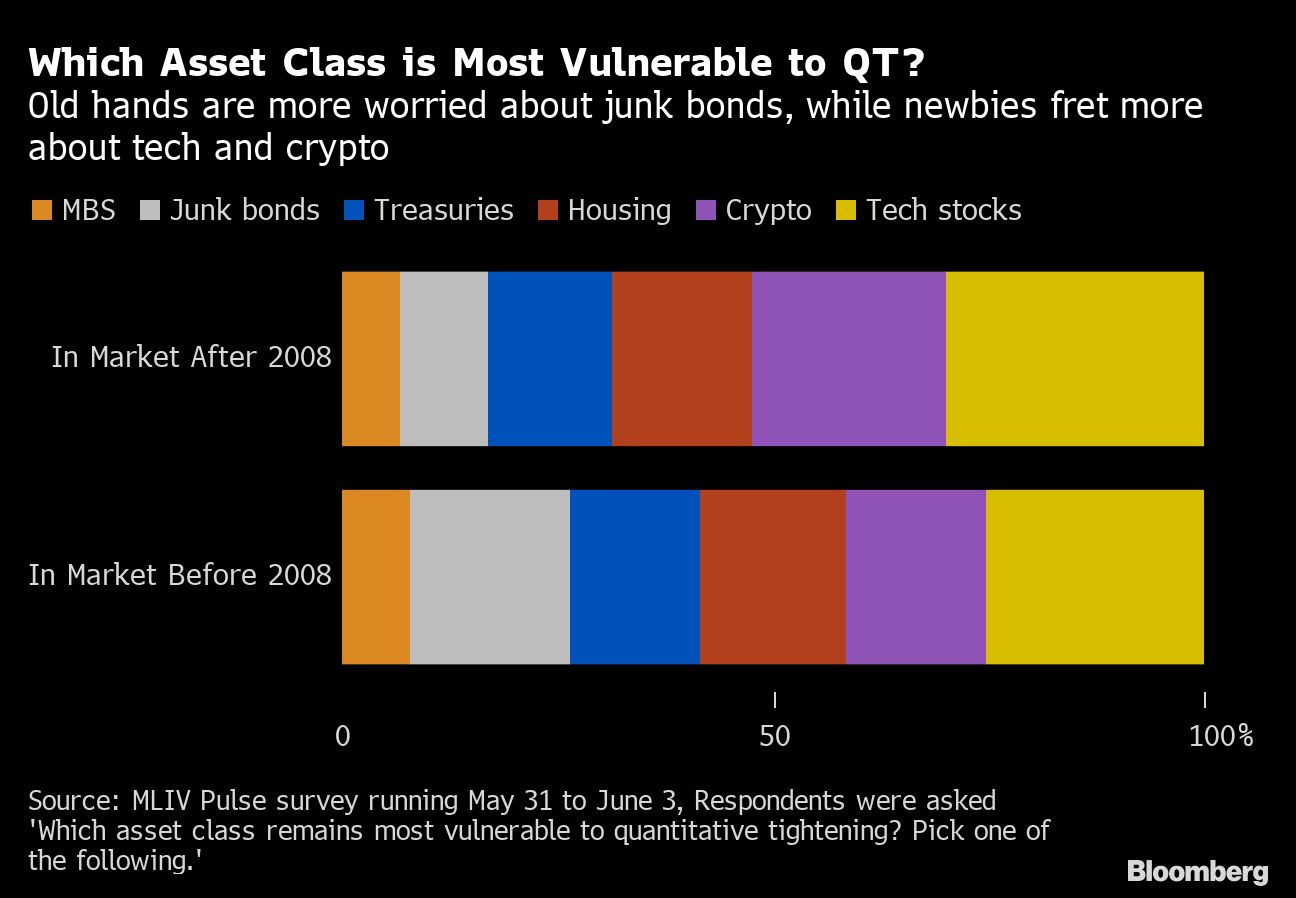
The MLIV survey of most-at-risk assets in the QT era canvassed a group ranging from retail investors to market strategists. Just 7% picked mortgage-backed bonds -- securities that were at the heart of the 2008-09 meltdown -- with almost half citing tech and crypto.
Draining money from the system tends to tighten financial conditions, all else equal, which acts as a brake on economic growth. That can reduce valuations for tech stocks given their reliance on optimism about future profits.
Read more: Team Transitory Is Back Warning Big Rate Hikes Are a Big Mistake
The end of Fed bond-buying also forces the Treasury to sell more debt in the open market, potentially putting upward pressure on bond yields, which play a big role in how Wall Street values listed companies -- a headwind for so-called growth stocks in particular.
Fueled by pandemic-era policy easing, the tech-heavy Nasdaq 100 Index climbed more than 130% from its March 2020 low before plunging this year. Futures on the gauge climbed 1.3% before the open on Monday.

Meanwhile, cryptocurrencies have increasingly been driven by fluctuations in tech stocks. Since March 2020, there has been a strong positive correlation between Bitcoin and the Nasdaq 100, with the relationship intensifying in this year's selloff.
The thinking goes that when money is cheap, traders can speculate about future digital trends en masse. But when the liquidity party fades, those bets become more costly.
“I don't think people fully realize how much QE caused investors to add a lot of leverage to their positions,” said Matt Maley, chief market strategist for Miller Tabak + Co. “Now that we're going through QT, that leverage has to be unwound.”
Respondents who were active in the market during the financial crisis more than a decade ago are particularly concerned that the Fed's balance-sheet shrinkage will hurt junk bonds. Newer entrants are more inclined to worry about its impact on crypto and tech shares.

Readers more broadly are sounding the alarm about global trading conditions as the likes of the European Central Bank -- which meets this week -- and the Bank of England look to rein in their expanded balance sheets. Nearly 53% said they're concerned markets are underestimating the liquidity importance of central banks outside the US.
Only 8% described QT in general as overhyped. Yet the principal concern of MLIV readers remains how far the US central bank will lift benchmark borrowing costs in this cycle. Some 61% said the level at which the terminal fed funds rate peaks is more important than the amount by which the balance sheet shrinks.
As for QT's end game, around two thirds say the primary catalyst is more likely to emerge from negative developments than victory on the inflation front. Some 38% said economic pain would prompt an end to the balance-sheet rundown, while 20% pointed to market turmoil.
Just 10% voted for problems related to bank reserves and short-term funding markets. That's an implicit vote of confidence in the measures the Fed has taken to avert logjams in the financial plumbing that caused it to intervene in 2019 during its previous tightening program.

For many, the era of ultra-low rates and big central bank balance sheets is all they've known professionally. Some 46% of MLIV respondents weren't active in markets before the widespread global adoption of quantitative easing in the aftermath of 2008.
Fewer still rode the early long-dated Treasury bull market in the decades past. A strong majority of readers -- 64% -- say the four-decade bullish stretch has finally ended, with experienced market players notably more hawkish than younger counterparts.
“Whenever you're seeing major shifts in liquidity, there's potential you could see some disruption in the market and that could trigger some violent trading behavior,” said Ed Moya, senior market analyst at Oanda.
- For more markets analysis, see the MLIV blog. For previous surveys, and to subscribe, see NI MLIVPULSE.
(Updates with price reference in 12th paragraph)
More stories like this are available on bloomberg.com
©2022 Bloomberg L.P.

-
Talking Points This Week: Leadership Shock At Nvidia, Earnings Strength, And The Fog Over Hormuz

The Anthropic IPO pricing and first trading day, Nvidia's upcoming earnings, and any fresh signals from Iran will set the tone for the following week.
-
Signature Play: The Classic Cocktail Is Dead. Or Is It?
Classic cocktails are disappearing from India's cocktail menus. But they're still being ordered, taught to bartenders and borrowed from. So, who's really having the last drink?
-
A New Samvat Wishlist: Inclusive Prosperity And Human Development
India has strengthened its economic foundations through infrastructure, digital access and enterprise. Its next growth chapter must deepen productivity, create better livelihoods and widen participation in prosperity.
-
Love, Sex Aur Dhokha: The Audacious Plot To Spy On Jensen Huang
A Taipei dinner, a Singapore chip buyer and a suspected Chinese asset: inside the alleged spy operation that got close to NVIDIA's Jensen Huang.
-
Ten Things I Learnt This Samvat
Patience can be a trap. Cheap stocks can stay cheap. Leverage can wipe you out. What did Samvat 2082 teach us? Niraj Shah writes on 10 lessons from the year gone by.
-
Talking Points This Week: Tech Nerves, FII Buying, And A Faraway Banking Shock
The global markets are not shining this Diwali. The exception in the large markets is, India.
-
Midterm Rally Lasted A Day. The Hard Reality Of A Divided US May Last Two Years | Opinion
Between a contested AI boom, a debt ceiling that arrives in 2027 and a president with every incentive to act alone, the next two years may prove more volatile than the first day's rally suggests.
-
Blue Wave Will Derail the AI Trade but Won't Dismantle the AI Era | Unhedged Position
The Democrats' sweep of the US Congress will see politics collide with economic forces both over the long and short term.
-
It's Time To Take The GST Council's Bet On Trust Global
Payment records can prove India's services exports, and clear, proportionate rules can bring foreign digital sellers into the tax net.
-
Opinion | India at 38: From Innovation Overperformer to Innovation Powerhouse
India now has 453 VC-backed deep science startups, 18 of them late-stage, after 117 percent growth since 2020. Laurus Labs, at USD 9.3 billion, is the most valuable deep science company in any middle-income economy outside China.









