Tata Steel Stays In The Red For Fourth Straight Quarter
Tata Steel Ltd. posted a net loss for the fourth straight quarter. The Mumbai-headquartered company's net loss stood at Rs 49.38 crore in the three months ended September from a restated figure of Rs 5,609.43 crore profit a year ago. The loss includes profit from discontinued operations in Europe of Rs 123 crore and an exceptional expense of Rs 59.3 crore in the second quarter, according to the company's filing with the stock exchange.
The restated profit figures of last year increased by Rs 4,081 crore due to adjustments under Ind AS - new accounting standards mandatory for the company.
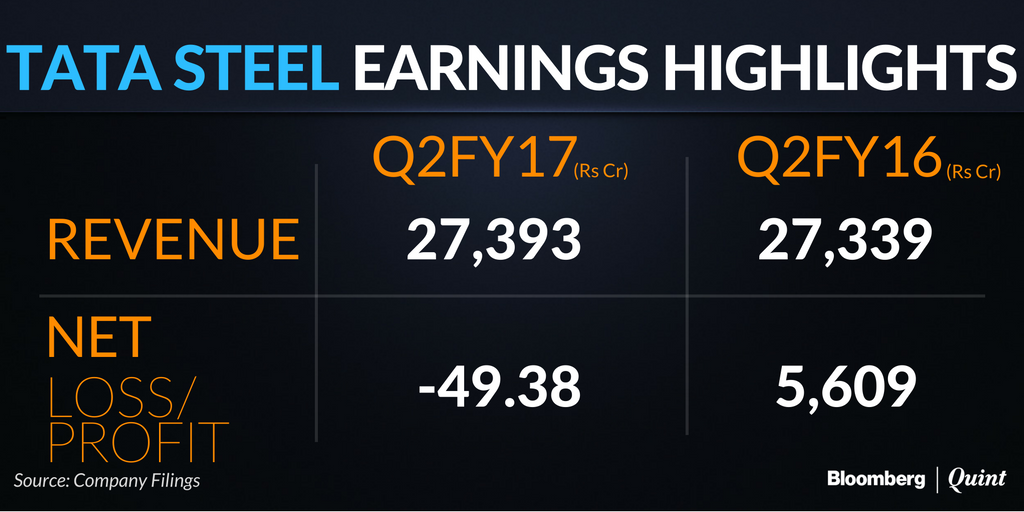
Though the company sold less steel in the quarter gone by, total sales remained flat at Rs 27,392 crore, due to lower steel prices coupled with muted demand. The figure was in line with the Bloomberg consensus estimate. Consolidated steel deliveries fell marginally to 5.65 million tonne from 5.84 million tonne in the same quarter a year ago.
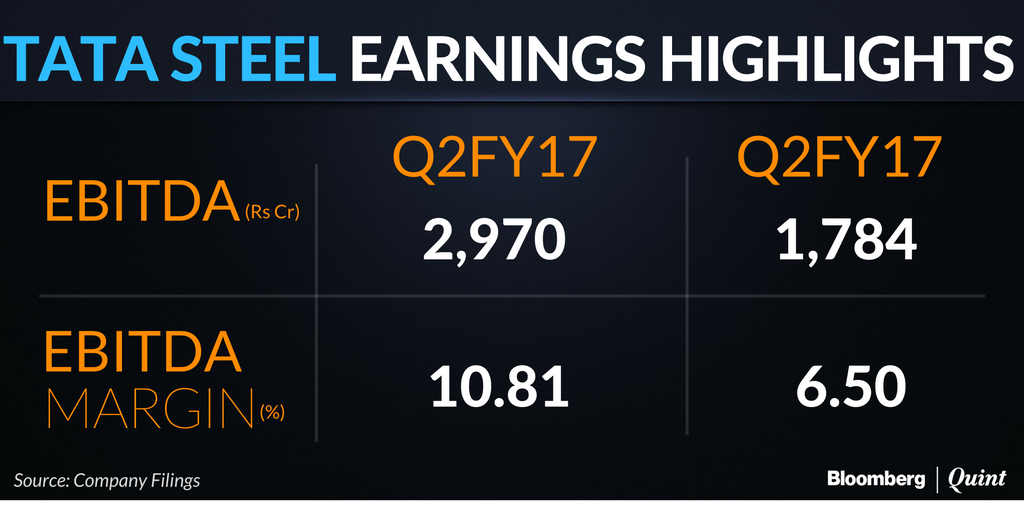
The earnings before interest, tax, depreciation and amortisation increased 67 percent year-on-year, but fell short of analyst expectations by 15 percent. EBITDA for the September-ended quarter stood at Rs 2,970 crore, while the EBITDA margin expanded by 430 basis points to 10.8 percent.
Finance cost surged 23 percent to Rs 1,351 crore due to a 3 percent rise in debt to Rs 86,113 crore.
Standalone Operations
Profit after tax on its standalone operations – which includes steel operations in India– stood at Rs 250 crore compared to a loss of Rs 289 crore in the year-ago period. Sales rose by 10 percent to Rs 11,639 crore but EBITDA margins fell marginally. Underlying EBITDA fell to Rs 1,915 crore from Rs 1,938 crore. Standalone steel deliveries rose 12.4 percent year-on-year, and 23 percent quarter-on-quarter to 2.62 million tonne.
U.K. Assets
The steel mills in U.K. will remain under pressure because of factors like negative growth, imports and weaker pound to increase cost of raw materials purchased in U.S. dollars, according to company's press release. For the first half of financial year 2017, the steel demand grew 2.6 percent, which was largely contributed by the automotive industry.
Tata Steel is likely to close the 15 billion pound British Steel Pension Scheme to future contributions before a 60 million pound payment deadline on March 31, 2017, in order to plug the mounting deficit, according to a Financial Times report on Wednesday.
Going Forward
Tata Steel expects a seasonal uptick in demand on the back of seventh pay commission, good monsoons and penetration of organised financing in tier 2 and tier 3 cities. For the short-term, it said, the recently announced demonetisation is expected to cause disruptions.
Tata Steel's Kalinganagar plant is ramping up production and so far the company has capitalised Rs 22,000 crore for that plant. It expects to produce and sell more than 1.3 million tonne of steel in financial year 2017 from Kalinganagar plant.
The sharp rise in coking coal prices will impact the company negatively as it imports 65 percent of its coking coal requirements. Currently the company has 1.2 million tonne of coking coal in stock, which will satisfy the needs for third quarter of financial year 2017. The major impact of rising coking coal prices will be realised mainly in fourth quarter.
One overhang on the company remains the fate of its Chairman Cyrus Mistry. On Friday, Tata Steel's principal shareholder, Tata Sons Ltd. sent a requisition to the company to call an extraordinary general meeting, seeking Mistry's removal as chairman and independent director Nusli Wadia from the board of the company.
Though Tata Steel has outperformed its benchmark, the BSE metal index, with a year-to-date return of 64 percent, only 30 percent of the analysts tracked by Bloomberg have a ‘buy' rating on the stock.

-
Indians Are Travelling, But Not Every Journey Is A Holiday | The Week In Whys

Pilgrims, patients and working women are the real travellers, and the system hasn't quite caught up with them.
-
Getting To Work Costs Women More | The Reason Why
It is not just about women paying more than men. It is about women paying much more in cities than in villages.
-
AI Bias In Investing Cannot Be Eliminated, But It Can Be Governed
Framing is a particularly important example as identical financial information presented in terms of gains rather than losses can lead an LLM to reach a different assessment.
-
Joining The Dots | Dark Skies, Steady Diya: Why Hope Holds This Diwali
With war, a weak rupee and foreign outflows weighing on sentiment, policymakers at the NDTV World Summit and market veterans at NDTV Profit Ignite: Diwali Edition offered the same advice: stay invested and filter out the noise.
-
The Curious Case of Equitas Small Finance Bank And A CEO Who Quit For Stock
PN Vasudevan believes persistent investor concerns over a perceived conflict of interest had become a governance overhang on Equitas Small Finance Bank's stock, even as the lender improved profitability and asset quality.
-
Talking Points This Week: AI Cash Burn, A Tiger Comeback And An India That Still Finds Its Own Path
India is not immune to higher oil or tighter global liquidity, yet its earnings base is broader, its domestic policy levers are still available.
-
Foreign Investors Own Half Of HDFC Bank and ICICI Bank. An LTCG Cut Could Matter Most Here
Foreign portfolio investors have US$115 billion parked in HDFC Bank, ICICI Bank. If the government cuts long-term capital gains tax, Jefferies says returning foreign money could land here first.
-
'Never Seen This Level Of Negativity': Sandeep Tandon Says The Next Rally May Be Closer Than You Think
Veteran investor Sandeep Tandon says foreign selling is easing, large-caps are due a comeback and mid-caps are crowded, while he turns positive on gold, power and pharma this Diwali.
-
Indians Stay With Family, Not In Hotels | The Reason Why
India still lacks enough clean, reliable and affordable hotels for budget-conscious travellers.
-
The Economic Imperative: Analysing The Material Driving Force Behind India-Canada Strategic Reset
This economic complementarity is further reinforced by deep institutional investment ties and talent mobility, which form the bedrock of the bilateral framework.










