Summers Warns ‘Too Early’ For All-Clear On US Financial Turmoil
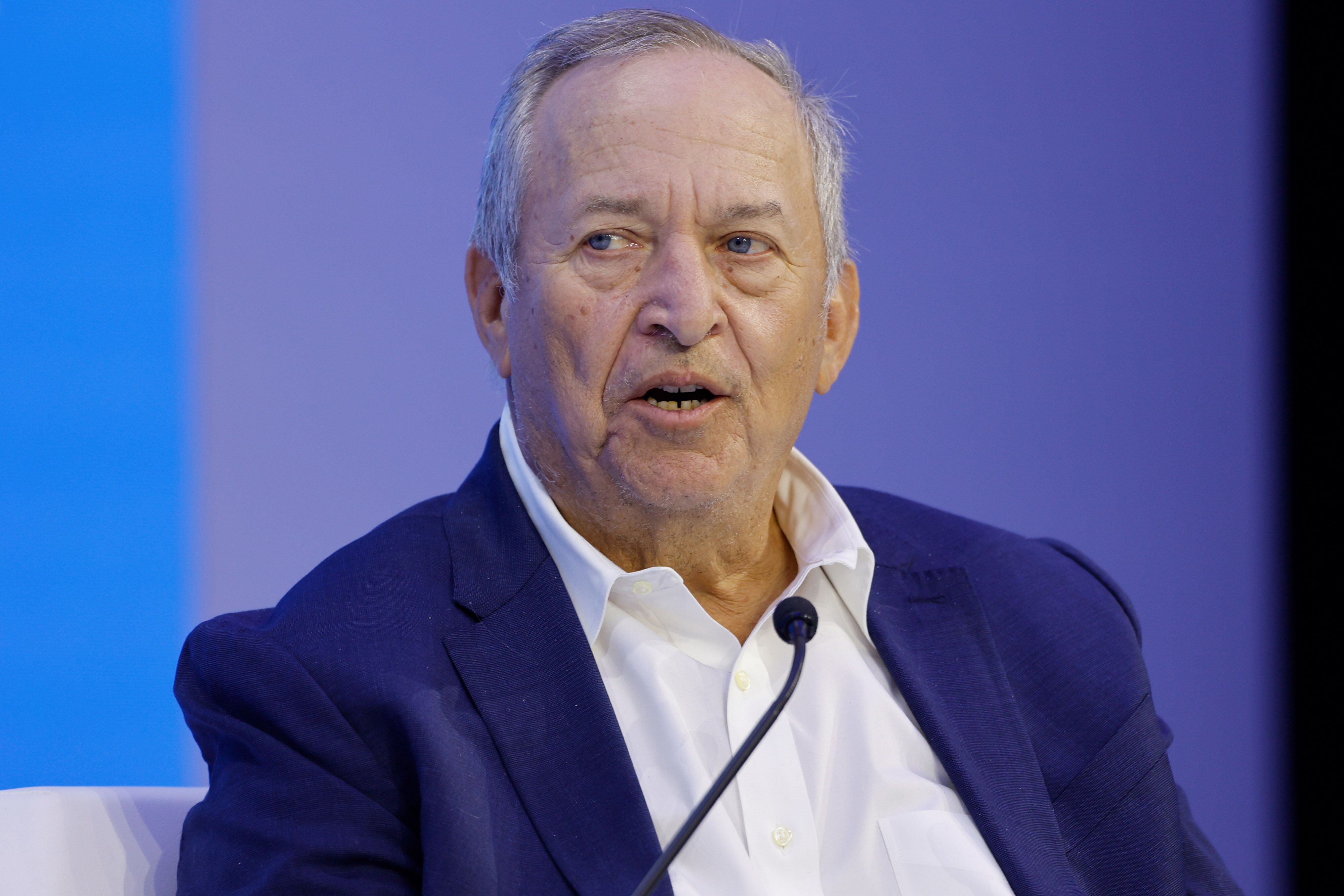
(Bloomberg) -- Former Treasury Secretary Lawrence Summers said it's too soon to be confident that the US has turned a corner on financial troubles that were sparked by the Federal Reserve's rapid interest-rate hikes.
“When you have a series of earthquake tremors, it's a fairly long time before you should be in a position to be confident that you've seen the last of them,” Summers said on Bloomberg Television's “Wall Street Week” with David Westin. “That's why the Fed's got such a difficult job.”

There's “well under” a 50% chance of a repeat of the bank runs that brought down Silicon Valley Bank and Signature Bank earlier this month, Summers said. But there could still be some other kind of “accident” that causes a constriction in credit, he said.
The key question is whether financial dynamics unfold in a “non-linear” fashion, “where constriction of credit leads to declining asset prices and leads to non-performance of loans, leads to more credit constriction,” said Summers, a Harvard University professor and paid contributor to Bloomberg Television. That question cannot now be answered, he added.
“It's too early to give any kind of all-clear sign,” Summers said. “We're going to be much of the way through the summer before I would feel comfortable being confident that it wasn't going to go non-linear.”
Inflation Fight
Summers spoke after the latest reading on US inflation, which showed a slowdown in the monthly pace of the core gauge — excluding food and energy costs — to 0.3% from 0.5%. The annual pace of gains ticked down to 4.6% from 4.7%, still more than double the Fed's long-run 2% projection.
Read More: US Inflation, Spending Cool in Sign of Some Progress for Fed
“We are still a substantially unsustainable-inflation country, unless the economy turns down fairly hard in response to the credit issues raised by the banking system,” Summers said.
It's also “plausible” that the recent banking woes subside without a big impact on credit, leaving in place “serious inflation issues.” In that scenario, “the Fed will have to tighten much more than is priced in.”
A third possibility is that the economy manages to skate in between those two scenarios, with a so-called soft landing — but that seems “very much odds-off,” he said.
The former Treasury chief also expressed concern about the cost of the Federal Deposit Insurance Corp.'s wind-downs of SVB and Signature.
The FDIC's deposit insurance fund will suffer an estimated $20 billion hit linked to SVB, and a $2.5 billion blow from Signature, according to the agency. After each lender was later sold, the acquiring banks saw their shares rally — suggesting investors concluded that they had got a good deal from the FDIC.
Read More: FDIC Mulls Forcing Big Banks to Pay Up After $23 Billion Hit
“These were stunningly expensive transactions,” Summers said. “Everybody's going to say ‘it's not coming back to taxpayers.' But banks are taxpayers on behalf of people — their depositors, their customers, the people they lend to — and the $23 billion the FDIC has spent is 100 bucks per adult American. And that's a fair amount.”
More stories like this are available on bloomberg.com
©2023 Bloomberg L.P.

-
The Economic Imperative: Analysing The Material Driving Force Behind India-Canada Strategic Reset

This economic complementarity is further reinforced by deep institutional investment ties and talent mobility, which form the bedrock of the bilateral framework.
-
Medicine Pricing: Where Must Profit Stop?
India must confront excessive margins, hidden incentives and regulatory gaps that threaten the integrity of medicine.
-
Why Amazon And Flipkart Are Struggling To Beat Meesho In India's Smaller Cities
With 274 million users and lowest-cost logistics, Meesho is defending its value commerce crown against giants like Amazon and Flipkart.
-
High US Salaries, No Green Card Certainty: The Financial Calculation Facing Indian H-1B Families
The suspension of PERM processing at eight technology employers does not cancel existing H-1B visas. What it does is force a question many Indian families have been avoiding: is the US salary worth tying your career and family plans to one employer?
-
Swiggy vs Eternal: Food Delivery's Two Rivals Are No Longer In The Same Race
Eternal is building a private AI assistant, dark.ai. Swiggy is still working out how to make Instamart pay, with an operating loss of Rs 895 crore in the July-September quarter while Blinkit stayed profitable.
-
Where You Live Shapes How You Get To Work | The Reason Why
Two-wheelers are the most popular way to get to work in India, accounting for nearly 43% of workplace commutes.
-
Unhedged Position: Can India See An Indonesia-Style Time Correction?
The Nifty is trading below levels it first clocked in 2024. Is there, then, as I have suggested in the headline, potential that the current time correction drags on painfully for the next three-five, even ten years?
-
Navigating Friction And Energy Realities: An Analysis Of Marco Rubio's October Visit To India
Occurring at a critical juncture marked by stalled trade negotiations and escalating geopolitical pressures over global energy supplies, the visit offers a profound window into modern US-India relations.
-
India Exports Capital. Why Not Export Trusteeship?
The big question, then, is whether India can build an institution that global borrowers, investors, banks, and lawyers can trust, even without an Indian connection.
-
France's Economy & Politics Are In Crisis | The Reason Why
Let's look at how the French economy and politics evolved under Nicolas Sarkozy, Franois Hollande and Emmanuel Macron.










