US Stocks End a Turbulent Month on a Down Note: Markets Wrap

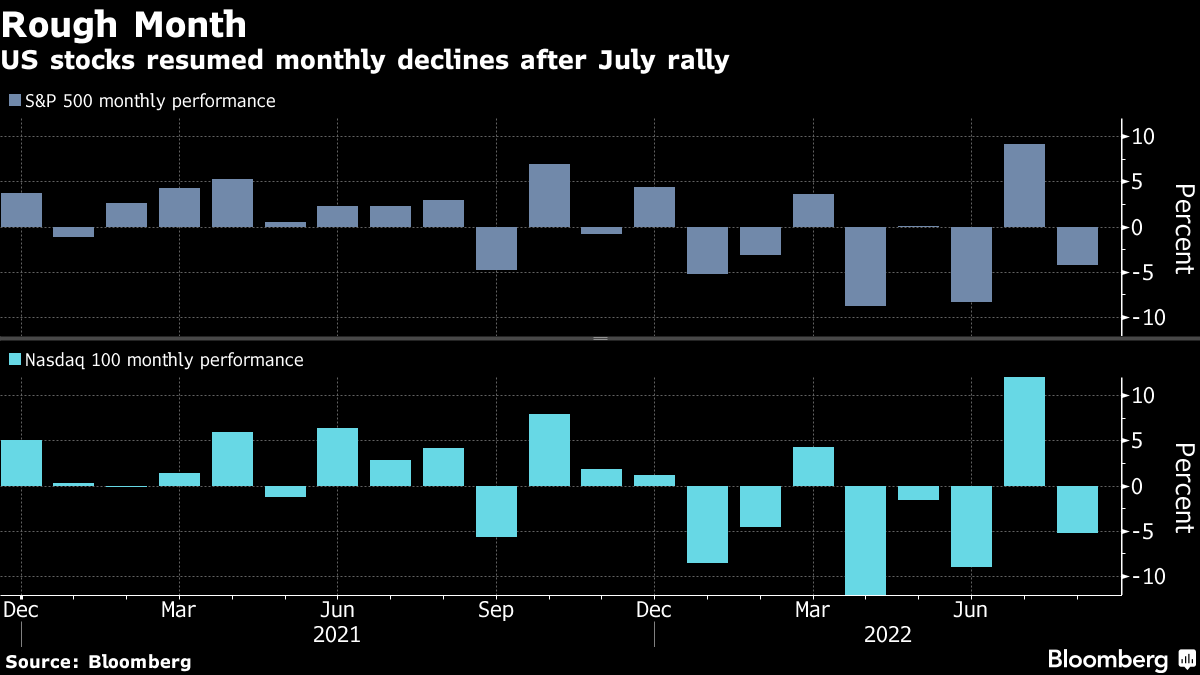
(Bloomberg) -- US stocks and bonds ended a turbulent August lower as traders recalibrated rate-hike expectations after central banks across the globe vowed to step up their fights against inflation.
All major US indexes had their worst month since June. Treasuries in August faced their biggest monthly loss since April as the Federal Reserve resolved to stay hawkish. Oil posted a third monthly drop -- the longest losing streak in more than two years -- hampered by the likelihood of slower global growth.
Read More: Bulls Starved in August Amid Worst Cross-Asset Selloff Since ‘81
Federal Reserve officials in recent days quashed hopes of a dovish pivot, a view that had helped fuel bets that this year's bear market is over. Since then, investors have been sifting through sometimes-conflicting economic data for further policy clues. While job openings data on Tuesday underscored tightness in the labor market, revamped ADP data on Wednesday showed US companies increased headcount at a relatively sluggish pace in August. All eyes will be on the job report on Friday for further hints about the central bank's path.
“Now that the Jackson Hole dust is settling, markets have gained clarity on today's investment question,” said Florian Ielpo, head of macro research at Lombard Odier Asset Management. “Yesterday's question was ‘will inflation level down' when today's is ‘how big will the needed slowdown be.' For now, markets are pricing a marked slowdown, not a fully-fledged recession.”
The Fed has ditched its soft-landing goal and is instead aiming for a “growth recession,” which would mean a protracted period of meager growth and rising unemployment.
Euro-area inflation accelerated to another all-time high, strengthening the case for the European Central Bank to consider a jumbo interest-rate hike when it meets next week. ECB Governing Council member Joachim Nagel urged a “strong” reaction. Money markets have now priced in 125 basis points of tightening from the ECB by October, which implies a half-point hike and a three-quarter point increase spread over its next two policy decisions.
Investors are also contending with mounting friction between Beijing and Taipei after Taiwanese soldiers fired shots to ward off civilian drones and evaluating the latest Chinese data, which indicated factory activity shrank for a second month. Power shortages, a property sector crisis and Covid outbreaks all took a toll.
Here are some key events to watch this week:
- ECB Governing Council members due to speak at event Tuesday through Sept. 2
- China Caixin manufacturing PMI, Thursday
- US nonfarm payrolls, Friday
- UK leadership ballot closes Friday. Winner announced Sept. 5
Will Chinese sovereign bonds outperform Treasuries? China is the theme of this week's MLIV Pulse survey. Click here to participate anonymously.
Some of the main moves in markets:
Stocks
- The S&P 500 fell 0.8% as of 4 p.m. New York time
- The Nasdaq 100 fell 0.6%
- The Dow Jones Industrial Average fell 0.9%
- The MSCI World index fell 0.8%
Currencies
- The Bloomberg Dollar Spot Index was little changed
- The euro rose 0.3% to $1.0049
- The British pound fell 0.3% to $1.1616
- The Japanese yen was little changed at 138.91 per dollar
Bonds
- The yield on 10-year Treasuries advanced six basis points to 3.16%
- Germany's 10-year yield advanced three basis points to 1.54%
- Britain's 10-year yield advanced 10 basis points to 2.80%
Commodities
- West Texas Intermediate crude fell 2.8% to $89.09 a barrel
- Gold futures fell 0.9% to $1,721.40 an ounce
More stories like this are available on bloomberg.com
©2022 Bloomberg L.P.

-
Talking Points This Week: Leadership Shock At Nvidia, Earnings Strength, And The Fog Over Hormuz

The Anthropic IPO pricing and first trading day, Nvidia's upcoming earnings, and any fresh signals from Iran will set the tone for the following week.
-
Signature Play: The Classic Cocktail Is Dead. Or Is It?
Classic cocktails are disappearing from India's cocktail menus. But they're still being ordered, taught to bartenders and borrowed from. So, who's really having the last drink?
-
A New Samvat Wishlist: Inclusive Prosperity And Human Development
India has strengthened its economic foundations through infrastructure, digital access and enterprise. Its next growth chapter must deepen productivity, create better livelihoods and widen participation in prosperity.
-
Love, Sex Aur Dhokha: The Audacious Plot To Spy On Jensen Huang
A Taipei dinner, a Singapore chip buyer and a suspected Chinese asset: inside the alleged spy operation that got close to NVIDIA's Jensen Huang.
-
Ten Things I Learnt This Samvat
Patience can be a trap. Cheap stocks can stay cheap. Leverage can wipe you out. What did Samvat 2082 teach us? Niraj Shah writes on 10 lessons from the year gone by.
-
Talking Points This Week: Tech Nerves, FII Buying, And A Faraway Banking Shock
The global markets are not shining this Diwali. The exception in the large markets is, India.
-
Midterm Rally Lasted A Day. The Hard Reality Of A Divided US May Last Two Years | Opinion
Between a contested AI boom, a debt ceiling that arrives in 2027 and a president with every incentive to act alone, the next two years may prove more volatile than the first day's rally suggests.
-
Blue Wave Will Derail the AI Trade but Won't Dismantle the AI Era | Unhedged Position
The Democrats' sweep of the US Congress will see politics collide with economic forces both over the long and short term.
-
It's Time To Take The GST Council's Bet On Trust Global
Payment records can prove India's services exports, and clear, proportionate rules can bring foreign digital sellers into the tax net.
-
Opinion | India at 38: From Innovation Overperformer to Innovation Powerhouse
India now has 453 VC-backed deep science startups, 18 of them late-stage, after 117 percent growth since 2020. Laurus Labs, at USD 9.3 billion, is the most valuable deep science company in any middle-income economy outside China.









