S&P 500 Bulls Drive Longest Weekly Win Since 2004: Markets Wrap
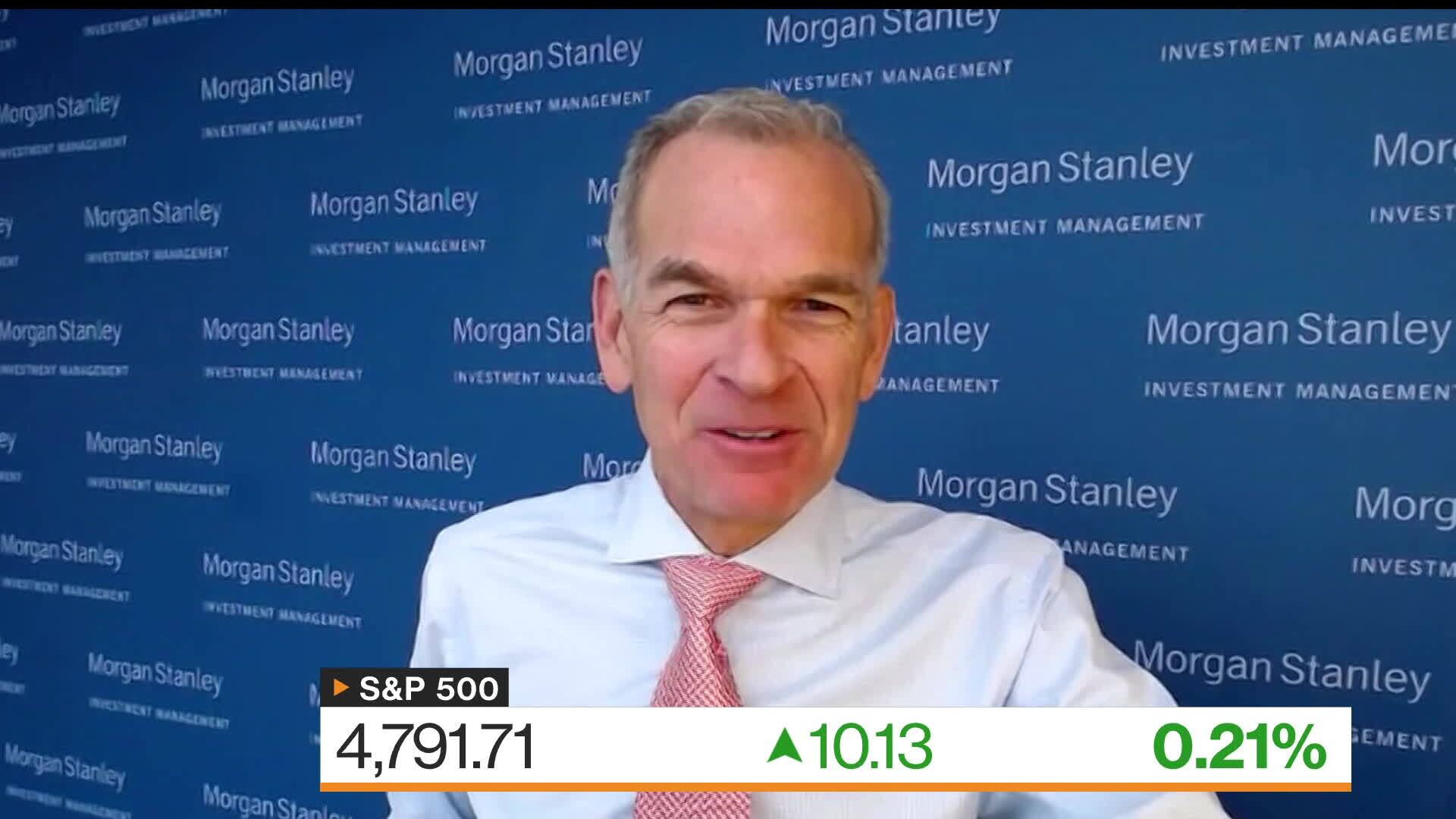
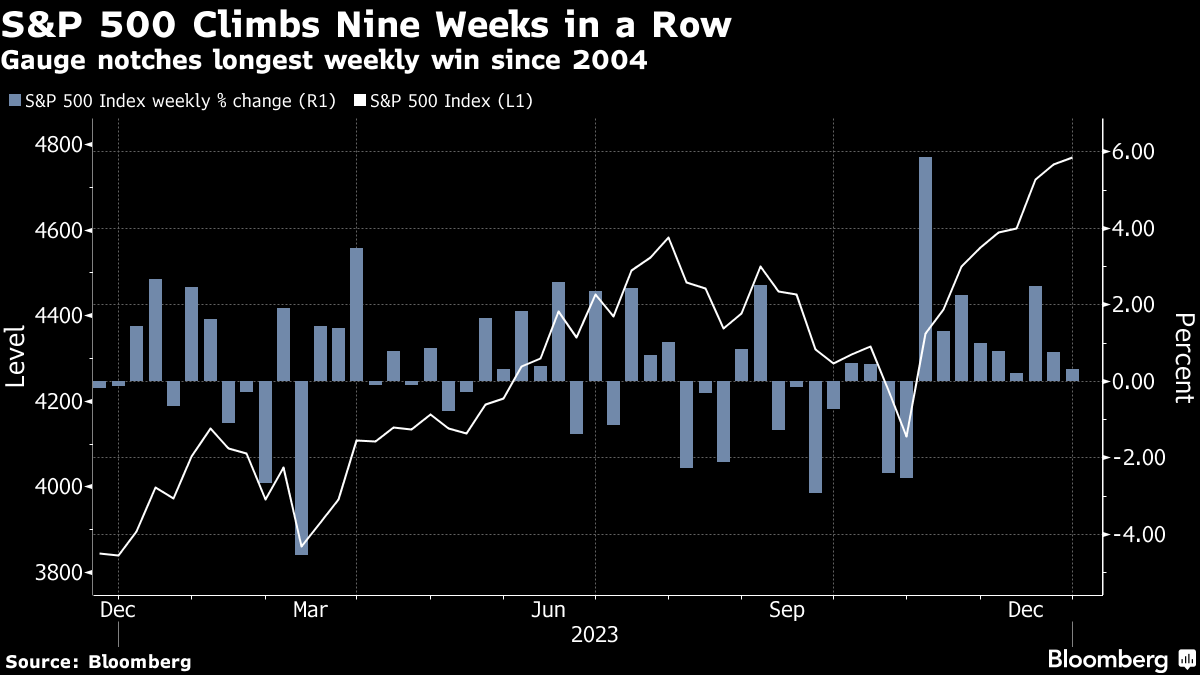
(Bloomberg) -- Wall Street's final session of 2023 saw stocks taking a breather near all-time highs. For bulls defying every doomsday scenario, that was just a blip for a market notching its longest weekly advance since 2004.
The uneventful Friday before the holiday had US equities halting a five-day advance. Signs of exhaustion emerged after an over $8 trillion surge in the S&P 500 this year, with the gauge still notching its ninth straight week of gains. Traders have looked past Federal Reserve uncertainty, recession angst and geopolitical risks. And many who came into 2023 dreading all that have ended up scrambling to chase the rally.
“The market shows signs of fatigue and undoubtedly needs to consolidate,” said Quincy Krosby at LPL Financial. “As long as participation remains broad, the bullish sentiment should carry the indexes as they navigate geopolitical and domestic scenarios, and an overarching positive consensus that 2024 will be a similarly strong year.”
Fueled by the artificial-intelligence boom, stretched positioning and the “fear of missing out,” the S&P 500 soared 24% in 2023, while the Nasdaq 100 had its best year since 1999. Chipmakers saw their biggest annual gain in more than a decade, led by major AI players Nvidia Corp. and Advanced Micro Devices Inc.
After a year of massive swings and numerous head fakes, the US 10-year yield ended 2023 pretty close to where it began. It's an almost farcical conclusion to 12 months of trading that saw it tumble to as low as 3.25% in the wake of March's banking crisis — only to surpass 5% just a few months later.
Benchmark 10-year US rates rose to almost 3.9% on Friday. The dollar was little changed on the day, but posted its worst year since 2020.
Key inflation data endorsing a growing narrative that central bankers will aggressively cut rates in 2024 fueled solid gains for both equities and bonds in the last two months. The rally was also driven by Fed Chair Jerome Powell's dovish pivot at the December policy meeting.
“The notion that the major central banks have surely done enough to quell the inflationary surge of 2022-23 is powering the rally,” said Brian Barish at Cambiar Investors LLC. “It's not hard to imagine new things for the markets to be concerned by, such as elections, the sizable bond funding requirements of the US government, and/or any notion that inflation resurges anew. But for now, there's not much news and not a lot of sellers.”
Former Treasury Secretary Lawrence Summers said investors are probably underestimating inflation risk as markets move swiftly toward expectations for Fed easing.
“I think there's still a risk that the market is probably underestimating: that we're not going to quite make as much progress on inflation as people hope, and that there's not going to be quite as much room for Fed easing as people hope,” Summers said on Bloomberg Television's with David Westin.
Equity markets have gone up so quickly that they're highly vulnerable to a pullback if the US economy slips into even a mild recession, according to RBC Global Asset Management. Rate cuts are likely to happen in 2024, but the global economy hasn't yet absorbed the full impact of almost two years of tightening, RBC economist Eric Lascelles said.
“What's baked into the cake is a sizable jump in earnings, which is really only achievable in a soft-landing scenario,” Lascelles said.
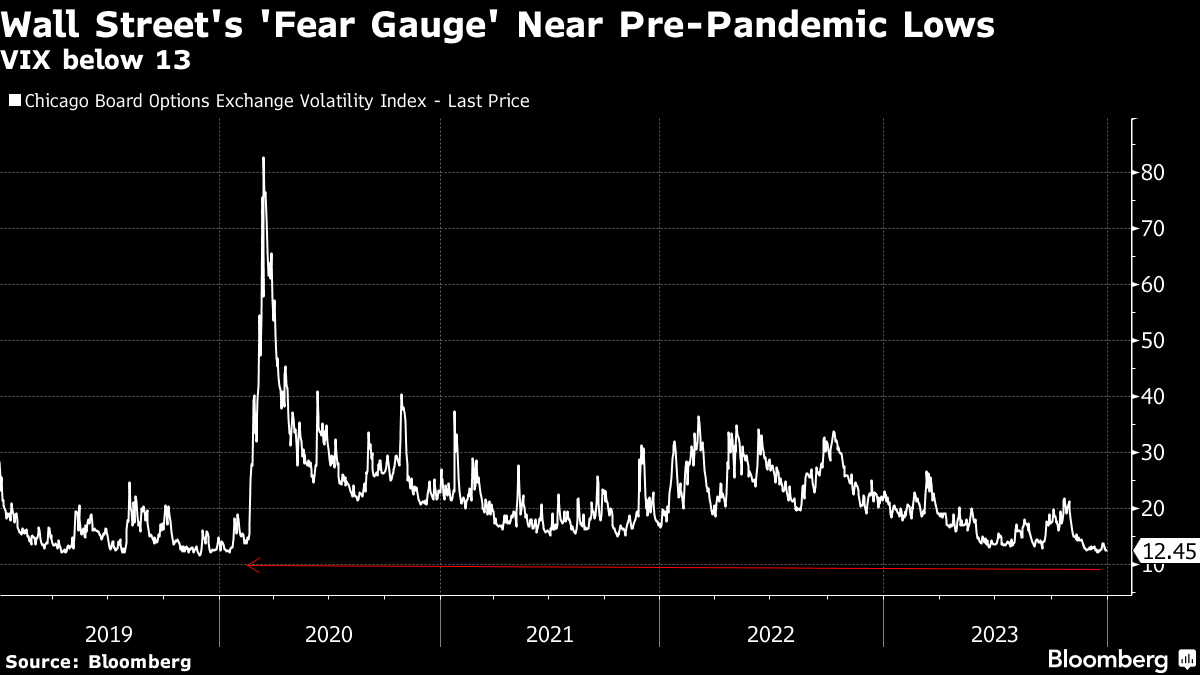
The lack of anxiety is also visible in the market's favorite volatility gauge — the VIX — which has held below 13 this week, near pre-pandemic lows and well below the five-year average.
That low reading “could be suggestive of a degree of investor complacency, even exuberance,” said Russ Mould, investment director at AJ Bell.
To Adam Turnquist at LPL Financial, momentum remains overbought but bullish.
“While extremely overbought conditions raise the odds of a temporary pause or pullback, longer-term returns have been positive and above average based on comparable periods,” he noted.
Following a nine-week winning streak, the S&P 500 has posted average and median 12-month forward returns of 8.1% and 12.2%, respectively, Turnquist said, citing data going back to 1950. Seven out of nine occurrences produced positive results, he noted.
Elsewhere, oil posted its biggest annual drop since 2020 as war and OPEC+ production cuts failed to propel prices higher in a year dominated by supply growth outside of the grouping. Emerging-market currencies closed out their best year since 2017 as the outlook for lower interest rates in the US revived investor appetite for risk.
Some of the main moves in markets:
Stocks
- The S&P 500 fell 0.3% as of 4 p.m. New York time
- The Nasdaq 100 fell 0.4%
- The Dow Jones Industrial Average was little changed
- The MSCI World index fell 0.3%
Currencies
- The Bloomberg Dollar Spot Index was little changed
- The euro fell 0.2% to $1.1039
- The British pound was little changed at $1.2744
- The Japanese yen rose 0.2% to 141.07 per dollar
Cryptocurrencies
- Bitcoin fell 1% to $42,042.01
- Ether fell 1.8% to $2,304.86
Bonds
- The yield on 10-year Treasuries advanced three basis points to 3.88%
- Germany's 10-year yield advanced eight basis points to 2.02%
- Britain's 10-year yield advanced four basis points to 3.54%
Commodities
- West Texas Intermediate crude fell 0.6% to $71.36 a barrel
- Spot gold fell 0.1% to $2,063.18 an ounce
This story was produced with the assistance of Bloomberg Automation.
--With assistance from Joanna Ossinger, Matthew Burgess, Divya Patil, Robert Brand and Elena Popina.
More stories like this are available on bloomberg.com
©2024 Bloomberg L.P.

-
Signature Play: The Classic Cocktail Is Dead. Or Is It?

Classic cocktails are disappearing from India's cocktail menus. But they're still being ordered, taught to bartenders and borrowed from. So, who's really having the last drink?
-
A New Samvat Wishlist: Inclusive Prosperity And Human Development
India has strengthened its economic foundations through infrastructure, digital access and enterprise. Its next growth chapter must deepen productivity, create better livelihoods and widen participation in prosperity.
-
Love, Sex Aur Dhokha: The Audacious Plot To Spy On Jensen Huang
A Taipei dinner, a Singapore chip buyer and a suspected Chinese asset: inside the alleged spy operation that got close to NVIDIA's Jensen Huang.
-
Ten Things I Learnt This Samvat
Patience can be a trap. Cheap stocks can stay cheap. Leverage can wipe you out. What did Samvat 2082 teach us? Niraj Shah writes on 10 lessons from the year gone by.
-
Talking Points This Week: Tech Nerves, FII Buying, And A Faraway Banking Shock
The global markets are not shining this Diwali. The exception in the large markets is, India.
-
Midterm Rally Lasted A Day. The Hard Reality Of A Divided US May Last Two Years | Opinion
Between a contested AI boom, a debt ceiling that arrives in 2027 and a president with every incentive to act alone, the next two years may prove more volatile than the first day's rally suggests.
-
Blue Wave Will Derail the AI Trade but Won't Dismantle the AI Era | Unhedged Position
The Democrats' sweep of the US Congress will see politics collide with economic forces both over the long and short term.
-
It's Time To Take The GST Council's Bet On Trust Global
Payment records can prove India's services exports, and clear, proportionate rules can bring foreign digital sellers into the tax net.
-
Opinion | India at 38: From Innovation Overperformer to Innovation Powerhouse
India now has 453 VC-backed deep science startups, 18 of them late-stage, after 117 percent growth since 2020. Laurus Labs, at USD 9.3 billion, is the most valuable deep science company in any middle-income economy outside China.









