Stocks Halt Winning Streak As Bonds Climb On JOLTS: Markets Wrap

(Bloomberg) -- The stock market snapped a four-day rally amid a selloff in banks. Treasuries climbed as softer data on job openings bolstered bets the Federal Reserve is about to wrap up its tightening campaign.
A gauge of financial heavyweights like Wells Fargo & Co. and Citigroup Inc. sank 2%. First Republic Bank and Zions Bancorporation drove regional lenders down, slumping at least 4.8%. In his wide-ranging annual letter to shareholders, JPMorgan Chase & Co.'s chief Jamie Dimon warned the US banking crisis that sent markets careening last month will be felt for years.
“Investors should continue to be vigilant for signs of bank stress, and we expect market participants to react disproportionately to negative economic news,” said Gennadiy Goldberg, senior US rates strategist at TD Securities.
Read: Riding Brutal Yield Swings Is the New Regime for Bond Investors
Two-year yields slumped 14 basis points to around 3.8%. Swap contracts referencing Fed meeting dates downgraded the odds of a quarter-point rate hike in May to just under 50%, from about 60%. The dollar fell.
Vacancies at US employers dropped to the lowest since May 2021, the Labor Department's Job Openings and Labor Turnover Survey, or JOLTS, showed.
“It was just a matter of when, not if, we were going to see evidence of lessened job demand,” said Peter Boockvar, author of the Boock Report. “And at some point, the pace of firings will pick up as companies try to defend profit margins and respond to the slowing economic backdrop. I just don't see the Fed hiking rates in May or any time thereafter in this cycle.”
The JOLTS data precede Friday's jobs report, which is currently forecast to show employers added nearly a quarter of a million workers in March. Economists are expecting the unemployment rate to hold at a historically low 3.6% and for average hourly earnings to rise firmly.
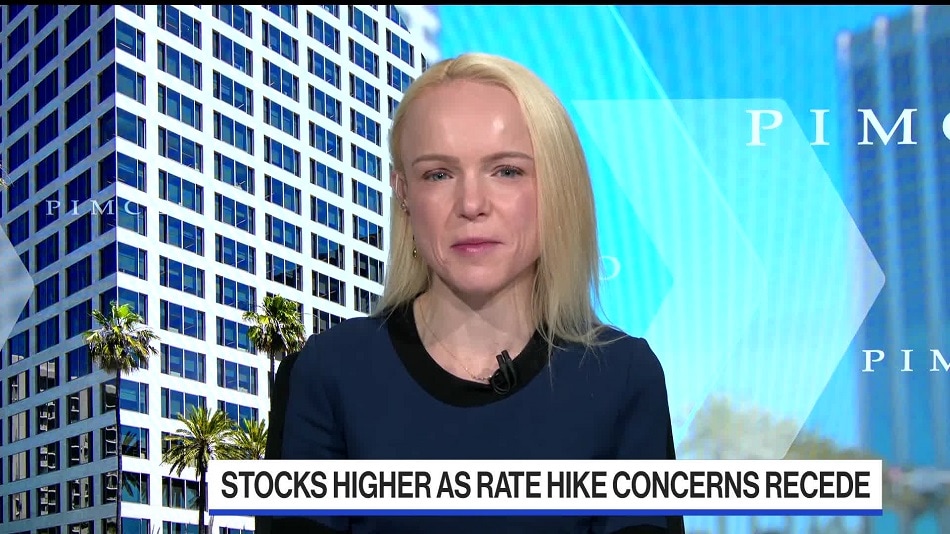
Read: Pimco's Browne Says US Stocks Ignore Threats of Recession, Banks
Headwinds from the recent bank turbulence, an oil shock and slowing growth are poised to send stocks back toward their 2022 lows, according to JPMorgan strategist Marko Kolanovic. In his view, the inflows into stocks over the past few weeks “make little sense” and were largely driven by systematic investors, a short squeeze and a decline in the Cboe Volatility Index, or VIX.
Bank of America Corp. clients sold US equities last week for the first time in five weeks, withdrawing the largest amount of funds from the asset class since October, according to strategists led by Jill Carey Hall.
Key events this week:
- Eurozone S&P Global Eurozone Services PMI, Wednesday
- US trade, Wednesday
- UBS annual general meeting, Wednesday
- US initial jobless claims, Thursday
- St. Louis Fed President James Bullard speaks, Thursday
- US unemployment, nonfarm payrolls, Friday
- Good Friday. US stock markets closed, bond markets close for part of the day
Some of the main moves in markets:
Stocks
- The S&P 500 fell 0.6% as of 4 p.m. New York time
- The Nasdaq 100 fell 0.4%
- The Dow Jones Industrial Average fell 0.6%
- The MSCI World index fell 0.2%
Currencies
- The Bloomberg Dollar Spot Index fell 0.2%
- The euro rose 0.5% to $1.0956
- The British pound rose 0.7% to $1.2499
- The Japanese yen rose 0.6% to 131.66 per dollar
Cryptocurrencies
- Bitcoin rose 2.2% to $28,188.14
- Ether rose 4.9% to $1,868.18
Bonds
- The yield on 10-year Treasuries declined six basis points to 3.35%
- Germany's 10-year yield was little changed at 2.25%
- Britain's 10-year yield was little changed at 3.43%
Commodities
- West Texas Intermediate crude rose 0.1% to $80.51 a barrel
- Gold futures rose 1.9% to $2,039.30 an ounce
This story was produced with the assistance of Bloomberg Automation.
--With assistance from Srinivasan Sivabalan, Vildana Hajric, Angel Adegbesan, Carly Wanna, Peyton Forte and Isabelle Lee.
More stories like this are available on bloomberg.com
©2023 Bloomberg L.P.

-
The Economic Imperative: Analysing The Material Driving Force Behind India-Canada Strategic Reset

This economic complementarity is further reinforced by deep institutional investment ties and talent mobility, which form the bedrock of the bilateral framework.
-
Medicine Pricing: Where Must Profit Stop?
India must confront excessive margins, hidden incentives and regulatory gaps that threaten the integrity of medicine.
-
Why Amazon And Flipkart Are Struggling To Beat Meesho In India's Smaller Cities
With 274 million users and lowest-cost logistics, Meesho is defending its value commerce crown against giants like Amazon and Flipkart.
-
High US Salaries, No Green Card Certainty: The Financial Calculation Facing Indian H-1B Families
The suspension of PERM processing at eight technology employers does not cancel existing H-1B visas. What it does is force a question many Indian families have been avoiding: is the US salary worth tying your career and family plans to one employer?
-
Swiggy vs Eternal: Food Delivery's Two Rivals Are No Longer In The Same Race
Eternal is building a private AI assistant, dark.ai. Swiggy is still working out how to make Instamart pay, with an operating loss of Rs 895 crore in the July-September quarter while Blinkit stayed profitable.
-
Where You Live Shapes How You Get To Work | The Reason Why
Two-wheelers are the most popular way to get to work in India, accounting for nearly 43% of workplace commutes.
-
Unhedged Position: Can India See An Indonesia-Style Time Correction?
The Nifty is trading below levels it first clocked in 2024. Is there, then, as I have suggested in the headline, potential that the current time correction drags on painfully for the next three-five, even ten years?
-
Navigating Friction And Energy Realities: An Analysis Of Marco Rubio's October Visit To India
Occurring at a critical juncture marked by stalled trade negotiations and escalating geopolitical pressures over global energy supplies, the visit offers a profound window into modern US-India relations.
-
India Exports Capital. Why Not Export Trusteeship?
The big question, then, is whether India can build an institution that global borrowers, investors, banks, and lawyers can trust, even without an Indian connection.
-
France's Economy & Politics Are In Crisis | The Reason Why
Let's look at how the French economy and politics evolved under Nicolas Sarkozy, Franois Hollande and Emmanuel Macron.










