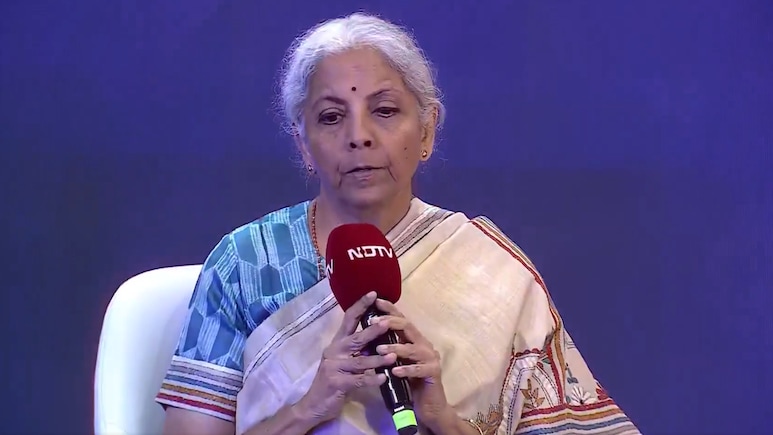
India's stock market weakness is partly linked to the ease with which investors can sell their holdings, Finance Minister Nirmala Sitharaman told CNBC in an interview in Bangkok. She said the economy's underlying fundamentals remained sound despite the decline in benchmark indices.
“Because of the ease of liquidity, ease of availability, people are even exiting easily,” Sitharaman told CNBC on Friday on the sidelines of the International Monetary Fund and World Bank annual meetings.
Indian equity benchmarks have declined nearly 12% so far this year, even as the economy has continued to grow amid trade uncertainty and geopolitical tensions. Foreign investors have withdrawn substantial amounts from domestic equities, and Sitharaman identified continued capital outflows as one of the biggest risks facing India in 2027.
Also Read | Layoffs Are Rising In Tech, But These Skills Are Helping People Unlock Better Pay
While overseas investors have reduced their exposure to Indian stocks, domestic investors have continued to support the market. Equity mutual funds in India have attracted net inflows every month since March 2021, according to data released by the Association of Mutual Funds in India last week.
READ | FIIs May Return To Indian Equities As They Hit Record Underweight, Says Mihir Vora
Investors Favour AI Markets
Foreign portfolio investors have sold more than $33 billion worth of Indian equities so far this year, according to data from Indian depository NSDL.
India has emerged as a market outside the main artificial intelligence investment boom, while Taiwan and South Korea have attracted stronger investor interest because of their exposure to companies linked to the technology.
Sitharaman said the movement of international capital towards the US and AI-related investments was a concern.
“The flight of capital toward AI and the U.S., which otherwise moves toward different countries for different sectoral investments, is a concern,” she told CNBC.
Despite the shift in global investment flows, Sitharaman said India would not be “hurt” if a collapse in the global AI boom triggered a wider market sell-off.
She said India had not received the “AI kind of investments coming into different jurisdictions”, suggesting that the country had less exposure to a reversal in investment linked to the technology.
READ | IT Stock Gains Are More Of A Relief Rally, Says Dinshaw Irani Of Helios Capital Amid AI Concerns
Semiconductor Investments
Sitharaman also said India was no longer a laggard in advanced technology and was investing in semiconductor manufacturing.
Her comments come amid concerns about the sustainability of the global AI rally, with weakness in Asian technology stocks reflecting investor worries about funding and the outlook for the sector.
Sitharaman said the Indian economy's fundamentals remained sound, while warning that sustained capital outflows could pose a significant challenge in 2027.
Essential Business Intelligence, Sharp Market Insights, Practical Personal Finance Advice, Daily Fuel, Gold and Silver Prices and Latest Stories — On NDTV Profit.