Samsung’s Profit Surges After AI Boom Reverses Chip Losses

(Bloomberg) -- Samsung Electronics Co. topped analyst earnings estimates after its semiconductor division returned to profitability, as companies like Microsoft Corp. and Alphabet Inc. led a surge in spending on artificial intelligence services.
The world's largest memory chipmaker reported net income of 6.62 trillion won ($4.8 billion) in the March quarter, versus the average analyst projection for 5.63 trillion won. That's more than four times the company's earnings a year earlier.
The results underscore how demand for the memory chips that power modern electronics and artificial intelligence is starting to rebound after a severe downturn. The company's shares rose as much as 2.4% in Seoul trading.
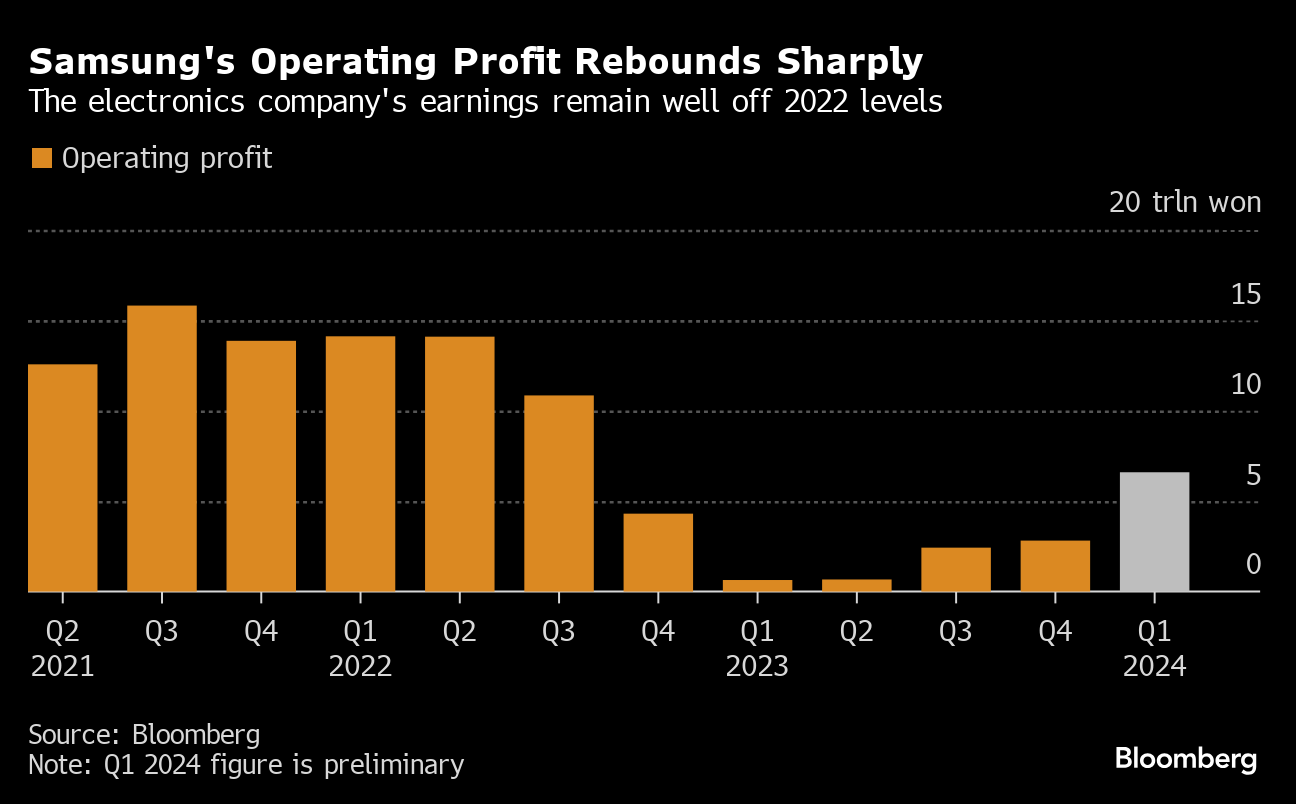
Samsung, also the world's largest smartphone maker, is trying to reverse a year-long decline triggered by global economic uncertainty. In 2023, the company's overall operating profit plunged to a 15-year low after its semiconductor unit posted a loss of 14.9 trillion won.
Signs are pointing to a gradual market rebound, driven in part by demand for chips used to develop AI after the advent of OpenAI's ChatGPT. Samsung's chip division posted a a better-than-projected 1.91 trillion won operating profit, its first quarter in the black after four successive losses. South Korean trade data released this month showed semiconductor shipments led growth in the country's exports in the first 20 days of April, rising 43% from a year earlier.
In its earnings release, Samsung said it expects chip demand to remain strong in the current quarter and the second half of this year. It said that the industry should remain strong, in large part because of the demand for generative AI. Microsoft and Alphabet, Google's parent company, reported financial results last week that beat analysts estimates, in part because of AI services.
Samsung shares have risen since an endorsement by Nvidia Corp.'s Jensen Huang in March fueled expectations for a supply deal later this year for its high-bandwidth memory or HBM, which is optimized for use with Nvidia AI accelerators. That would help it gain a key foothold in the battle with smaller SK Hynix Inc., which is dominating the latest version of HBM.
“Samsung is lagging behind in AI semiconductors, and also they're struggling with the utilization rates” in their foundry business, Daiwa Securities analyst SK Kim told Bloomberg Television. “However, I think that now, especially this quarter, we'll see the progress of the HBM3E.”
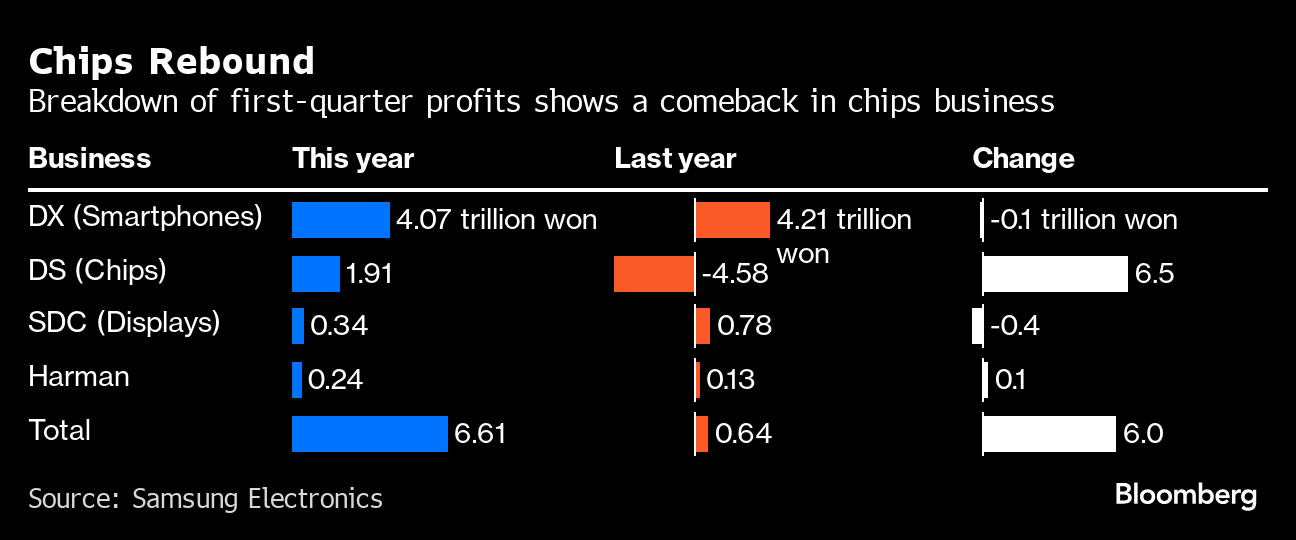
Samsung's smartphone and network business — the biggest contributor to its overall business — posted an operating profit of 3.5 trillion won on sales of 33.5 trillion won during the quarter, aided by strong sales of the Galaxy S24 series.
Still, Samsung expects overall demand for smartphones to decline sequentially due to seasonality, the company said.
Longer-term, Samsung is trying to catch SK Hynix in the rapidly expanding market for HBM. Hynix last week reported its fastest pace of revenue growth since at least 2010, said overall memory demand is on a steady growth path, citing double-digit price rises in the broader DRAM market and the NAND market.
Samsung said it began mass production of its latest HBM product, HBM3E 8H, and plans to mass produce future HBM chips in the second quarter.
Kyung Kye-hyun, who leads Samsung's semiconductor business, said at the company's annual shareholders' meeting in March that the division should recover to 2022 levels this year as the longstanding slump begins to end. The company averaged an operating profit of more than 10 trillion won a quarter that year.
(Updates with analyst comment from eighth paragraph.)
More stories like this are available on bloomberg.com
©2024 Bloomberg L.P.

-
Gold Is Rs 22,000 Cheaper Than A Month Ago. Should You Buy Amid The Wedding Season?

Gold's potential slide to $3,500 could save around Rs 4,700 per 10 grams, but a soft inflation print could just as easily push prices back up. One way to split the risk is to buy in parts, some now and the rest after the Fed's Dec. 9 decision.
-
AI Agents Are Gaining Power. Who Governs Them?
Artificial intelligence agents promise to transform productivity by moving machines from assisting decisions to executing them. But as organisations delegate greater authority to these AI-agents, they must first establish who controls that authority and who remains accountable when things go wrong.
-
Why Swapping Your Old Gold Can Trigger A Rs 5 Lakh Tax Bill, And How You Can Avoid It Legally
Swapping old gold for new is taxed as a sale and a fresh purchase. Getting your own gold remade can cut most of that bill, though it has its own costs.
-
The AI Trade is Done. The Real Opportunity for Investors Starts in 2027 | Unhedged Position
As pureplay AI stocks plunge and circular, capex-led financing unwinds, 2027 is set to be a year of reckoning for AI companies. Yet the bust clears the way for a better opportunity for investors in 2027 -- shifting the spotlight from AI builders to the companies using AI.
-
Leadership As Mission: Why The Age Of AI Demands More Human Leadership
Debjani Ghosh examines how AI is changing leadership, arguing that its success must be measured by its impact on people and the accountability of those guiding its use.
-
We May Need Another Tukaram Mundhe To Fight Air Pollution | The Reason Why
Developers may install basic measures such as sprinklers and green nets, resume work, and continue violating rules when this equipment stops working.
-
Extracting Value From Battery Scrap Could Be Challenging For India | The Reason Why
A discarded lithium-ion battery still contains valuable materials such as lithium, nickel and cobalt. These can be recovered and reused. When such batteries are crushed and shredded, they produce a dark powder called black mass.
-
One El Nino, India Can Handle. Two Could Break The Granary
India's grain stocks can absorb one bad year, but a second El Nino could drain the buffer in two to three years, economists say.
-
India's Troika Of Good Luck | Joining The Dots
As Jensen Huang's exit drags Nvidia down, a cooling AI trade and resilient earnings have revived investor interest in India. A likely RBI rate hike looms.
-
Talking Points This Week: Leadership Shock At Nvidia, Earnings Strength, And The Fog Over Hormuz
The Anthropic IPO pricing and first trading day, Nvidia's upcoming earnings, and any fresh signals from Iran will set the tone for the following week.









