Reliance Jio Can Now Undercut Rivals With Regulatory Backing
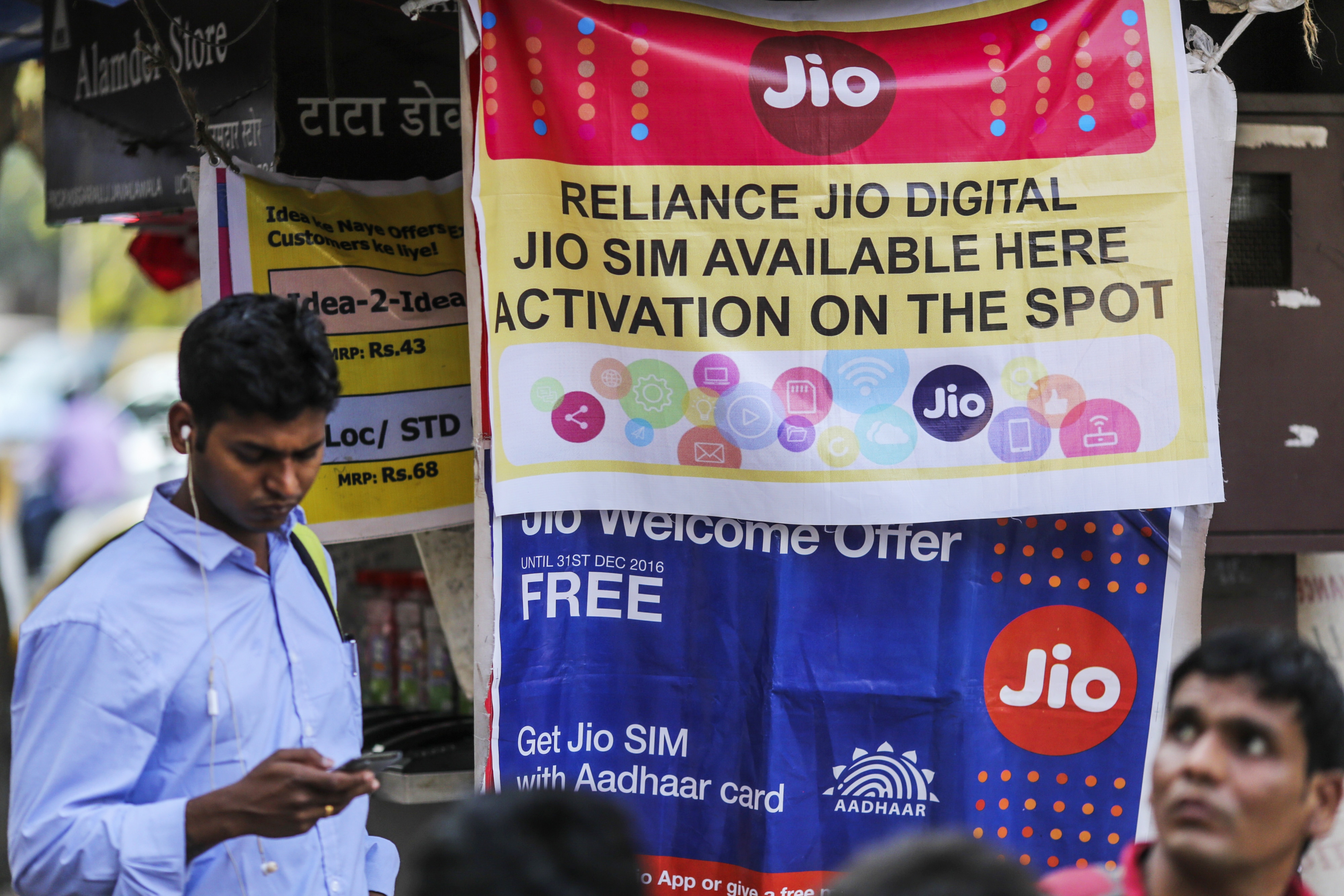
Mukesh Ambani's Reliance Jio Infocomm Ltd. stands to gain from another regulatory change that will also keep its larger rivals in check.
The Telecom Regulatory Authority of India, through its new tariff order, revised the definition of “significant market power” that prevents a wireless carrier from misusing its dominant position. Service providers holding a share of at least 30 percent of total activity in a relevant market qualify for it. The changed rules mean Reliance Jio, despite having the highest share in the data market, stays out of its ambit.
While the new definition of significant market power is somewhat in line with the old view, it doesn't reflect the current reality, Mahesh Uppal, director at consultancy ComFirst (India), told BloombergQuint. “The definition fails to reflect that Reliance Jio is not a stereotype young small player but a formidable corporation that is making a huge dent and bidding for power in telecom sector.”
The new norms mean India's youngest telecom operator can continue to undercut rivals. That's when it has already triggered consolidation in the world's second-biggest telecom market by unleashing a tariff war, first with free services and then cut-rate plans, hurting profits of older rivals. The regulator's decision to slash interconnect charges for cross-network calls by more than half came as another boost. Upstart Reliance Jio is the net payer of such fees while older rivals with deeper networks were the net earners. The new tariff order will help it further dent its rivals.
The Changes
Of the four parameters to identify significant market power, TRAI in its new order retained subscriber base and gross revenue, but dropped capacity and traffic share. Reliance Jio has the highest monthly data consumption per user or traffic share. So, the exclusion benefits the company.
Restrictions remain on Bharti Airtel Ltd., India's largest telecom operator, and the combine of Idea Cellular Ltd. and Vodafone India Ltd. Bharti Airtel has more than 30 percent customer market share in nine circles, while Vodafone-Idea breach the 30 percent mark in more than 10 circles.


Reliance Jio, Bharti Airtel and Ideal Cellular were yet to respond to BloombergQuint's emailed queries.
The changes made in the definition of significant market power benefits only the new player in the industry, said Rajan Mathews, director general of industry lobby Cellular Operators Association of India. “Other major operators still remain under the ambit.”
TRAI said that only an incumbent operator enjoying the significant marker power can distort the market. “We beg to differ,” said brokerage Kotak Securities in a note. “That fails to capture the current reality across many industries.”
How It Works
For determining predatory pricing, the regulator will consider average variable cost as the benchmark. Any tariff charged below the cost would be considered the misuse of the dominant position. The onus of providing the business rationale of pricing below the average variable cost rests on the operator.
Which means, incumbents like Bharti Airtel and Vodafone-Idea may not be allowed to price below the average variable cost, even for promotional offers, to increase market share.
The only solace is that the larger operators can match competitive pricing of rivals to protect market share. Still, that restricts their ability to undercut Reliance Jio to challenge it with lower pricing.
Chances of the carriers pricing below Reliance Jio are, however, slim as the Ambani-owned operator has promised customers to offer 20 percent more value compared with its rivals.

-
Getting To Work Costs Women More | The Reason Why

It is not just about women paying more than men. It is about women paying much more in cities than in villages.
-
AI Bias In Investing Cannot Be Eliminated, But It Can Be Governed
Framing is a particularly important example as identical financial information presented in terms of gains rather than losses can lead an LLM to reach a different assessment.
-
Joining The Dots | Dark Skies, Steady Diya: Why Hope Holds This Diwali
With war, a weak rupee and foreign outflows weighing on sentiment, policymakers at the NDTV World Summit and market veterans at NDTV Profit Ignite: Diwali Edition offered the same advice: stay invested and filter out the noise.
-
The Curious Case of Equitas Small Finance Bank And A CEO Who Quit For Stock
PN Vasudevan believes persistent investor concerns over a perceived conflict of interest had become a governance overhang on Equitas Small Finance Bank's stock, even as the lender improved profitability and asset quality.
-
Talking Points This Week: AI Cash Burn, A Tiger Comeback And An India That Still Finds Its Own Path
India is not immune to higher oil or tighter global liquidity, yet its earnings base is broader, its domestic policy levers are still available.
-
Foreign Investors Own Half Of HDFC Bank and ICICI Bank. An LTCG Cut Could Matter Most Here
Foreign portfolio investors have US$115 billion parked in HDFC Bank, ICICI Bank. If the government cuts long-term capital gains tax, Jefferies says returning foreign money could land here first.
-
'Never Seen This Level Of Negativity': Sandeep Tandon Says The Next Rally May Be Closer Than You Think
Veteran investor Sandeep Tandon says foreign selling is easing, large-caps are due a comeback and mid-caps are crowded, while he turns positive on gold, power and pharma this Diwali.
-
Indians Stay With Family, Not In Hotels | The Reason Why
India still lacks enough clean, reliable and affordable hotels for budget-conscious travellers.
-
The Economic Imperative: Analysing The Material Driving Force Behind India-Canada Strategic Reset
This economic complementarity is further reinforced by deep institutional investment ties and talent mobility, which form the bedrock of the bilateral framework.
-
Medicine Pricing: Where Must Profit Stop?
India must confront excessive margins, hidden incentives and regulatory gaps that threaten the integrity of medicine.










