Record Foreign Exodus Casts A Pall Over India’s Stock Market
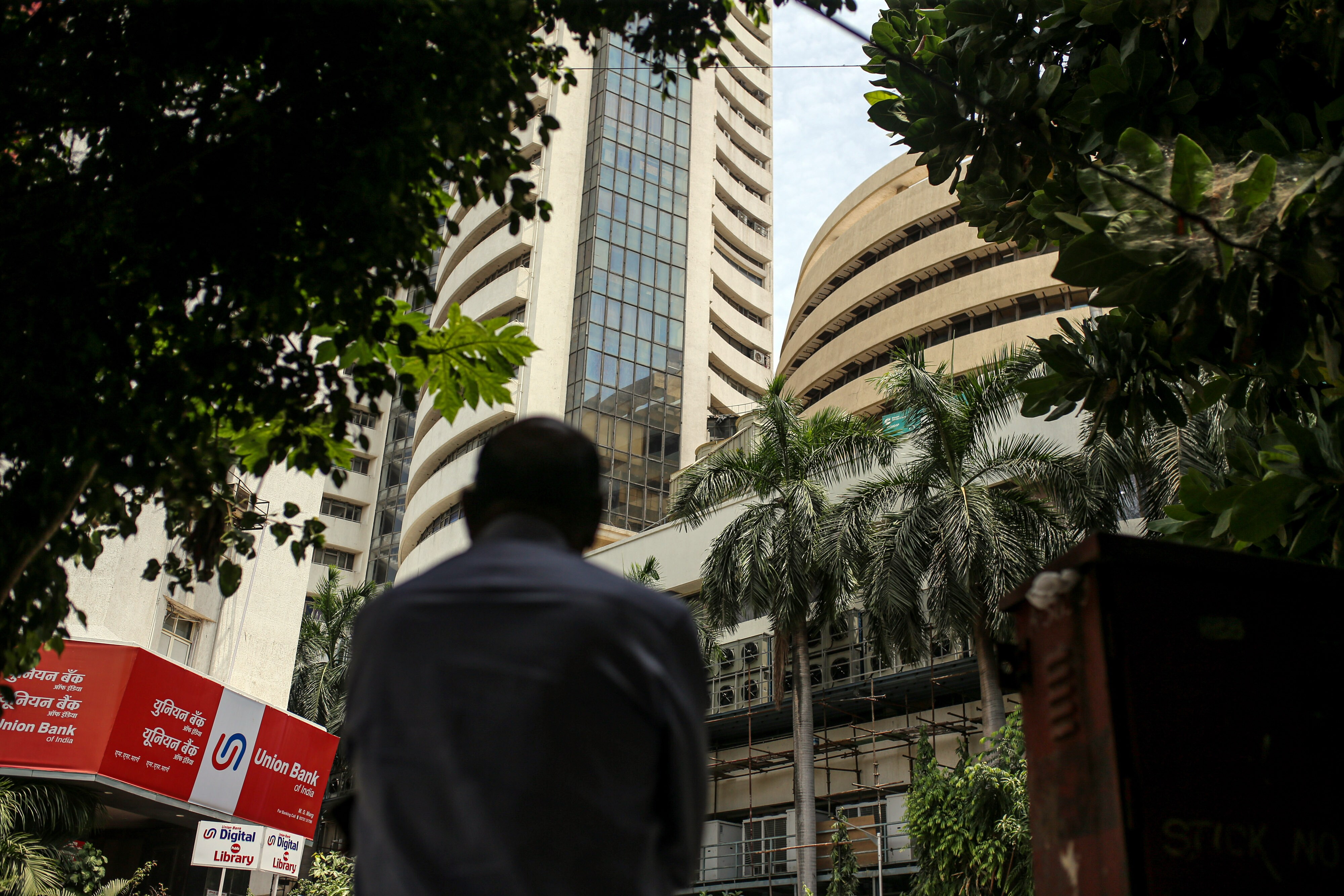
Foreign investors are souring on India's stock market, selling a record amount of shares amid signs the South Asian nation's post-pandemic economic boom is losing steam.
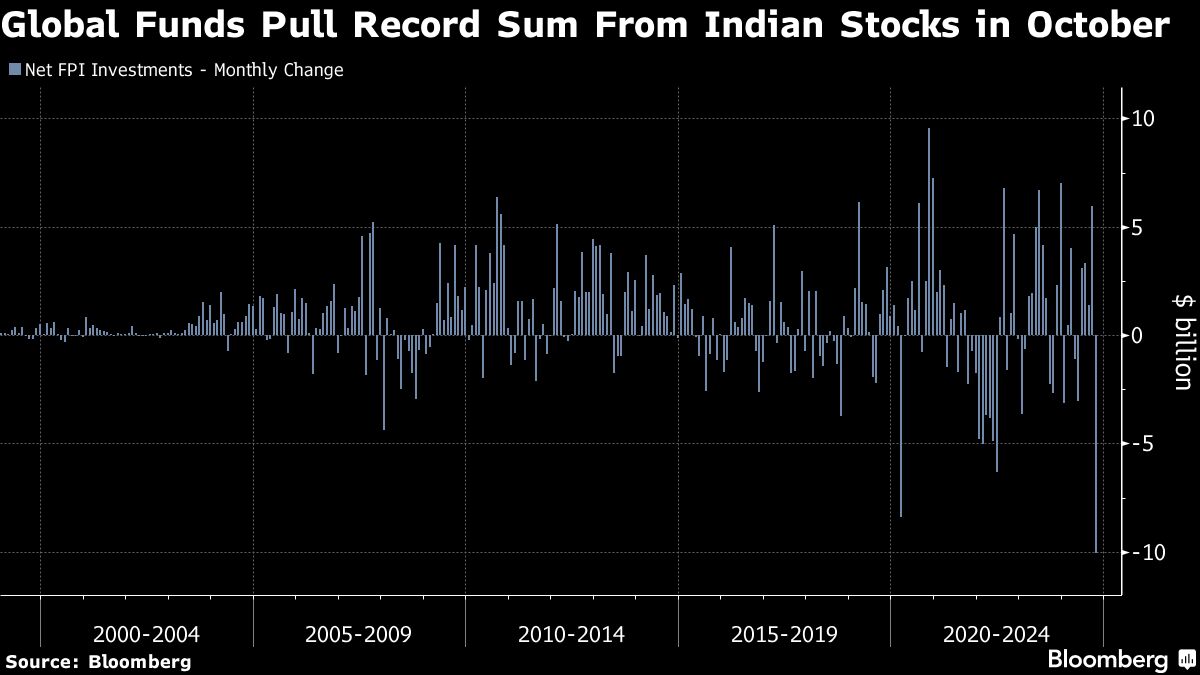
Global funds pulled out more than $10 billion on a net basis in October, helping drive the benchmark stock index toward a so-called technical correction. Sustained foreign investor outflows could act as a drag on near-term stock performance, according to Citigroup Inc.
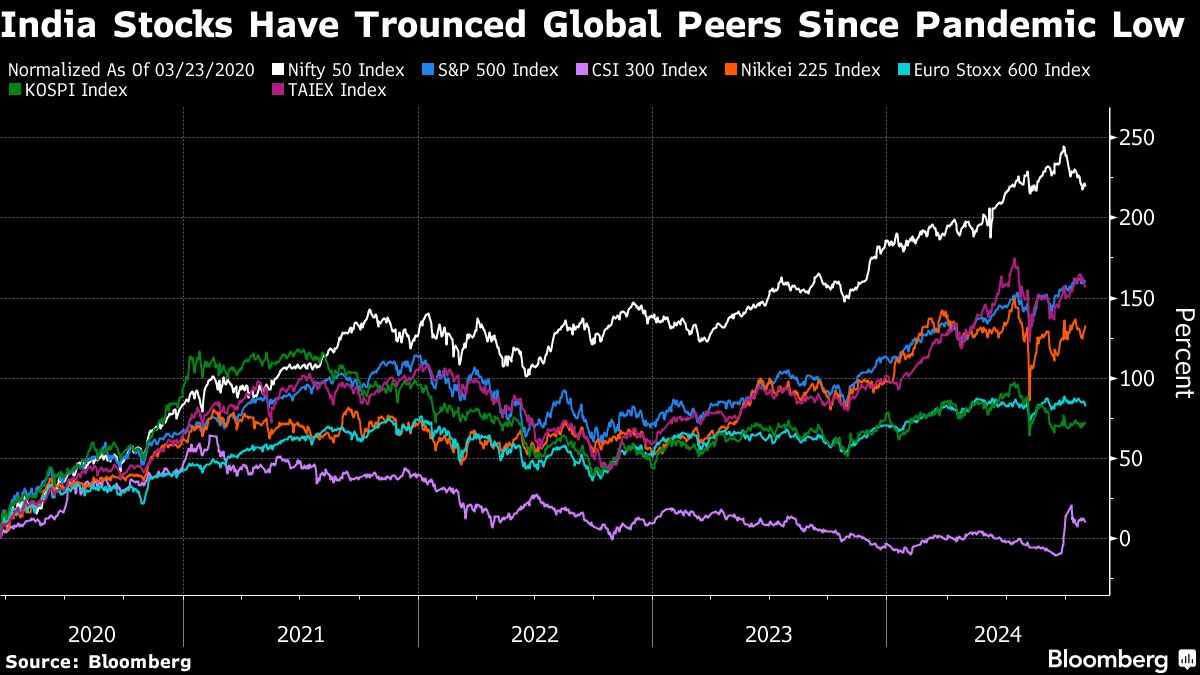
The past few years have seen India emerge as a preferred investment destination, thanks to its breakneck economic growth, surging corporate profits and a broader shift away from China. But some of that shine is now starting to fade as equity valuations have become among the priciest in the world, the pace of expansion in the economy and earnings is slowing and Chinese stocks are staging a comeback following a stimulus blitz since late September.
“While the selling by foreign investors may not remain as severe, they will stay on the cautious side,” said Rajat Agarwal, an Asia equity strategist at Societe Generale SA. Agarwal, who tactically turned neutral on Indian equities in late 2023, said both earnings growth and valuations have “more room to moderate.”
Consumers in Indian cities are cutting back on spending, with firms making everything from soaps to cars warning of a decline in urban middle-class demand due to inflation and poor job prospects. While rural consumers are showing signs of spending more thanks to a good monsoon season that boosted farm incomes, that can't make up for the pullback among nearly 500 million city dwellers.
Goldman Sachs Group Inc. also tactically turned neutral on Indian equities from overweight last month, citing slowing economic growth and high valuations. Some economists project the economy to grow at less than 7% this fiscal year, down from more than 8% in the prior year.
As foreign outflows picked up pace, the benchmark NSE Nifty 50 Index lost 6.2% in October, its worst monthly performance since March 2020. The fiscal 2025 earnings estimate for the gauge's components has seen a 2.2% cut during the ongoing reporting season, according to Jefferies Financial Group Inc.
Still, the Nifty is up more than 10% in 2024, on track for an unprecedented ninth straight year of gains. Share purchases worth more than $50 billion by the nation's domestic institutions this year have helped prevent a deeper market selloff.
“Domestic liquidity can continue to support India's stock market,” said Joanne Goh, senior investment strategist at Singapore-based DBS Bank. “We still think that earnings can grow at about 15% and the Sensex index can still reach another high.”
Even after the recent slump, the NSE Nifty 50 Index's valuation remains the priciest in emerging Asia. The gauge is trading at more than 21 times its 12-month forward earnings, versus a five-year average multiple of 19.4 times.
Global investors tend to invest in certain sectors within India, “and I think some of those have some stretched valuations,” Brian Kersmanc, a portfolio manager at GQG Partners, said on Bloomberg Television last week.
Strategists at Bernstein Societe Generale Group expect some more weakness in Indian stocks heading into the year-end.
“The market hasn't yet fully priced in the extent of the slowdown that could be on the cards,” Venugopal Garre and Nikhil Arela wrote in a note. “Once reality hits, we expect a further but limited moderation in Nifty from current levels to ~23,500 — which remains our year-end target.”
The gauge fell 1.3% on Monday, the most in a month, to finish at 23,995.35.

-
Your iPhone Costs 12 Grams Of Gold, A Car About 100. What Does Your Life Weigh?

Measured in rupees, almost everything looks more expensive than it did a generation ago. Measured in grams of gold, a lot of it has become cheaper.
-
Gold Is Rs 22,000 Cheaper Than A Month Ago. Should You Buy Amid The Wedding Season?
Gold's potential slide to $3,500 could save around Rs 4,700 per 10 grams, but a soft inflation print could just as easily push prices back up. One way to split the risk is to buy in parts, some now and the rest after the Fed's Dec. 9 decision.
-
AI Agents Are Gaining Power. Who Governs Them?
Artificial intelligence agents promise to transform productivity by moving machines from assisting decisions to executing them. But as organisations delegate greater authority to these AI-agents, they must first establish who controls that authority and who remains accountable when things go wrong.
-
Why Swapping Your Old Gold Can Trigger A Rs 5 Lakh Tax Bill, And How You Can Avoid It Legally
Swapping old gold for new is taxed as a sale and a fresh purchase. Getting your own gold remade can cut most of that bill, though it has its own costs.
-
The AI Trade is Done. The Real Opportunity for Investors Starts in 2027 | Unhedged Position
As pureplay AI stocks plunge and circular, capex-led financing unwinds, 2027 is set to be a year of reckoning for AI companies. Yet the bust clears the way for a better opportunity for investors in 2027 -- shifting the spotlight from AI builders to the companies using AI.
-
Leadership As Mission: Why The Age Of AI Demands More Human Leadership
Debjani Ghosh examines how AI is changing leadership, arguing that its success must be measured by its impact on people and the accountability of those guiding its use.
-
We May Need Another Tukaram Mundhe To Fight Air Pollution | The Reason Why
Developers may install basic measures such as sprinklers and green nets, resume work, and continue violating rules when this equipment stops working.
-
Extracting Value From Battery Scrap Could Be Challenging For India | The Reason Why
A discarded lithium-ion battery still contains valuable materials such as lithium, nickel and cobalt. These can be recovered and reused. When such batteries are crushed and shredded, they produce a dark powder called black mass.
-
One El Nino, India Can Handle. Two Could Break The Granary
India's grain stocks can absorb one bad year, but a second El Nino could drain the buffer in two to three years, economists say.
-
India's Troika Of Good Luck | Joining The Dots
As Jensen Huang's exit drags Nvidia down, a cooling AI trade and resilient earnings have revived investor interest in India. A likely RBI rate hike looms.









