RBI Hikes Foreign Investment Limit In Government And Corporate Bonds

Foreign portfolio investors can now buy more Indian government and corporate debt.
The Reserve Bank of India said it would increase the FPI investment limit in central government bonds to 5.5 percent in 2018-19 from 5 percent in two tranches, according to a notification on the central bank's website. The FPI limit would then be increased to 6 percent of the outstanding stock in 2019-20.
RBI decided not to raise the limit for FPI investment in state development loans. That was kept unchanged at 2 percent.
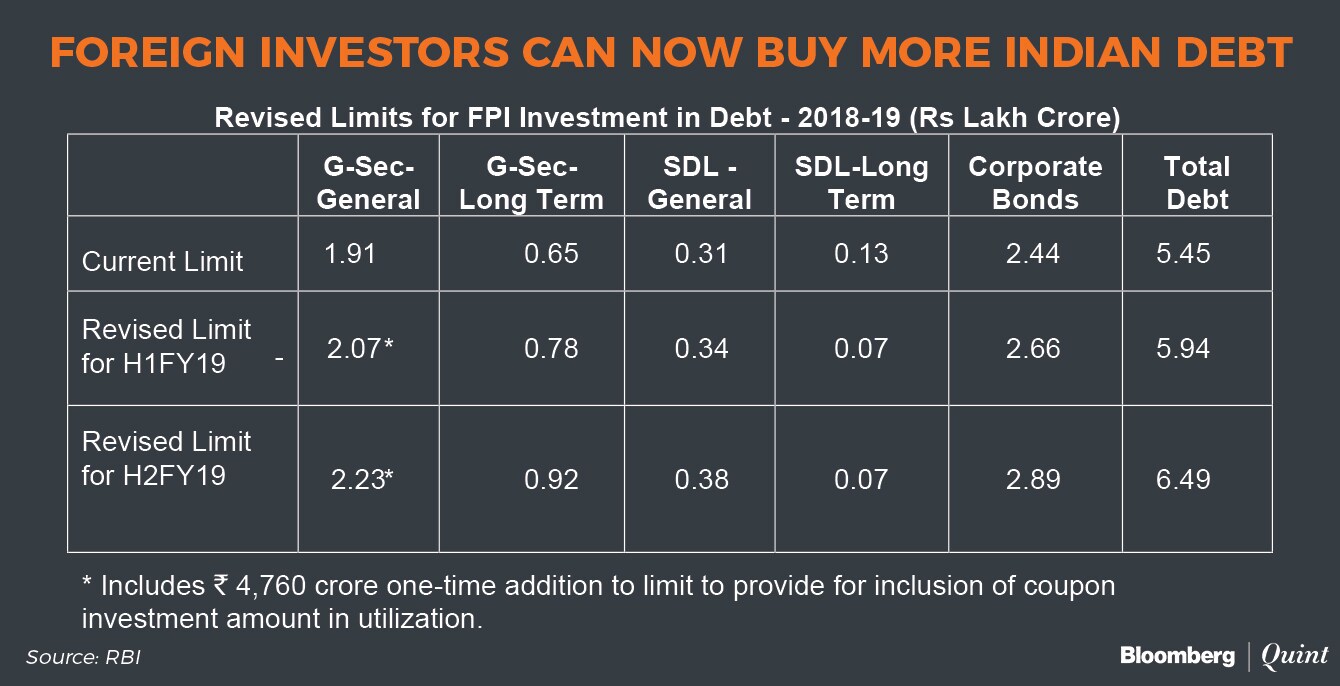
The overall limit for FPI investment in corporate bonds will be fixed at 9 percent of the outstanding stock, the central bank said. The FPI limit in corporate bonds would hence go up to Rs 2.66 lakh crore in the first half of fiscal 2018 from Rs 2.44 lakh crore currently. That would again be raised to Rs 2.89 lakh crore in the second half of 2018-19.
The decision to raise the caps comes at the start of a financial year in which the government will seek to borrow more than Rs 6 lakh crore from the markets. This against the backdrop of tightening liquidity conditions and subdued demand for government debt from local banks.
The FPI limit hike is "somewhat smaller" than market expectations and will temporarily dampen bond yields further, according to Aditi Nayar, principal economist at ICRA Ltd. The revised limits also mean that aggregate foreign investor inflows into debt are likely to ease in the current fiscal from a three-year high of $19 billion in the year ended March 2018, Nayar said in an emailed note.
In ICRA's view, the 10-year G-sec yield is likely to trade in a range of 7-7.3 percent in the remainder of Q1 FY2019, before rising to 7.3-7.6 percent in Q2 FY2019, as the outlook for the government's fiscal trends, domestic inflation and FPI appetite for G-sec become clearer.Aditi Nayar, Principal Economist, ICRA
She said that the trajectory of bond yields will be dominated by the government's borrowing plan for the second half of the financial year, risks of fiscal slippage, the demand for domestic credit from other sources, and interest rate action by central banks around the world. But the appetite of foreign investors for Indian debt “remains to be seen” given the expectation that central banks around the globe will tighten monetary policy, she added.
Also Read: India To Borrow Rs 2.88 Lakh Crore In First Half Of 2018-19
The RBI last announced a road map for foreign investment in government debt in September 2015. At the time, it had said that foreign investors would be allowed to hold up to 5 percent of central government bonds in stages. That limit has now been exhausted.
General category foreign investors currently hold Rs 1.91 lakh crore of central government bonds, according to data available on NSDL. The limit in this category is completely used. Some room is available for long-term investors, such as sovereign wealth funds and pension funds, which have a separate quota.
Also Read: Government Cuts Additional Borrowing Plan After Bond Yields Spike

-
The Economic Imperative: Analysing The Material Driving Force Behind India-Canada Strategic Reset

This economic complementarity is further reinforced by deep institutional investment ties and talent mobility, which form the bedrock of the bilateral framework.
-
Medicine Pricing: Where Must Profit Stop?
India must confront excessive margins, hidden incentives and regulatory gaps that threaten the integrity of medicine.
-
Why Amazon And Flipkart Are Struggling To Beat Meesho In India's Smaller Cities
With 274 million users and lowest-cost logistics, Meesho is defending its value commerce crown against giants like Amazon and Flipkart.
-
High US Salaries, No Green Card Certainty: The Financial Calculation Facing Indian H-1B Families
The suspension of PERM processing at eight technology employers does not cancel existing H-1B visas. What it does is force a question many Indian families have been avoiding: is the US salary worth tying your career and family plans to one employer?
-
Swiggy vs Eternal: Food Delivery's Two Rivals Are No Longer In The Same Race
Eternal is building a private AI assistant, dark.ai. Swiggy is still working out how to make Instamart pay, with an operating loss of Rs 895 crore in the July-September quarter while Blinkit stayed profitable.
-
Where You Live Shapes How You Get To Work | The Reason Why
Two-wheelers are the most popular way to get to work in India, accounting for nearly 43% of workplace commutes.
-
Unhedged Position: Can India See An Indonesia-Style Time Correction?
The Nifty is trading below levels it first clocked in 2024. Is there, then, as I have suggested in the headline, potential that the current time correction drags on painfully for the next three-five, even ten years?
-
Navigating Friction And Energy Realities: An Analysis Of Marco Rubio's October Visit To India
Occurring at a critical juncture marked by stalled trade negotiations and escalating geopolitical pressures over global energy supplies, the visit offers a profound window into modern US-India relations.
-
India Exports Capital. Why Not Export Trusteeship?
The big question, then, is whether India can build an institution that global borrowers, investors, banks, and lawyers can trust, even without an Indian connection.
-
France's Economy & Politics Are In Crisis | The Reason Why
Let's look at how the French economy and politics evolved under Nicolas Sarkozy, Franois Hollande and Emmanuel Macron.










