‘Peak Euphoria’ Warning Blares As Stress Vanishes On Wall Street
(Bloomberg) -- Remember, this wasn't supposed to happen.
The era of tight money – and an uncertain inflation trajectory — threatened to deliver a big reckoning on Wall Street and beyond, after a debt bonanza for more than a decade.
And sure, pain came as promised. Who can ignore the fresh woes for regional banks and commercial real estate in recent weeks, or forget the double-digit plunges in 2022 across bonds, stocks, speculative tech, and more.
Yet for all these pockets of interest rate-driven stress, financial markets as a whole have weathered the monetary storm — with key risk-taking measures evoking the euphoric days of easy money.
Even after two higher-than-expected inflation readings that prompted bond traders to reassess the timing of the first Federal Reserve rate cut, the S&P 500 remains near recent records, down just 0.4% for the week.
Thank the enduring artificial-intelligence boom — and a US economy that continues to roar ahead while recession stalks the UK, other parts of Europe and Japan.
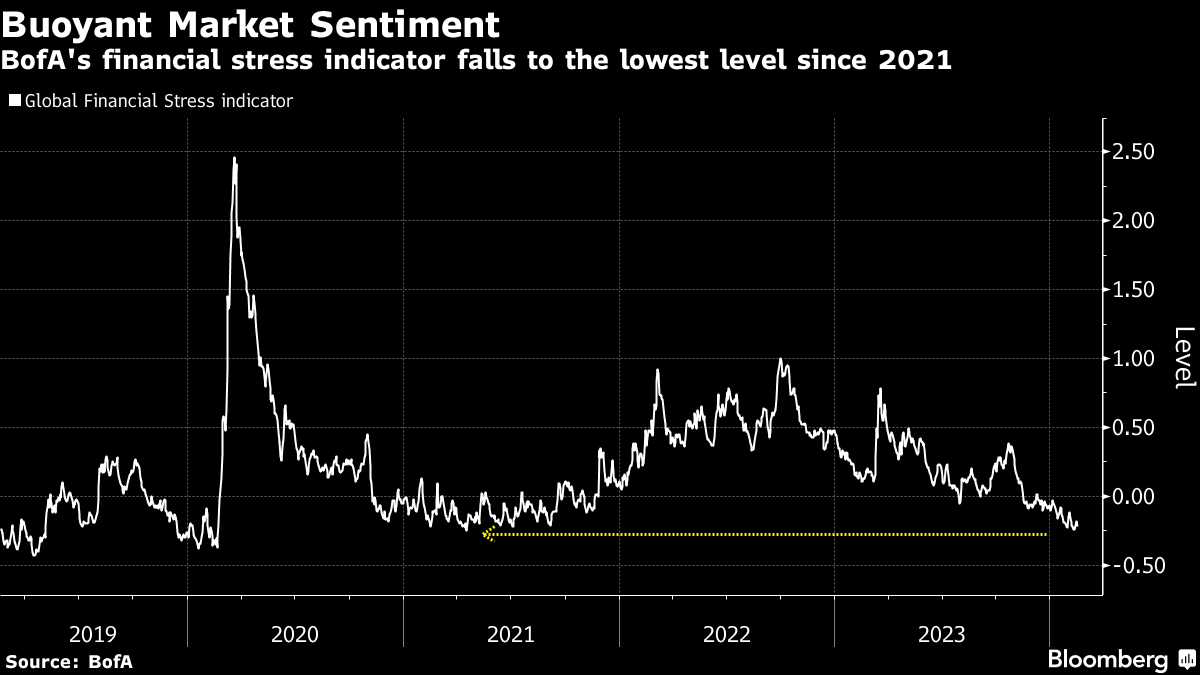
All told, the Bank of America Corp.'s Global Financial Stress indicator, which measures market risk, hedging demand and investor flows, sits this month at the lowest level since April 2021.
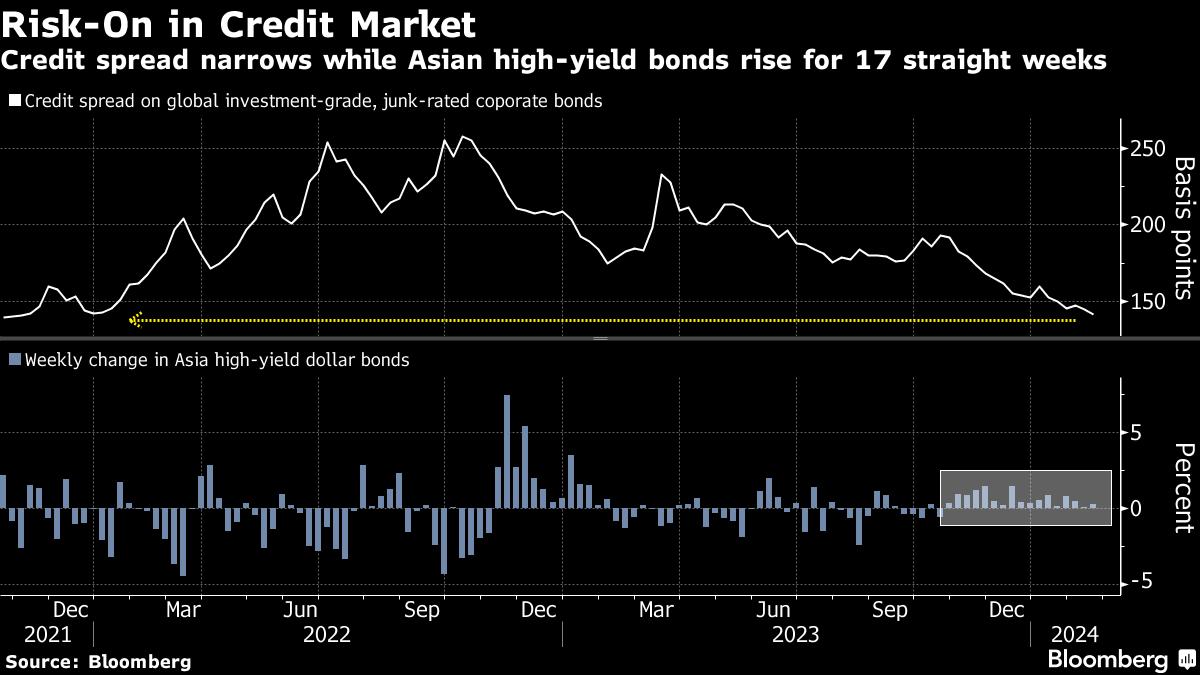
Stock traders have flocked to bullish options. Asian high-yield dollar bonds have climbed for a record 17 straight weeks. Even Bitcoin is above $50,000 for the first time since 2021.
“Growth seems OK, and corporate profits are resilient. So, the soft landing is still on the table. What's not to like?” said Que Nguyen, chief investment officer of equity strategies at Research Affiliates. “True, headline inflation announcements are stickier than we'd like, but Fed officials seem sanguine about it all, and indicate that the next move is a cut, just further out.”
With risk appetite flying high, financial conditions have eased to levels not seen since before the central bank embarked on its aggressive inflation-fighting campaign. When deciding on the next rate move, Fed Chair Jerome Powell may heed former Fed Chair Alan Greenspan's famous 1996 speech on irrational exuberance, according to Ed Yardeni.
“Might Powell & Co. choose not to lower the federal funds rate at all if they conclude that a 1990s-style stock market bubble is inflating?” asked the founder of Yardeni Research Inc. “We don't know for sure, but we suspect that we might find out this year.”
Wall Street traders did get whiplashed this week amid mixed economic data. Stocks sold off Tuesday on a hot reading in the consumer price index before bouncing back over the next two sessions amid weak retail sales — only to come under pressure again after a strong print in the producer price index. Despite Friday's retreat, the S&P 500 managed to hold above the 5,000 level. Along the way, traders pared expectations for interest-rate cuts, seeing only a one-in-four chance of a Fed move in May.
Yet with the earnings season drawing to a close, corporate America has delivered another solid quarter. Profits for S&P 500 firms expanded 7%, extending a recovery from a contraction in the first half of 2023, data compiled by Bloomberg Intelligence show.
“The biggest change I think was we have shifted the narrative from ‘Hey the Fed is going to cut rates a lot' to ‘Hey the Fed will cut rates,'” said Art Hogan, chief market strategist at B. Riley Wealth. “So what took the place of that excitement over the Fed cutting rates was earnings in the fourth quarter which were better.”
In fixed income, fear is hard to find. Around the globe, the extra yield investors demand to hold investment-grade and junk-rated corporate bonds has fallen to the lowest in two years, according to data compiled in a Bloomberg index.
Interest in hedging is also waning. Credit default swaps, or instruments designed to hedge exposure to credit risks, retreated as the Markit CDX North American High Yield Index and a similar investment-grade CDS tracker both hit a two-year low.
Similar sentiment is ruling the equity market. Rather than hedging against the downside, stock traders are piling in on bullish options to prepare for further upside. These contracts are so popular that their cost for the average stock in the S&P 500 was almost on a par with bearish puts. The difference, known as call skew, reached the highest level since 2021, a year when speculative fervor broke out in everything from meme stocks to non-fungible tokens.
“Many indicators are rhyming with levels last seen during 2021 ‘peak euphoria,'” Brian Garrett, a managing director at Goldman Sachs Group Inc., wrote in a note. “I have personally seen more than one ‘SPX 5k' hat making the rounds on the floor.”
Investors can be forgiven for being reluctant to add protection for potential losses. After all, options hedging has mostly failed to work during the last two years. This week, the implied probability for a 10% decline in the S&P 500 over the next six months stood near 9%, the lowest level since at least 2010 and half the historic average, according to a model by Morgan Stanley.
To contrarians, it's time to consider the downside risk, especially when everyone from stock-picking hedge funds to rules-based traders and individual investors has increased equity exposure this year. Global equity funds pulled in $59.5 billion over the past four weeks, the largest inflow since February 2022, data compiled by BofA show.
By Morgan Stanley's estimate, the overall investor positioning now ranks at about eight out of ten.
“A hot CPI woke markets up to the fact that risks are two sided. But still, mindsets are hard to change, as most people anchor to recent history,” the firm's team including Christopher Metli wrote in a note. “Equity length is building – so there is a greater need for hedges for many investors.”
More stories like this are available on bloomberg.com
©2024 Bloomberg L.P.

-
Signature Play: The Classic Cocktail Is Dead. Or Is It?

Classic cocktails are disappearing from India's cocktail menus. But they're still being ordered, taught to bartenders and borrowed from. So, who's really having the last drink?
-
A New Samvat Wishlist: Inclusive Prosperity And Human Development
India has strengthened its economic foundations through infrastructure, digital access and enterprise. Its next growth chapter must deepen productivity, create better livelihoods and widen participation in prosperity.
-
Love, Sex Aur Dhokha: The Audacious Plot To Spy On Jensen Huang
A Taipei dinner, a Singapore chip buyer and a suspected Chinese asset: inside the alleged spy operation that got close to NVIDIA's Jensen Huang.
-
Ten Things I Learnt This Samvat
Patience can be a trap. Cheap stocks can stay cheap. Leverage can wipe you out. What did Samvat 2082 teach us? Niraj Shah writes on 10 lessons from the year gone by.
-
Talking Points This Week: Tech Nerves, FII Buying, And A Faraway Banking Shock
The global markets are not shining this Diwali. The exception in the large markets is, India.
-
Midterm Rally Lasted A Day. The Hard Reality Of A Divided US May Last Two Years | Opinion
Between a contested AI boom, a debt ceiling that arrives in 2027 and a president with every incentive to act alone, the next two years may prove more volatile than the first day's rally suggests.
-
Blue Wave Will Derail the AI Trade but Won't Dismantle the AI Era | Unhedged Position
The Democrats' sweep of the US Congress will see politics collide with economic forces both over the long and short term.
-
It's Time To Take The GST Council's Bet On Trust Global
Payment records can prove India's services exports, and clear, proportionate rules can bring foreign digital sellers into the tax net.
-
Opinion | India at 38: From Innovation Overperformer to Innovation Powerhouse
India now has 453 VC-backed deep science startups, 18 of them late-stage, after 117 percent growth since 2020. Laurus Labs, at USD 9.3 billion, is the most valuable deep science company in any middle-income economy outside China.









