Oil Sinks As OPEC+ Supply Surge Threatens To Swamp Global Market
Oil buckled on concerns of a global glut after OPEC+ agreed to another bumper output increase, adding to supply at a time when demand is challenged by the drag from the trade war.
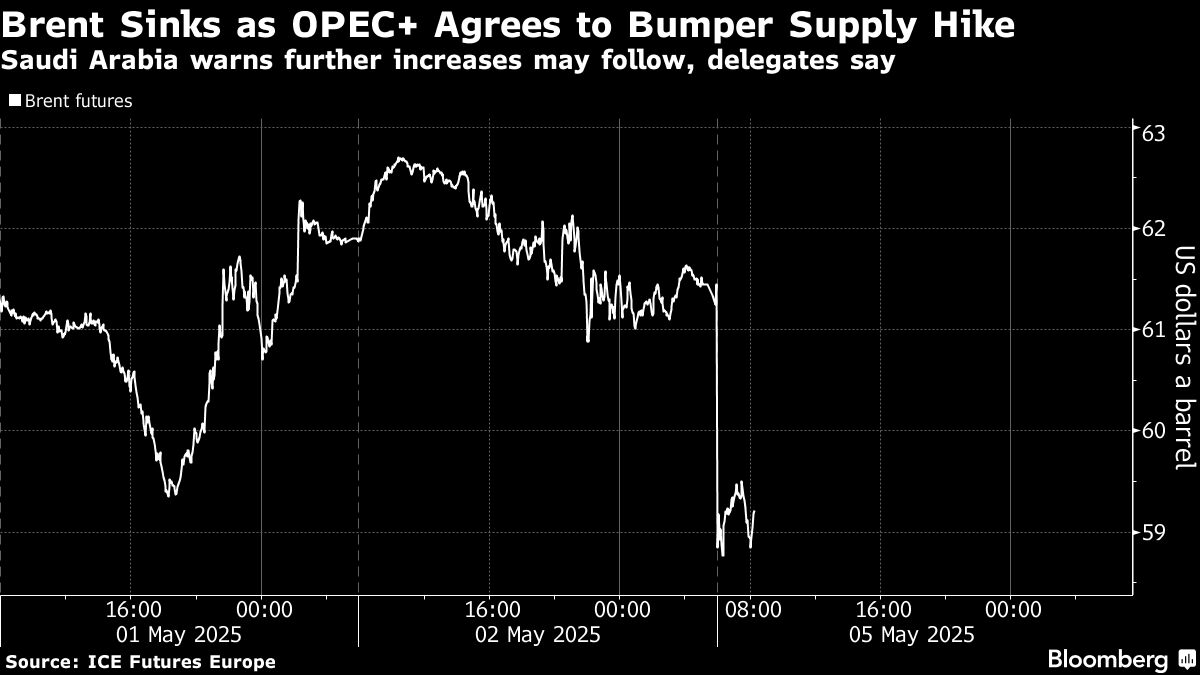
Global benchmark Brent tumbled as much as 4.6% toward $58 a barrel as the week's trading kicked off, while West Texas Intermediate was near $56. The decision by OPEC and its allies was taken at a meeting on Saturday, with the group's leaders seeking to punish overproducing members including Kazakhstan in a strategy shift that had already sent prices plunging.
The latest hike of more than 400,000 barrels a day from June matched a similar increase announced last month, when the group made the shock decision to bring back triple the planned volume for May. The alliance — led by Saudi Arabia and Russia — has been reversing prolonged output curbs that were meant to support prices, but which cost it market share to rival drillers.
After the meeting, Saudi Arabia signaled further similar-sized increases could follow, according to delegates.
Crude has slumped in 2025, and has returned to near a four-year low hit in April, as US President Donald Trump's trade war threatened to derail growth, erode investor confidence and undercut energy demand. The dramatic policy pivot by OPEC+ has added momentum to the sustained selloff, which has made oil one of the worst performing major commodities of 2025.
The increase from OPEC+ “simply cannot be absorbed,” said Ajay Parmar, director of oil analytics at ICIS. “Demand growth is weak, particularly with the recent imposition of tariffs,” he said.
The move by the Organization of the Petroleum Exporting Nations and its allies stoked bumper trading volumes. Timespreads, meanwhile, have also collapsed. The September-October Brent spread fell into contango — when later prices trade at a premium to earlier ones — from its opposite, backwardated structure on Friday, signaling an impending glut.
Morgan Stanley reduced price forecasts following the OPEC+ move, predicting $62.50 a barrel for Brent in the third and fourth quarters of 2025, $5 lower than previously seen, analysts including Martijn Rats said in a note. Goldman Sachs Group Inc. analysts led by Daan Struyven also cut their forecasts.
Prices:
Brent for July settlement dropped 3.7% to $59.05 a barrel at 11:49 a.m. in Singapore.
WTI for June delivery declined 3.9% to $55.99 a barrel.
The decline in energy costs — if sustained — may be welcomed by central bankers, including those at the Federal Reserve, who meet this week to assess policy. Cheaper oil and associated products including gasoline could offset some of the inflationary impact expected to be driven by tariffs.
President Trump — who is scheduled to travel to the Middle East later this month — had called on OPEC+ to bolster production and help bring down energy prices. At the same time, Saudi Arabia has been seeking to strengthen ties with Washington, which has also been holding talks on a nuclear pact with Riyadh's political foe and fellow OPEC member, Iran.
On the trade war front, Trump said he was willing to lower tariffs on China at some point because the levies now are so high that the world's two largest economies have essentially stopped doing business with each other. However, he said he had no plans to speak with his Chinese counterpart this week.

-
'Never Seen This Level Of Negativity': Sandeep Tandon Says The Next Rally May Be Closer Than You Think

Veteran investor Sandeep Tandon says foreign selling is easing, large-caps are due a comeback and mid-caps are crowded, while he turns positive on gold, power and pharma this Diwali.
-
Indians Stay With Family, Not In Hotels | The Reason Why
India still lacks enough clean, reliable and affordable hotels for budget-conscious travellers.
-
The Economic Imperative: Analysing The Material Driving Force Behind India-Canada Strategic Reset
This economic complementarity is further reinforced by deep institutional investment ties and talent mobility, which form the bedrock of the bilateral framework.
-
Medicine Pricing: Where Must Profit Stop?
India must confront excessive margins, hidden incentives and regulatory gaps that threaten the integrity of medicine.
-
Why Amazon And Flipkart Are Struggling To Beat Meesho In India's Smaller Cities
With 274 million users and lowest-cost logistics, Meesho is defending its value commerce crown against giants like Amazon and Flipkart.
-
High US Salaries, No Green Card Certainty: The Financial Calculation Facing Indian H-1B Families
The suspension of PERM processing at eight technology employers does not cancel existing H-1B visas. What it does is force a question many Indian families have been avoiding: is the US salary worth tying your career and family plans to one employer?
-
Swiggy vs Eternal: Food Delivery's Two Rivals Are No Longer In The Same Race
Eternal is building a private AI assistant, dark.ai. Swiggy is still working out how to make Instamart pay, with an operating loss of Rs 895 crore in the July-September quarter while Blinkit stayed profitable.
-
Where You Live Shapes How You Get To Work | The Reason Why
Two-wheelers are the most popular way to get to work in India, accounting for nearly 43% of workplace commutes.
-
Unhedged Position: Can India See An Indonesia-Style Time Correction?
The Nifty is trading below levels it first clocked in 2024. Is there, then, as I have suggested in the headline, potential that the current time correction drags on painfully for the next three-five, even ten years?
-
Navigating Friction And Energy Realities: An Analysis Of Marco Rubio's October Visit To India
Occurring at a critical juncture marked by stalled trade negotiations and escalating geopolitical pressures over global energy supplies, the visit offers a profound window into modern US-India relations.










