Oil Posts Longest Monthly Slump Since 2020 Amid Growth Concerns

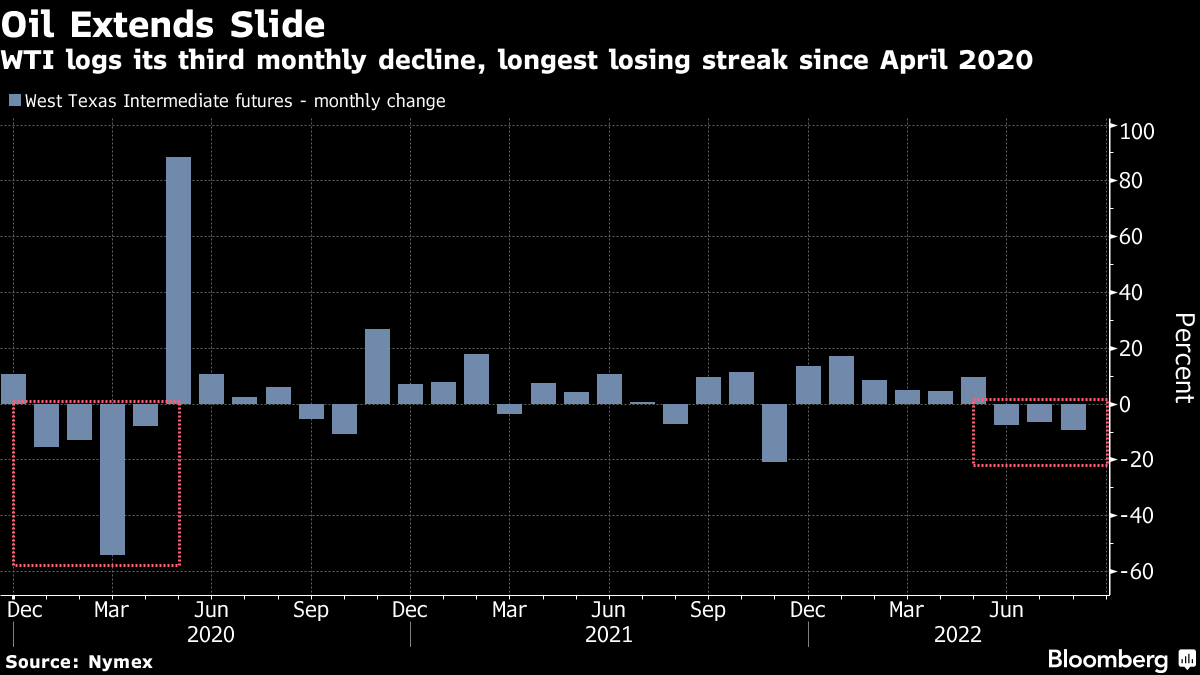
(Bloomberg) -- Oil registered its third straight monthly decline, its longest losing run in more than two years, on concern that tighter monetary policy and China's economic slowdown will impact crude demand.
West Texas Intermediate lost more than 9% in August, the largest monthly decline since November. Bearish sentiment is mounting amid slowing economic growth for major oil consumer China. Also, central bank officials reaffirmed their commitment to raising interest rates to cool rapid inflation. The US oil benchmark settled Wednesday below $90 a barrel for the first time in two weeks.
“This morning's price weakness is a summation of overall sentiment for the month of August, in which rising central bank interest rates are seen as the brake pedals to oil demand growth,” said Harry Altham, an energy analyst for StoneX Group.
Low liquidity has exacerbated crude's steep price swings, frustrating oil bulls including hedge fund manager Pierre Andurand, who opined Thursday that the futures market is “broken.” In the past week, oil has traded in a range of close to $10 a barrel.
The decline in futures comes even as the US supply picture has turned bullish, with crude stockpiles dropping for a third week while inventories at the largest storage hub fell for the first time in over two months, according to the latest Energy Information Administration report.
While there has been significant unrest in both Libya and Iraq in recent days, oil output in both OPEC members appears to be unaffected so far. Separately, talks to revive an Iranian nuclear deal that may unlock greater crude exports have dragged on, and Russian output has been maintained at levels higher than prior expectations.
An agreement to revive the 2015 nuclear deal is “not out of reach” if the text of the final accord is stronger with better guarantees for Iran, Iranian Foreign Minister Hossein Amirabdollahian said at a press conference in Moscow.
Oil's decline in August marks the latest chapter in a tumultuous year, with prices driven higher in the first half by Russia's invasion of Ukraine, then undermined as central banks shifted tack and Moscow managed to keep most exports flowing. Crude's recent slump prompted OPEC+ heavyweight Saudi Arabia to float the idea the alliance could cut output, although Russian media reported the group wasn't discussing such a move at present.
The main theme “is pessimistic macro-economic expectations, coupled with tight supply from low inventories,” said Zhou Mi, an analyst at Chaos Research Institute in Shanghai, which is affiliated with Chaos Ternary Futures Co.
Key time spreads suggest that tightness in the market has eased. WTI's prompt spread -- the difference between the two nearest contracts -- settled for the month at 52 cents a barrel in backwardation, compared with $1.87 a month ago.
“This just seems like a violent retracement in prices and spreads in oil after they failed to maintain their strength yesterday in what is an extremely illiquid market,” said Scott Shelton, an energy specialist at ICAP.
Elements, Bloomberg's daily energy and commodities newsletter, is now available. Sign up here.
More stories like this are available on bloomberg.com
©2022 Bloomberg L.P.

-
Talking Points This Week: Leadership Shock At Nvidia, Earnings Strength, And The Fog Over Hormuz

The Anthropic IPO pricing and first trading day, Nvidia's upcoming earnings, and any fresh signals from Iran will set the tone for the following week.
-
Signature Play: The Classic Cocktail Is Dead. Or Is It?
Classic cocktails are disappearing from India's cocktail menus. But they're still being ordered, taught to bartenders and borrowed from. So, who's really having the last drink?
-
A New Samvat Wishlist: Inclusive Prosperity And Human Development
India has strengthened its economic foundations through infrastructure, digital access and enterprise. Its next growth chapter must deepen productivity, create better livelihoods and widen participation in prosperity.
-
Love, Sex Aur Dhokha: The Audacious Plot To Spy On Jensen Huang
A Taipei dinner, a Singapore chip buyer and a suspected Chinese asset: inside the alleged spy operation that got close to NVIDIA's Jensen Huang.
-
Ten Things I Learnt This Samvat
Patience can be a trap. Cheap stocks can stay cheap. Leverage can wipe you out. What did Samvat 2082 teach us? Niraj Shah writes on 10 lessons from the year gone by.
-
Talking Points This Week: Tech Nerves, FII Buying, And A Faraway Banking Shock
The global markets are not shining this Diwali. The exception in the large markets is, India.
-
Midterm Rally Lasted A Day. The Hard Reality Of A Divided US May Last Two Years | Opinion
Between a contested AI boom, a debt ceiling that arrives in 2027 and a president with every incentive to act alone, the next two years may prove more volatile than the first day's rally suggests.
-
Blue Wave Will Derail the AI Trade but Won't Dismantle the AI Era | Unhedged Position
The Democrats' sweep of the US Congress will see politics collide with economic forces both over the long and short term.
-
It's Time To Take The GST Council's Bet On Trust Global
Payment records can prove India's services exports, and clear, proportionate rules can bring foreign digital sellers into the tax net.
-
Opinion | India at 38: From Innovation Overperformer to Innovation Powerhouse
India now has 453 VC-backed deep science startups, 18 of them late-stage, after 117 percent growth since 2020. Laurus Labs, at USD 9.3 billion, is the most valuable deep science company in any middle-income economy outside China.









