New India Assurance IPO: Here’s What You Need To Know
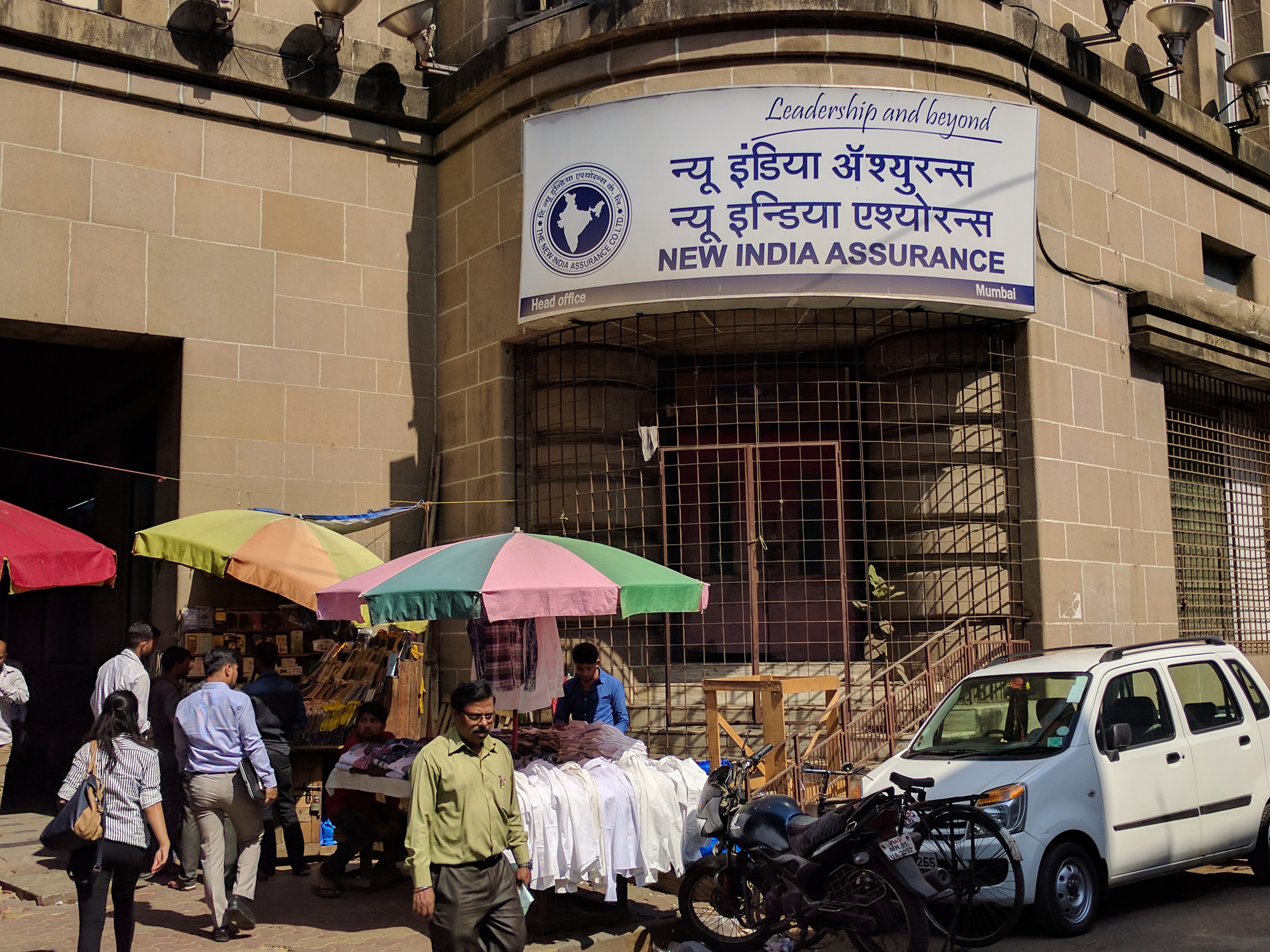
The century-old New India Assurance Company Ltd. will launch its Rs 9,600 crore initial public offering today as the government continues to pare stake in state-run insurers.
India's largest general insurer will sell shares at Rs 770-800 apiece, valuing the company at up to Rs 65,920 crore. This will be the second largest IPO this year after General Insurance Corporation of India Ltd. raised Rs 11,372 crore.
Axis Capital, Yes Securities, Nomura Financial Advisory and Securities (India) Pvt. Ltd., IDFC Bank and Kotak Investment Bank are managing the share sale.
Offer Highlights
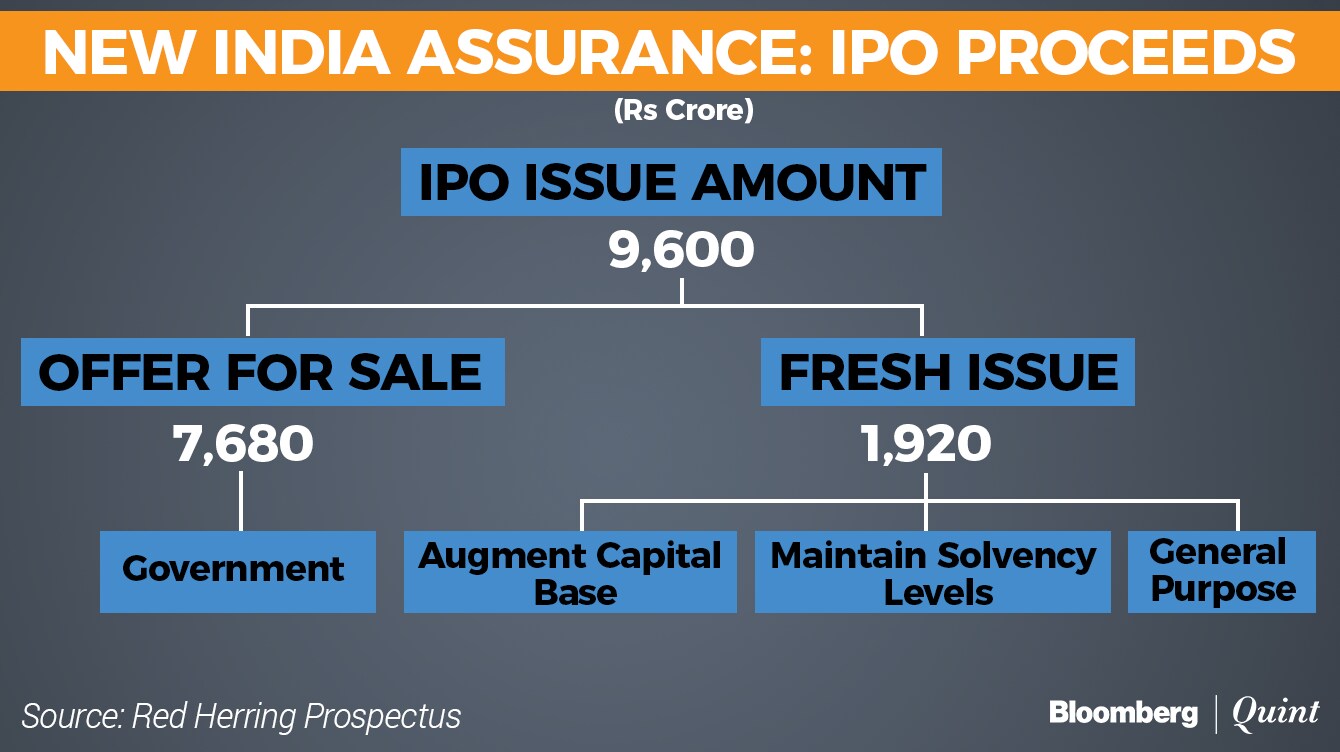
- The company is selling 14.13 percent stake or 12 crores shares, of which 2.4 crore are a fresh issue and 9.6 crore an offer for sale by the government.
- Retail investors and employees will get a Rs 30 discount per share, according to a stock exchange filing.
- The company will issue new stock worth Rs 1,920 crore while the government is looking to raise up to Rs 7,680 crore.
Use Of Proceeds
The company plans to use the proceeds from the fresh issue to augment its capital base to support growth and scale up business, and improve solvency margin and solvency ratio, according to its red herring prospectus.
Business Overview
New India Assurance was the largest general insurance company by net worth, domestic gross direct premium, profit after tax and distribution network in the year ended March, according to a Crisil Report.
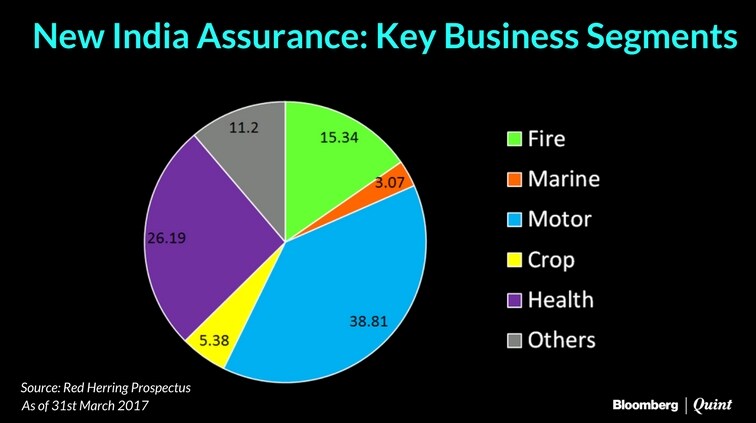
The company sold the highest 2.71 crores policies across all segments in the last financial year. It offers fire, marine, motor, crop, health and other covers through 230 products plans.
Strengths
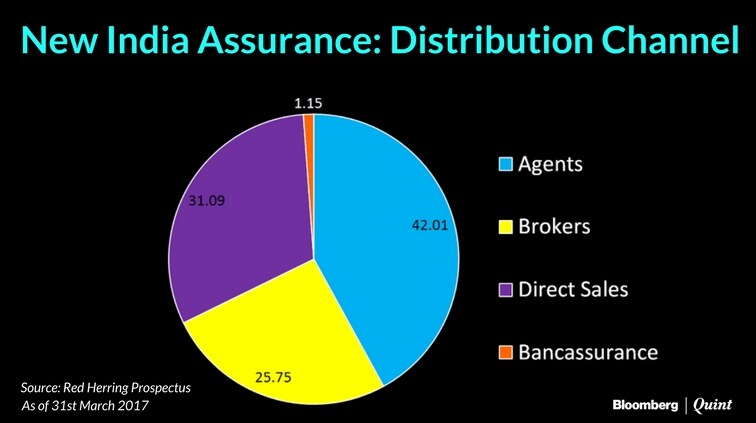
Multi-Channel Distribution: The insurer has exclusive arrangements with a large number of agents, and bancassurance partnerships, and distribution arrangements with other intermediaries.
Global Operations: New India is the country's only direct insurer with an international 'A-' rating and has a presence in 28 countries through international branches, agency offices and subsidiaries, including a desk at Lloyd's, the world's largest specialist insurance marketplace. The underwriting profits from its global operations grew at an annualised rate of 6 percent in the past three years.
Customer Satisfaction: The claim settlement ratio (excluding suits) stood at 96.51 percent, the highest among the top 10 multi-product insurers in the year to March. Rejected claims at 1.2 percent were the second lowest, a Crisil report said.
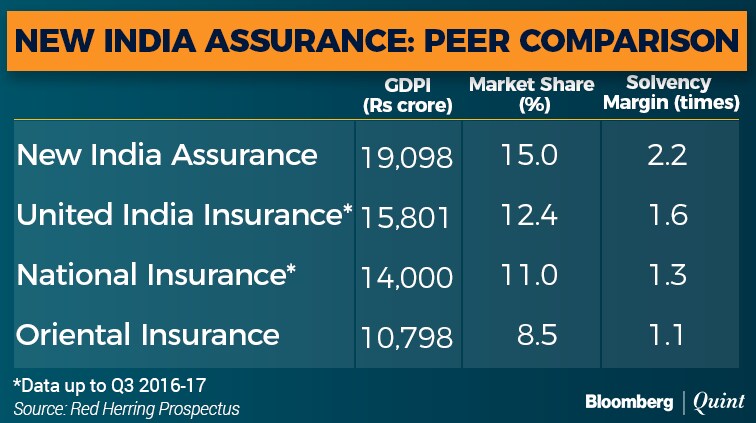
Capital Buffers, Cost Efficiency: It has a solvency ratio of 2.22 compared to the statutory requirement of 1.5 times. That tells us how an insurance company will fare if all its liabilities and claims become due at the same time. It spends 20.4 percent on operating expenses and commissions (operating ratio) compared to the average of 32 percent for its top 10 peers.
Robust Financial Position
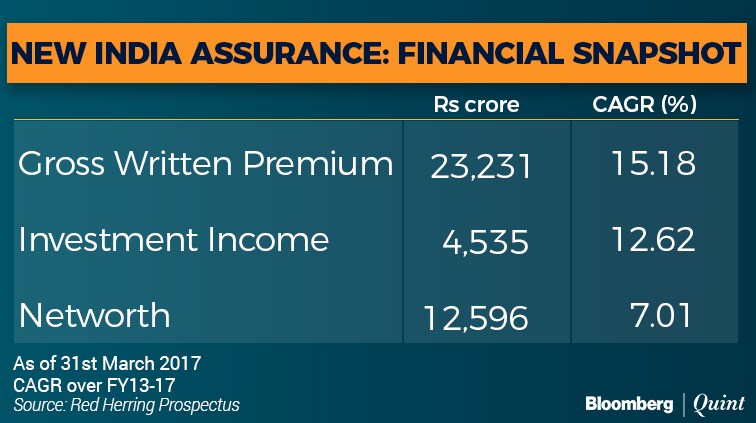
Market Leader: It commands the largest 15 percent share of the gross domestic premium among general insurers in India, and has been a leader in all segments except crop insurance for the past five years.
Weaknesses
Dependence On Investment Income: The combined ratio stood at 119.73 percent for the year ended March. Which means, it's paying more in claims and expenses than what it collects as premium. Though the company is operationally profitable, it's due to investment income that has yielded close to 15 percent in the past five years.
Increasing Loss Ratio: The loss ratio, or the proportion of claims paid out of gross premium, has deteriorated to 92.22 percent from 85.31 percent in five years to March. As a result, profit after tax declined 8 percent during the period to Rs 8,398.6 crore.
Expensive Valuations: At the upper price band of Rs 800, the issue is offered at five times the book value and 76 times the earnings per share for the year ended March. Its listed peer ICICI Lombard is trading at eight and 48 times, respectively.
Brokerage View:
ICICI Securities
- Recommends ‘Subscribe' from a long-term view.
- Despite increasing competition from private players, New India remains a market leader.
- Net earned premium growth remains healthy.
- Improved penetration in motor insurance to boost growth.
Geojit Financial
- Recommends ‘Subscribe' for the long term.
- Well-established general insurer in India and a diversified product offering.
- The company has significant growth opportunities in the key segments like motor, health as well as crop insurance.
Angel Broking
- Recommends ‘Neutral'.
- The company has a subdued return on equity, inconsistent profit after tax as well as higher combined ratio.
- Though New India is market leader in terms of gross direct premium, it reports loss in the insurance business.
- Declining interest rates would impact interest income on debt investments.

-
One Battle After Another: India's Corporate Dynasties Battle For Control

2026 could go down as Corporate India's year of succession wars, governance battles and family fault lines.
-
Rs 50-Lakh Gold In Bank Locker, Rs 3 Lakh Of Protection: The Gap Most Families Don't Know About
The RBI ties a bank's liability to the annual locker rent and families who want to insure their jewellery face a separate question about how to prove what was inside.
-
The More Food Turns Into Fuel, The Harder It Is To Read Agricultural Markets | The Reason Why
A policy designed to reduce dependence on imported fuel can create new pressures elsewhere in the food economy.
-
Your iPhone Costs 12 Grams Of Gold, A Car About 100. What Does Your Life Weigh?
Measured in rupees, almost everything looks more expensive than it did a generation ago. Measured in grams of gold, a lot of it has become cheaper.
-
Gold Is Rs 22,000 Cheaper Than A Month Ago. Should You Buy Amid The Wedding Season?
Gold's potential slide to $3,500 could save around Rs 4,700 per 10 grams, but a soft inflation print could just as easily push prices back up. One way to split the risk is to buy in parts, some now and the rest after the Fed's Dec. 9 decision.
-
AI Agents Are Gaining Power. Who Governs Them?
Artificial intelligence agents promise to transform productivity by moving machines from assisting decisions to executing them. But as organisations delegate greater authority to these AI-agents, they must first establish who controls that authority and who remains accountable when things go wrong.
-
Why Swapping Your Old Gold Can Trigger A Rs 5 Lakh Tax Bill, And How You Can Avoid It Legally
Swapping old gold for new is taxed as a sale and a fresh purchase. Getting your own gold remade can cut most of that bill, though it has its own costs.
-
The AI Trade is Done. The Real Opportunity for Investors Starts in 2027 | Unhedged Position
As pureplay AI stocks plunge and circular, capex-led financing unwinds, 2027 is set to be a year of reckoning for AI companies. Yet the bust clears the way for a better opportunity for investors in 2027 -- shifting the spotlight from AI builders to the companies using AI.
-
Leadership As Mission: Why The Age Of AI Demands More Human Leadership
Debjani Ghosh examines how AI is changing leadership, arguing that its success must be measured by its impact on people and the accountability of those guiding its use.
-
We May Need Another Tukaram Mundhe To Fight Air Pollution | The Reason Why
Developers may install basic measures such as sprinklers and green nets, resume work, and continue violating rules when this equipment stops working.









