Metals Spike As Sanctions On New Russian Supplies Rattle LME
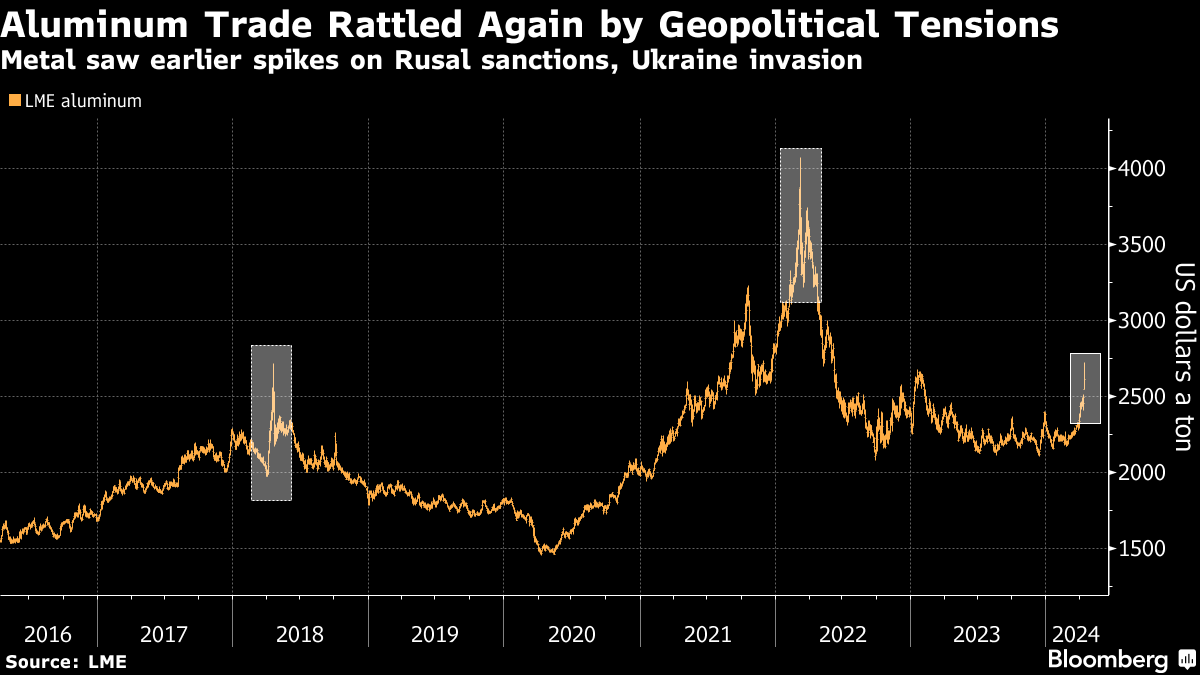
(Bloomberg) -- Aluminum surged by a record on the London Metal Exchange as traders responded to new US and UK sanctions that banned deliveries of Russian supplies produced after midnight on Friday.
The restrictions on key industrial metals — aimed at curbing President Vladimir Putin's ability to fund his war machine — are unlikely to stop Russian sales but inject significant uncertainty into commodities markets that have already been reshaped in the aftermath of Russia's invasion of Ukraine.
Aluminum jumped as much as 9.4%, the most since the current form of the contract was launched in 1987, while nickel rose as much as 8.8%, although prices later pared the advance.
Read More: Russian Metal Hit With Sanctions as US Blocks Deliveries to LME
The immediate price action was fueled by “worries that the sanctions will reduce Russian flows to Western markets,” said Jia Zheng, head of trading and research at Shanghai Dongwu Jiuying Investment Management Co. “Any stimulation will be amplified amid an existing bullish backdrop.”
Russia is an important metals producer, accounting for 6% of global nickel supply, 5% of aluminum and 4% of copper. The fresh restrictions bar new Russian supplies of all three to the LME — where global benchmark prices are set — as well as to the Chicago Mercantile Exchange. The metals had until now escaped the kind of direct curbs that have shaken up supply chains from natural gas to crude oil and coal.
Metals traders are hardened to wild swings and long weekends after a period marked by a nickel short squeeze that almost destroyed the LME in March 2022, and sanctions on United Co Rusal International PJSC that caused havoc in 2018.
And some traders and executives argued that new restrictions are ultimately unlikely to have as dramatic an impact as those two events.
There are concerns over the prospect of a flood of old Russian metal — which is still permitted — getting dumped onto the LME, and restrictions only directly affect deliveries to the exchange, rather than the much larger quantity of metal that's bought, sold and shipped without ever entering an LME warehouse.
“The measures are not meaningfully targeting physical trade of units outside the LME warehouse system, which should moderate the scale of the price impact,” Citigroup Inc. analysts wrote in an emailed note.
Russia's two metal giants, Rusal and MMC Norilsk Nickel PJSC, are also much less entangled in the western financial system than they were before the war, and the industry has spent the past two years preparing for the prospect of sanctions.
The LME considered banning Russian metal in 2022 and decided against it, arguing that it was still being consumed in the physical market and it wasn't the exchange's place to act over and above the requirements of sanctions.
The LME on Saturday confirmed that “old” Russian metal can continue to be delivered, though the exchange said it would require evidence that the metal was not in breach of sanctions and would approve deliveries on a case-by-case basis.
The LME's approach is effectively just enforcing the restrictions imposed by the US and UK on Friday.
But it is likely to reignite a debate over whether Russian metal should be banned altogether to protect the exchange's role as the home of global benchmark prices — by continuing to allow Russian supplies, the likelihood is that the LME's prices increasingly become the price of the older Russian metal.
Read More: New Sanctions on Russia to Drive Even More Metals Sales to China
The escalation of hostilities in the Middle East could also stoke volatility across metals, which have advanced this year on expectations for the US Federal Reserve to cut interest rates, and on signs of a recovery in global manufacturing. Aluminum's surge on Monday carried the metal to its highest since June 2022.
“Price-wise, the natural predilection will be higher,” said Alastair Munro, a broker at Marex Group based in London. “But against that, it will be interesting to see if any funds or traders have to reduce positioning because of the increasing volatility.”
Aluminum was up 4.9% at $2,616.50 a ton by 1:35 p.m. Shanghai time, while nickel was 3.9% higher.
Most observers agree on one likely outcome of the curbs: more Russian material flowing to China. Rusal got almost a quarter of its revenues from the Asian nation last year, up from 8% a year earlier, while sales to the Europe and US declined. Rusal's shares in Hong Kong fell nearly 6% on Monday.
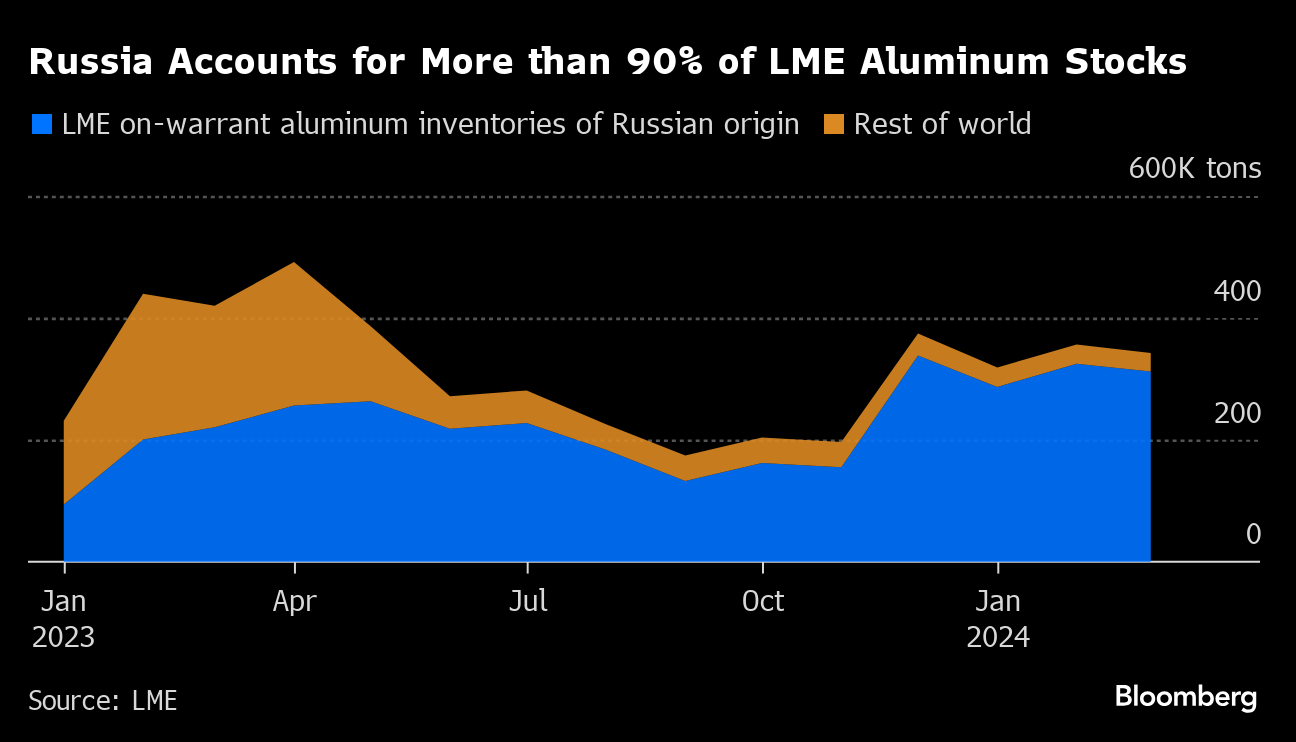
Russian metal already accounted for 91% of LME aluminum stockpiles at the end of March, 62% of copper and 36% of nickel. Traders are now expecting a wave of deliveries of Russian material that was being held outside the LME system, which could now be dumped onto the exchange as its owners worry about the prospect of future restrictions.
Estimates of the amount of Russian aluminum being held outside of the LME system range from a couple of hundred thousand tons to as much as one million tons.
In its notice on Saturday, the LME acknowledged the possibility that the uncertainty caused by the sanctions means “a relatively large supply” of Russian metal could flood onto the exchange.
--With assistance from Andrew Janes and Martin Ritchie.
(Updates with price moves in 17th paragraph)
More stories like this are available on bloomberg.com
©2024 Bloomberg L.P.

-
Getting To Work Costs Women More | The Reason Why

It is not just about women paying more than men. It is about women paying much more in cities than in villages.
-
AI Bias In Investing Cannot Be Eliminated, But It Can Be Governed
Framing is a particularly important example as identical financial information presented in terms of gains rather than losses can lead an LLM to reach a different assessment.
-
Joining The Dots | Dark Skies, Steady Diya: Why Hope Holds This Diwali
With war, a weak rupee and foreign outflows weighing on sentiment, policymakers at the NDTV World Summit and market veterans at NDTV Profit Ignite: Diwali Edition offered the same advice: stay invested and filter out the noise.
-
The Curious Case of Equitas Small Finance Bank And A CEO Who Quit For Stock
PN Vasudevan believes persistent investor concerns over a perceived conflict of interest had become a governance overhang on Equitas Small Finance Bank's stock, even as the lender improved profitability and asset quality.
-
Talking Points This Week: AI Cash Burn, A Tiger Comeback And An India That Still Finds Its Own Path
India is not immune to higher oil or tighter global liquidity, yet its earnings base is broader, its domestic policy levers are still available.
-
Foreign Investors Own Half Of HDFC Bank and ICICI Bank. An LTCG Cut Could Matter Most Here
Foreign portfolio investors have US$115 billion parked in HDFC Bank, ICICI Bank. If the government cuts long-term capital gains tax, Jefferies says returning foreign money could land here first.
-
'Never Seen This Level Of Negativity': Sandeep Tandon Says The Next Rally May Be Closer Than You Think
Veteran investor Sandeep Tandon says foreign selling is easing, large-caps are due a comeback and mid-caps are crowded, while he turns positive on gold, power and pharma this Diwali.
-
Indians Stay With Family, Not In Hotels | The Reason Why
India still lacks enough clean, reliable and affordable hotels for budget-conscious travellers.
-
The Economic Imperative: Analysing The Material Driving Force Behind India-Canada Strategic Reset
This economic complementarity is further reinforced by deep institutional investment ties and talent mobility, which form the bedrock of the bilateral framework.
-
Medicine Pricing: Where Must Profit Stop?
India must confront excessive margins, hidden incentives and regulatory gaps that threaten the integrity of medicine.










