Meta Jumps As Advertising, AI Spending Defy Tariff Concerns

Meta Platforms Inc. quelled Wall Street concerns about the impact of the Trump administration's trade war on advertising sales, reporting first-quarter revenue that beat expectations and forecasting additional spending.
The maker of Facebook and Instagram reported $42.3 billion in first-quarter sales. That beat analysts' estimates for $41.4 billion for the quarter ended March 31. The company also said Wednesday that current-quarter revenue will be in line with analysts' expectations, and that it is responding to the trade war by rethinking suppliers and projecting higher costs for infrastructure.
“We're well positioned to navigate the macroeconomic uncertainty,” Chief Executive Officer Mark Zuckerberg told investors on the company's earnings call.
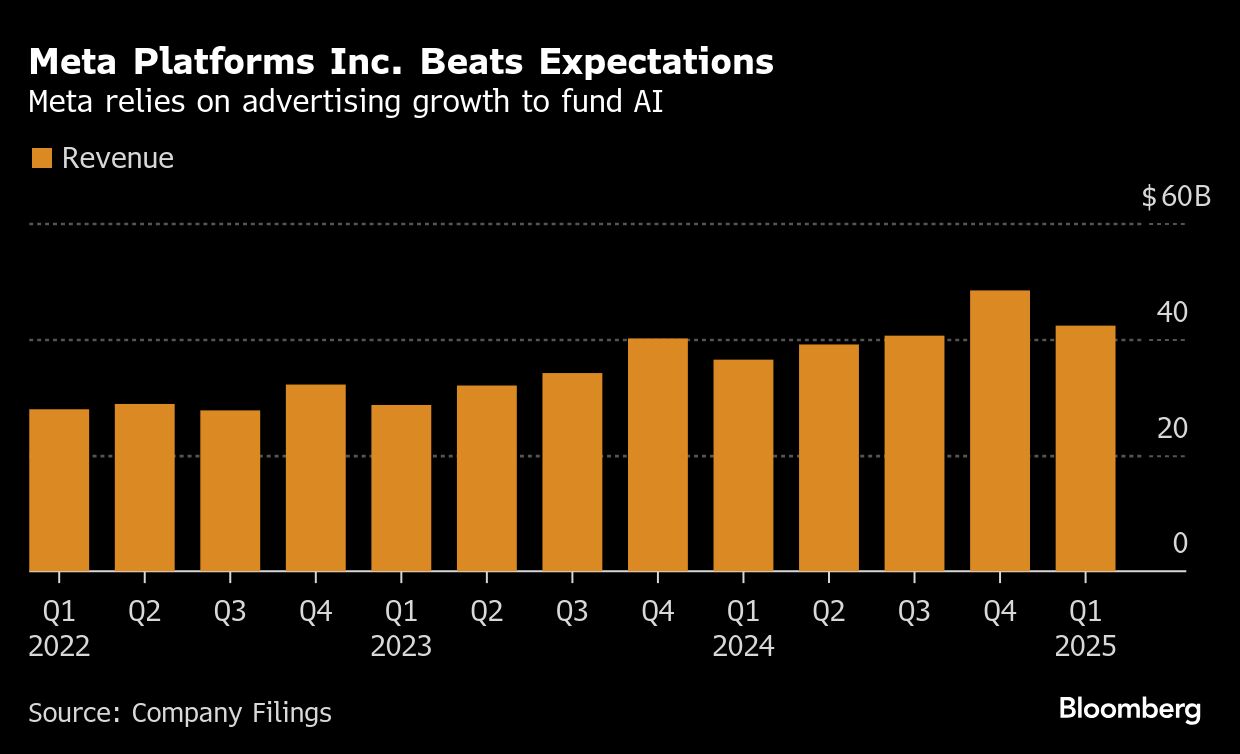
Meta needs its advertising business, which makes up 98% of the company's revenue, to continue growing in order to fund an expensive expansion in artificial intelligence. So far, AI is helping improve ad targeting and personalization of the content people see on social networks. Meta is also investing heavily to keep pace with rivals like OpenAI and Alphabet Inc.'s Google in developing large language models and chatbots.
Meta now expects to spend $64 billion to $72 billion, up from its prior outlook of $60 billion to $65 billion, attributing some of its spending to a wave of tariffs imposed by the Trump administration.
“The higher cost we expect to incur for infrastructure hardware this year really comes from suppliers who source from countries around the world and there's just a lot of uncertainty around this given the ongoing trade discussions,” Chief Financial Officer Susan Li said on the call with investors. Meta is working on mitigating that impact by “optimizing our supply chain.”
Meta shares rose more than 4% in after-hours trading, after closing at $549. Shares of companies that make gear used in AI computing, including Nvidia Corp., also rallied after markets closed in New York. Meta stock was down more than 6% year-to-date before the company reported earnings, but has still performed better than most of America's biggest technology companies amid a market selloff spurred by tariffs.
“While many companies have not been providing forward guidance amid tariff concerns and an uncertain macro environment, Meta did — a bullish sign,” said Andrew Rocco, a stock strategist at Zacks Investment Research. Rocco pointed not just to the company's second-quarter forecast, but also to the increase in the company's expected capital expenditures, which he said was a positive look for the broader AI sector.
Meta reported first-quarter earnings per share of $6.43, up 37% from a year prior and surpassing the average analyst estimate of $5.25. The company's social apps now reach 3.4 billion people around the world each day.
In January, Zuckerberg signaled heavy AI investment ahead, saying the company would ultimately spend hundreds of billions of dollars on the technology. Those plans appear to be on track despite global economic turmoil, and even as Chinese AI companies figure out how to do more with less. Earlier this year, a Chinese company called DeepSeek released a competitive model that it said used cheaper and less powerful chips.
Meta's quarterly results come a day after the company hosted its inaugural LlamaCon conference, which was focused on its AI development efforts. The company's Llama models have been downloaded about 1.2 billion times, Chief Product Officer Chris Cox said at Meta's Menlo Park, California headquarters.
In an effort to further extend the technology's reach, Meta also unveiled a new standalone AI app, called Meta AI, which it hopes will compete with rivals like OpenAI's ChatGPT and give users an easier way to access the product without turning to Facebook, Instagram or WhatsApp.
WhatsApp, which is currently the most common place for users to access Meta AI, isn't the dominant messaging app in the US, Zuckerberg said on the Wednesday earnings call.
“So I think that the Meta AI app as a standalone is going to be particularly important in the United States to establishing leadership,” he said.

-
Indians Are Travelling, But Not Every Journey Is A Holiday | The Week In Whys

Pilgrims, patients and working women are the real travellers, and the system hasn't quite caught up with them.
-
Getting To Work Costs Women More | The Reason Why
It is not just about women paying more than men. It is about women paying much more in cities than in villages.
-
AI Bias In Investing Cannot Be Eliminated, But It Can Be Governed
Framing is a particularly important example as identical financial information presented in terms of gains rather than losses can lead an LLM to reach a different assessment.
-
Joining The Dots | Dark Skies, Steady Diya: Why Hope Holds This Diwali
With war, a weak rupee and foreign outflows weighing on sentiment, policymakers at the NDTV World Summit and market veterans at NDTV Profit Ignite: Diwali Edition offered the same advice: stay invested and filter out the noise.
-
The Curious Case of Equitas Small Finance Bank And A CEO Who Quit For Stock
PN Vasudevan believes persistent investor concerns over a perceived conflict of interest had become a governance overhang on Equitas Small Finance Bank's stock, even as the lender improved profitability and asset quality.
-
Talking Points This Week: AI Cash Burn, A Tiger Comeback And An India That Still Finds Its Own Path
India is not immune to higher oil or tighter global liquidity, yet its earnings base is broader, its domestic policy levers are still available.
-
Foreign Investors Own Half Of HDFC Bank and ICICI Bank. An LTCG Cut Could Matter Most Here
Foreign portfolio investors have US$115 billion parked in HDFC Bank, ICICI Bank. If the government cuts long-term capital gains tax, Jefferies says returning foreign money could land here first.
-
'Never Seen This Level Of Negativity': Sandeep Tandon Says The Next Rally May Be Closer Than You Think
Veteran investor Sandeep Tandon says foreign selling is easing, large-caps are due a comeback and mid-caps are crowded, while he turns positive on gold, power and pharma this Diwali.
-
Indians Stay With Family, Not In Hotels | The Reason Why
India still lacks enough clean, reliable and affordable hotels for budget-conscious travellers.
-
The Economic Imperative: Analysing The Material Driving Force Behind India-Canada Strategic Reset
This economic complementarity is further reinforced by deep institutional investment ties and talent mobility, which form the bedrock of the bilateral framework.










