Media And Entertainment To Become A Rs 2 Lakh Crore Industry By 2020

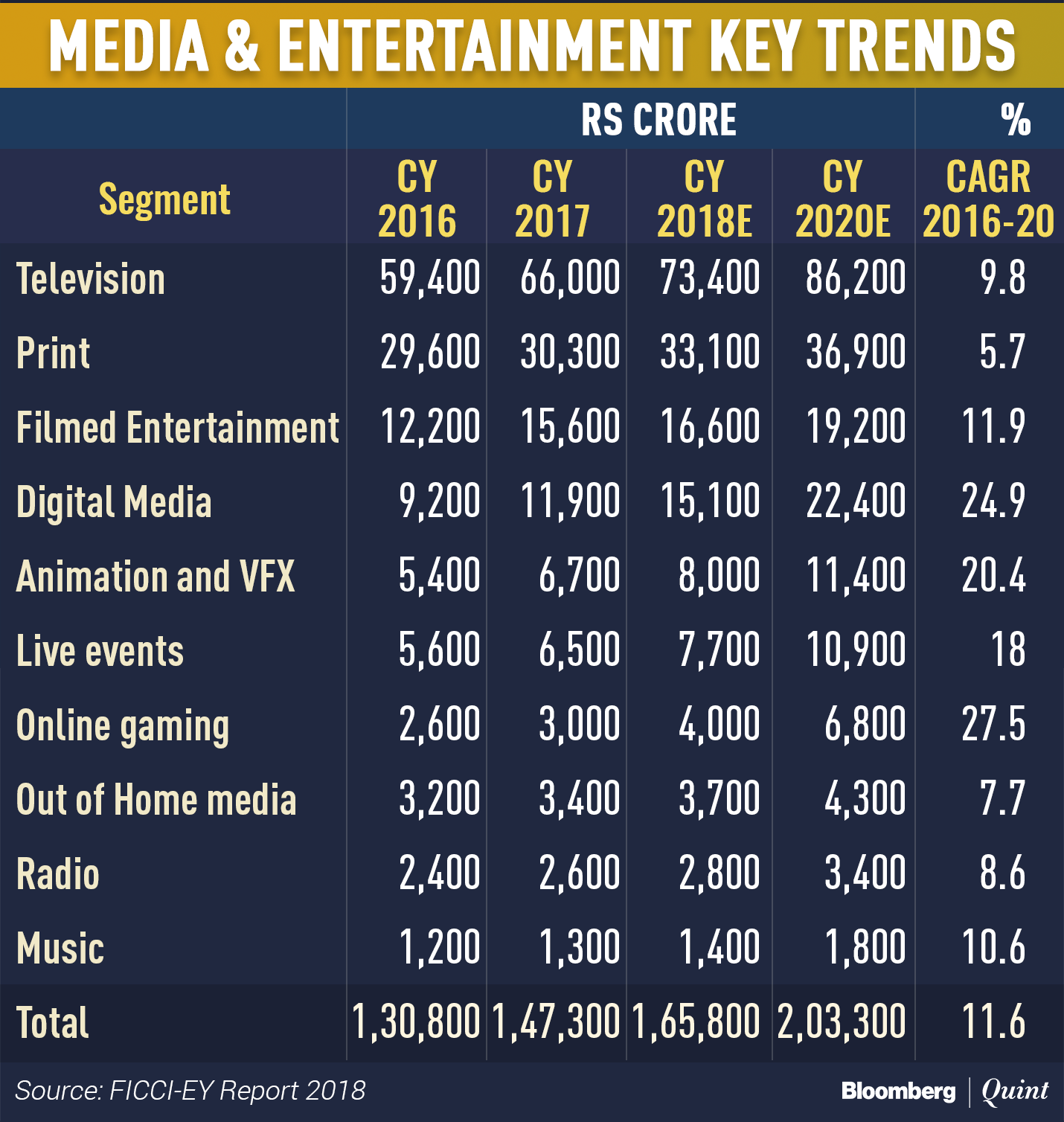
The media and entertainment sector is likely to clock a compounded annual growth rate of 11.6 percent to become Rs 2 lakh crore industry by 2020, riding on the digital wave, says a report.
The industry, which reached about Rs 1.5 lakh crore in 2017, continues to grow faster than the GDP growth rate, reflecting the growing disposable income led by stable economic growth and changing demographics, said the report released by Federation of Indian Chambers of Commerce and Industry along with consulting firm EY yesterday.
Even as subscription growth outpaced advertising in 2017, advertising will continue to grow till 2020 led by digital advertising, it said.
Approximately 15 lakh consumers in India today are digital-only and would not normally use traditional media. That's expected to grow to nearly 40 lakh by 2020, generating significant digital subscription revenues for the sector. It could reach 2 crore households in the next two years.
The Indian media and entertainment industry has been hitting new milestones and has stepped into a matured phase with an annualised growth of 11.6 percent, said Ficci President Rashesh Shah.
The need is to promote India as an entertainment hub to the world, facilitate policy change for the betterment of the Indian M&E industry as well as create and encourage platform for Business-to-Business interface and dialogueRashesh Shah, President, Ficci
Also Read: Reliance Industries To Acquire Stake In Eros International To Boost Digital Content
Last year, the growth was led by the digital, film and animation and visual effects segments, said Ashish Pherwani, partner and media and entertainment advisory leader, EY India. “We expect sectors like digital and gaming to grow between two to three times by 2020.”
Key Highlights
Television
- Grew by 11.2 percent to Rs 66,000 crore in 2017, with advertising growing to Rs 26,700 crore and comprising 40 percent of the revenues and distribution growing to Rs 39,300 crore and making up the remaining 60 percent.
- At the broadcaster level, subscription revenues (including international subscription) made up approximately 28 percent of revenues.
- TV advertising likely to grow to 43 percent of total revenues by 2020 from its current contribution of 41 percent.
- Second largest share of the sector; grew 3 percent to Rs 30,300 crore in 2017.
- Print media is estimated to grow at an overall CAGR of approximately 7 percent till 2020, with vernacular at 8-9 percent and English slightly slower.
- It grew despite the foreign direct investment limit remaining unchanged at 26 percent, restricting access to foreign print players and the imposition of GST at 5 percent on the advertising revenues of the print industry.
- Today, 98 percent of readers read dailies and 20 percent read magazines. Reader base is 39.5 crore, or 38 percent of the population. Readership has grown by 11 crore over the last three years.
- Rural (52 percent) reader base is larger than urban (48 percent).
Films
- Grew the most, 27 percent, in 2017 to reach Rs 15,600 crore with box office collections of the top 50 films growing 11.6 percent.
- Both domestic and international box office revenue contributed to the growth, with phenomenal success of films such as Dangal that grossed about Rs 2,000 crore worldwide, including Rs 1,200 crore in China alone.
- Returns increased from ancillary streams like satellite television and digital, with home video remaining the only segment that failed to display growth.
- While regional cinema drove the growth in terms of the number of releases, Hindi films continue to make up most of the Indian film segment, contributing almost 40 percent of the net domestic box office collections annually, despite comprising only 17 percent of the films made.
- The number of Hindi movies crossing the Rs 100-crore mark was the highest in 2017 in the past five years. Films in 29 other Indian languages, while accounting for 75 percent of the total films released, together contributed only 50 percent to the annual domestic box office earnings.
- Screen count increased marginally—from 9,481 in 2016 to 9,530 in 2017.
Digital Media
- Subscription-based over-the-top streaming services flooded the Indian market over the past two years with around 30 players vying for audiences' attention, including both American Amazon Prime Video and Netflix as well as a host of local platforms like Balaji Telefilms' ALTBalaji and those owned by broadcast networks.
- OTT subscription in India is expected to touch Rs 2,000 crore by 2020. And recent investments by companies such as Reliance Jio that already has stakes in Network18, ALT and movie studio Eros International, will make media convergence a reality.
- About 25 crore people viewed videos online in 2017 and these numbers are expected to double to 50 crore by 2020.
- Around 40 percent of total mobile traffic came from the consumption of video services in 2015 and this figure is expected to touch 72 percent by 2020. Ninety-three percent of time spent on digital videos is in Hindi and other regional languages.
Also Read: INX Media Case: CBI Takes Karti to Mumbai for Further Questioning

-
'Never Seen This Level Of Negativity': Sandeep Tandon Says The Next Rally May Be Closer Than You Think

Veteran investor Sandeep Tandon says foreign selling is easing, large-caps are due a comeback and mid-caps are crowded, while he turns positive on gold, power and pharma this Diwali.
-
Indians Stay With Family, Not In Hotels | The Reason Why
India still lacks enough clean, reliable and affordable hotels for budget-conscious travellers.
-
The Economic Imperative: Analysing The Material Driving Force Behind India-Canada Strategic Reset
This economic complementarity is further reinforced by deep institutional investment ties and talent mobility, which form the bedrock of the bilateral framework.
-
Medicine Pricing: Where Must Profit Stop?
India must confront excessive margins, hidden incentives and regulatory gaps that threaten the integrity of medicine.
-
Why Amazon And Flipkart Are Struggling To Beat Meesho In India's Smaller Cities
With 274 million users and lowest-cost logistics, Meesho is defending its value commerce crown against giants like Amazon and Flipkart.
-
High US Salaries, No Green Card Certainty: The Financial Calculation Facing Indian H-1B Families
The suspension of PERM processing at eight technology employers does not cancel existing H-1B visas. What it does is force a question many Indian families have been avoiding: is the US salary worth tying your career and family plans to one employer?
-
Swiggy vs Eternal: Food Delivery's Two Rivals Are No Longer In The Same Race
Eternal is building a private AI assistant, dark.ai. Swiggy is still working out how to make Instamart pay, with an operating loss of Rs 895 crore in the July-September quarter while Blinkit stayed profitable.
-
Where You Live Shapes How You Get To Work | The Reason Why
Two-wheelers are the most popular way to get to work in India, accounting for nearly 43% of workplace commutes.
-
Unhedged Position: Can India See An Indonesia-Style Time Correction?
The Nifty is trading below levels it first clocked in 2024. Is there, then, as I have suggested in the headline, potential that the current time correction drags on painfully for the next three-five, even ten years?
-
Navigating Friction And Energy Realities: An Analysis Of Marco Rubio's October Visit To India
Occurring at a critical juncture marked by stalled trade negotiations and escalating geopolitical pressures over global energy supplies, the visit offers a profound window into modern US-India relations.










