MAS Financial Services IPO: Here’s All You Need To Know

Non-banking financial company MAS Financial Services Ltd. is looking to raise Rs 460 crore through an initial public offering that opens tomorrow.
Of this, Rs 233 crore will be raised by issuing fresh shares at Rs 456-459 apiece while the rest will be an offer for sale by existing shareholders. At the upper end of the price band, the lender to small businesses and individuals will be valued at Rs 2,510 crore.
Who's Selling Shares?
The Netherlands-based development bank FMO and its German peer DEG will completely exit the company by offloading their stakes in the IPO. Private equity investor Sarva Capital will sell 60 percent. Post the offer, promoter shareholding will fall to 73.2 percent from 80.7 percent.
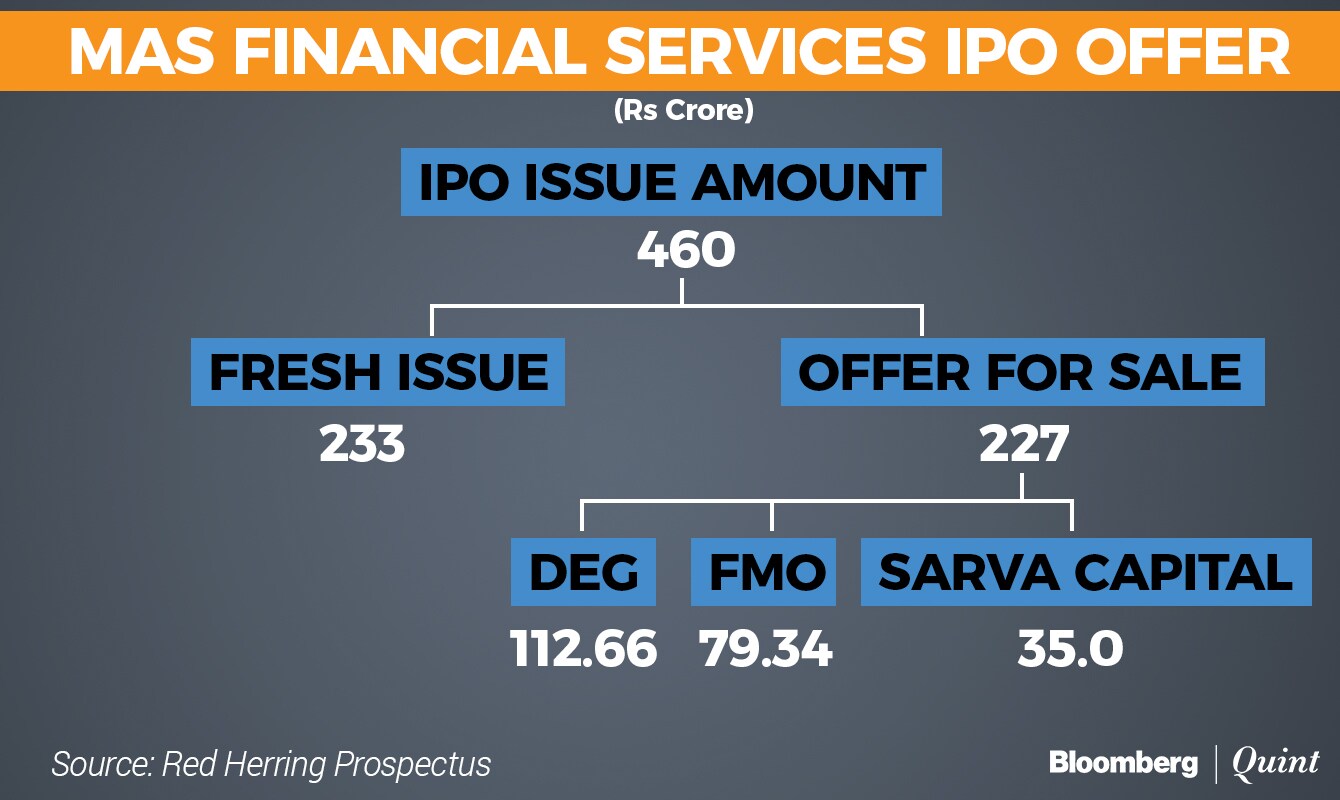
Utilisation Of Funds
The funds raised by issuing new shares will be used to meet future capital requirements.
Business
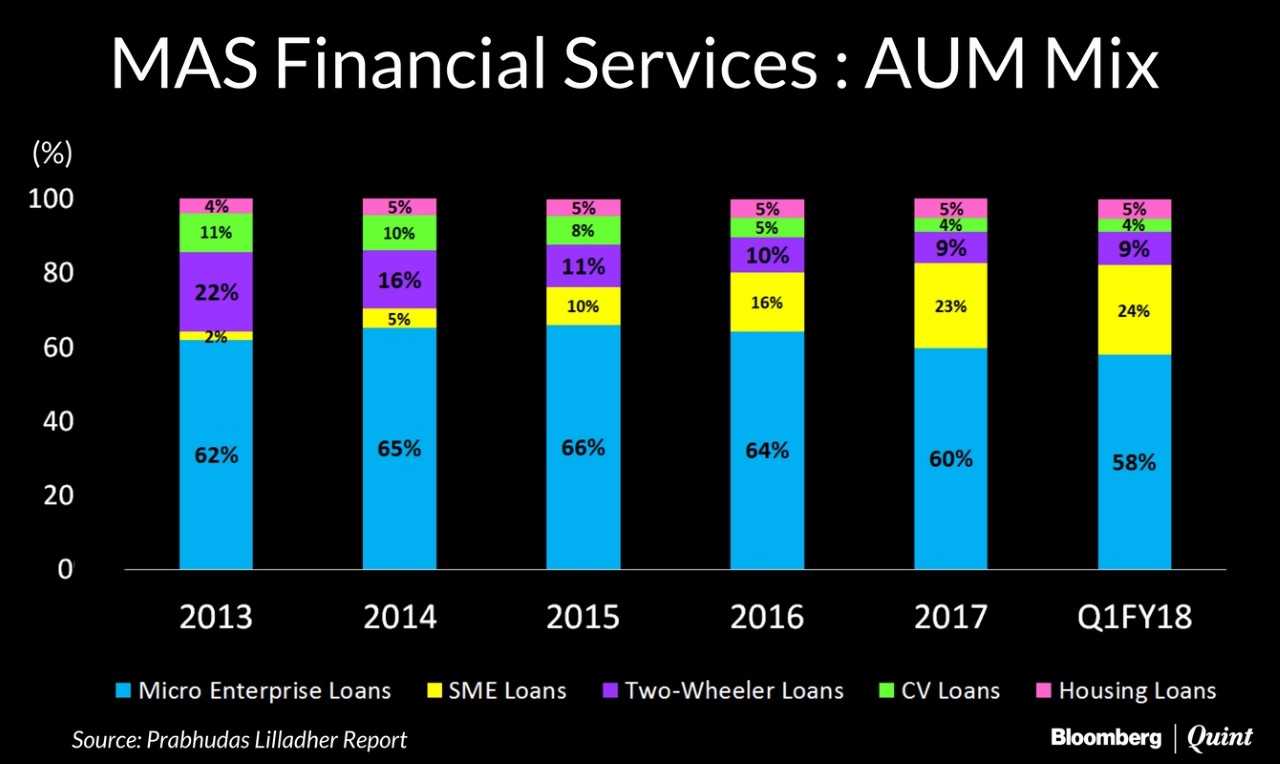
- Incorporated in 1995, MAS Financial provides small and micro enterprise loans, auto loans and housing loans.
- The company's assets under management stood at Rs 3,451 crore as of the first quarter of the financial year 2017-18.
- The micro enterprise loans comprises 58 percent of its total assets.
- It also has a high share of wholesale lending with loans extended to microfinance companies and NBFCs forming 47.7 percent of its assets in the quarter ended June.
- The share of retail loans stood at 52.6 percent in the same period.
- As of June 30, the NBFC had more than 500,000 active loan accounts served through 121 branches.
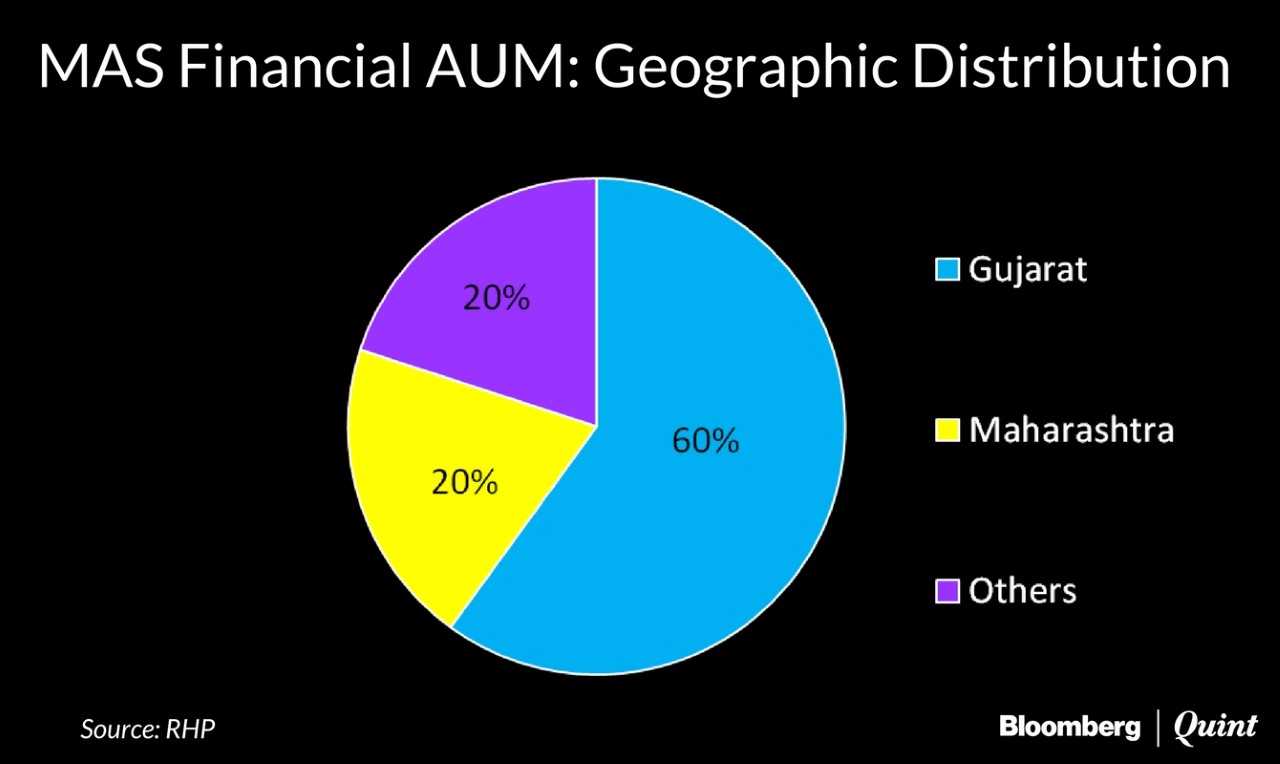
Key Risk
MAS Financial faces geographic concentration risk with 60 percent exposure to Gujarat alone, 20 percent to Maharashtra and the rest coming from other states.
Financial Highlights
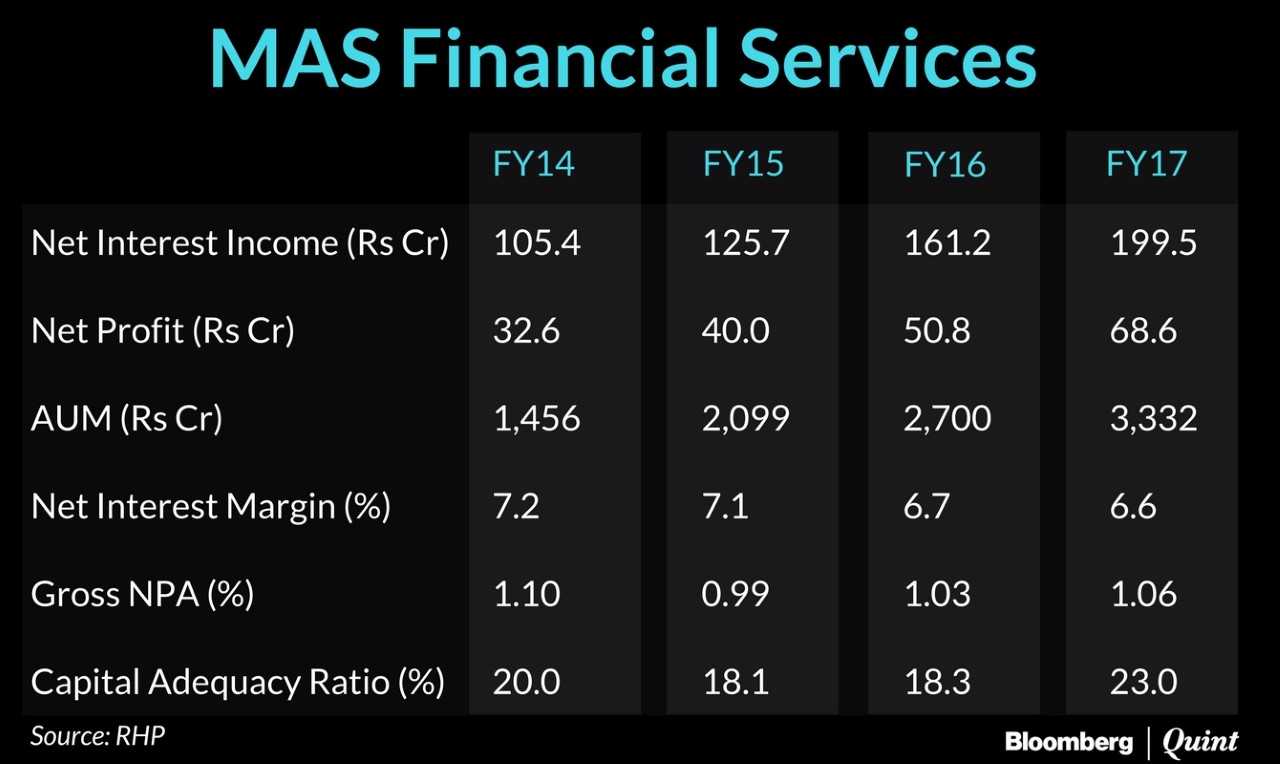
- Net interest income clocked 23 percent compounded annual growth rate in five years to March, while net profit rose at 26 percent.
- Net interest margin stood at 6.6 percent as of March.
- Gross bad loan ratio remained around the 1.1 percent mark in the last five years.
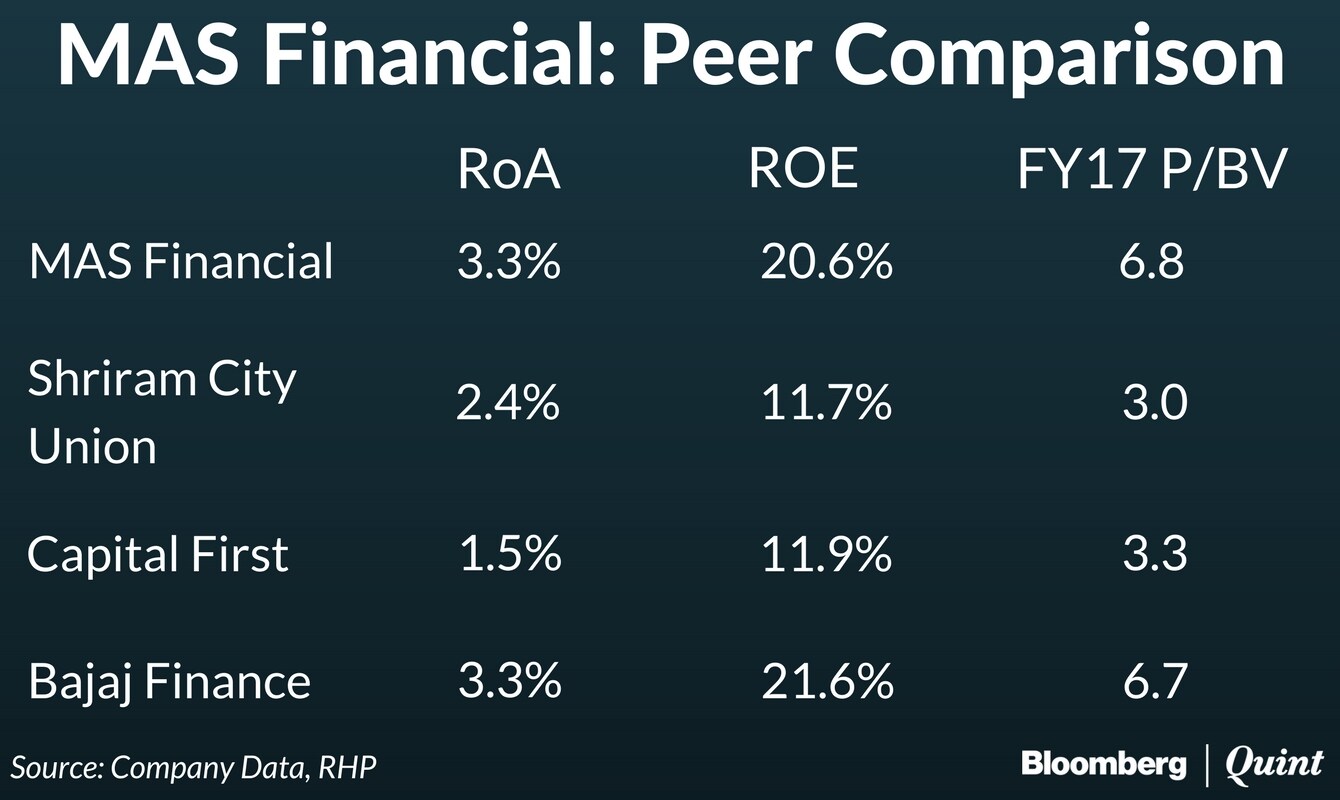
- The company has superior return ratios compared to peers.
- Provision coverage ratio stood at 15 percent.
Peer Comparison
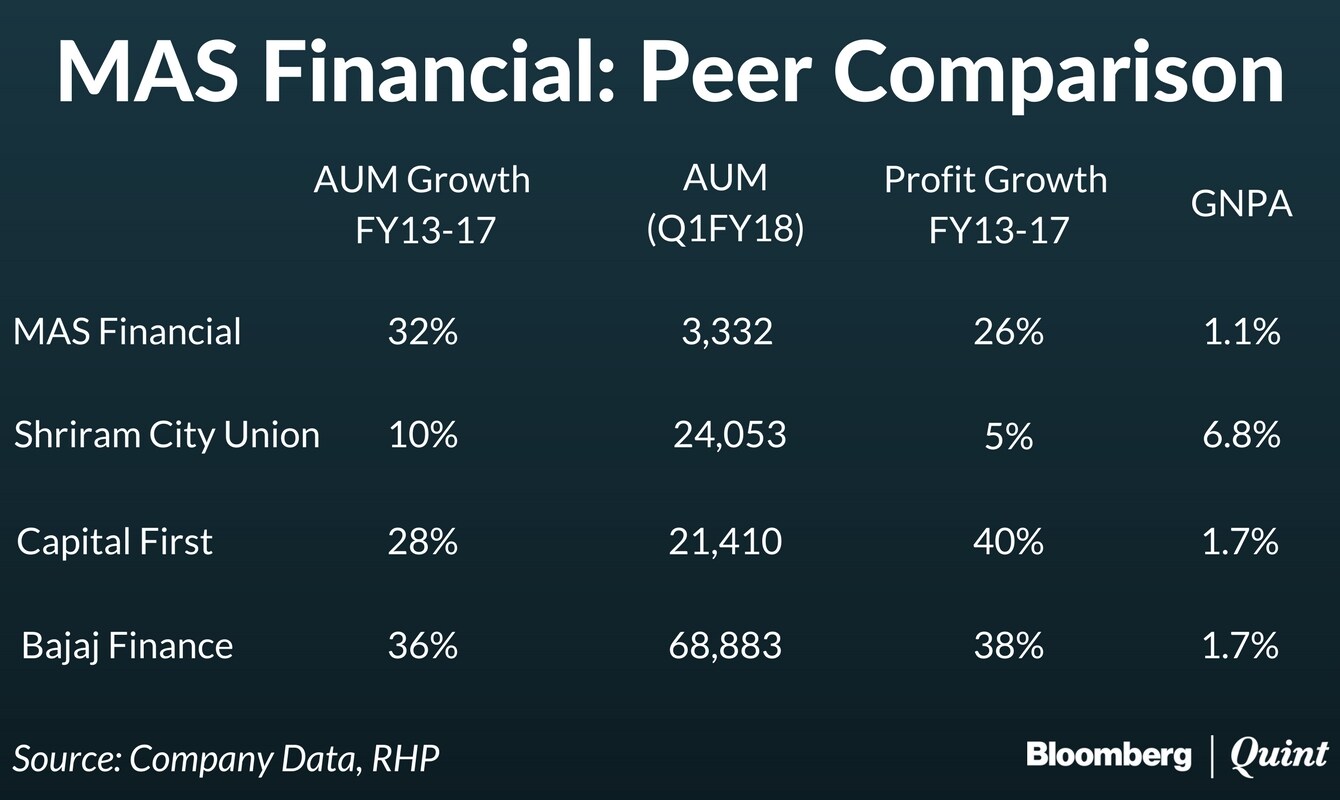
At the upper price band, MAS Financial is valued at 6.8 times its book value for the year to March and at 4 times its book value on a post-dilution basis. That's higher than peers such as Shriram City Union and Capital First and is comparable to that of Bajaj Finance.
Brokerages' Take
Quant Broking
- Recommends ‘Subscribe'.
- Healthy business momentum, prudent management practices and well-diversified presence across developed geographies
- Healthy trends of return ratios.
- Raising considerable capital for expansion purposes.
IIFL Wealth
- Recommends ‘Subscribe'.
- Relatively stable profitability franchise compared to other NBFCs of similar size.
- Valuation at 3.7 times price-to book on a post-money basis; should be palatable for long-term investors.
Prabhudas Lilladher
- Recommends ‘Subscribe'
- Fairly priced compared to peers.
- Superior return ratios.
- Strong lending growth.
Angel Broking
- Recommends ‘Subscribe'
- Valuations are on the higher side.
- Strong and sustainable growth and ROE prospects.

-
Indians Stay With Family, Not In Hotels | The Reason Why

India still lacks enough clean, reliable and affordable hotels for budget-conscious travellers.
-
The Economic Imperative: Analysing The Material Driving Force Behind India-Canada Strategic Reset
This economic complementarity is further reinforced by deep institutional investment ties and talent mobility, which form the bedrock of the bilateral framework.
-
Medicine Pricing: Where Must Profit Stop?
India must confront excessive margins, hidden incentives and regulatory gaps that threaten the integrity of medicine.
-
Why Amazon And Flipkart Are Struggling To Beat Meesho In India's Smaller Cities
With 274 million users and lowest-cost logistics, Meesho is defending its value commerce crown against giants like Amazon and Flipkart.
-
High US Salaries, No Green Card Certainty: The Financial Calculation Facing Indian H-1B Families
The suspension of PERM processing at eight technology employers does not cancel existing H-1B visas. What it does is force a question many Indian families have been avoiding: is the US salary worth tying your career and family plans to one employer?
-
Swiggy vs Eternal: Food Delivery's Two Rivals Are No Longer In The Same Race
Eternal is building a private AI assistant, dark.ai. Swiggy is still working out how to make Instamart pay, with an operating loss of Rs 895 crore in the July-September quarter while Blinkit stayed profitable.
-
Where You Live Shapes How You Get To Work | The Reason Why
Two-wheelers are the most popular way to get to work in India, accounting for nearly 43% of workplace commutes.
-
Unhedged Position: Can India See An Indonesia-Style Time Correction?
The Nifty is trading below levels it first clocked in 2024. Is there, then, as I have suggested in the headline, potential that the current time correction drags on painfully for the next three-five, even ten years?
-
Navigating Friction And Energy Realities: An Analysis Of Marco Rubio's October Visit To India
Occurring at a critical juncture marked by stalled trade negotiations and escalating geopolitical pressures over global energy supplies, the visit offers a profound window into modern US-India relations.
-
India Exports Capital. Why Not Export Trusteeship?
The big question, then, is whether India can build an institution that global borrowers, investors, banks, and lawyers can trust, even without an Indian connection.










