Markets See Fed’s Exit From Quantitative Tightening Nearing

(Bloomberg) -- The Federal Reserve is trying to find the right time to start deliberating about how it will extract itself from its balance sheet unwind, a signal that the end might be closer than previously expected.
In the minutes of last month's Federal Open Market Committee meeting, several participants suggested it would be appropriate to begin discussing the technical factors that would determine when the US central bank slows the pace of its balance sheet runoff, a process known as quantitative tightening. Participants remarked the Committee's plans indicated it would slow and then stop shrinking its balance sheet when reserve balances are “somewhat above the level judged consistent with ample reserves.”
A debate has been simmering in recent months over whether the Fed is misjudging how much it can tighten without causing dislocations in places like the market for overnight repurchase agreements, part of the essential plumbing of the financial system.
Read more: How Fed's Quantitative Tightening Is Going This Time: QuickTake
While bank reserves — currently at $3.48 trillion — are well above the levels seen when the Fed started unwinding its balance sheet in 2022, there's concern that the amount of reserves is not as abundant as policymakers believe. Central bankers in 2019 learned a lesson when a different overnight market rate soared five-fold to as high as 10% and the central bank was forced to intervene.
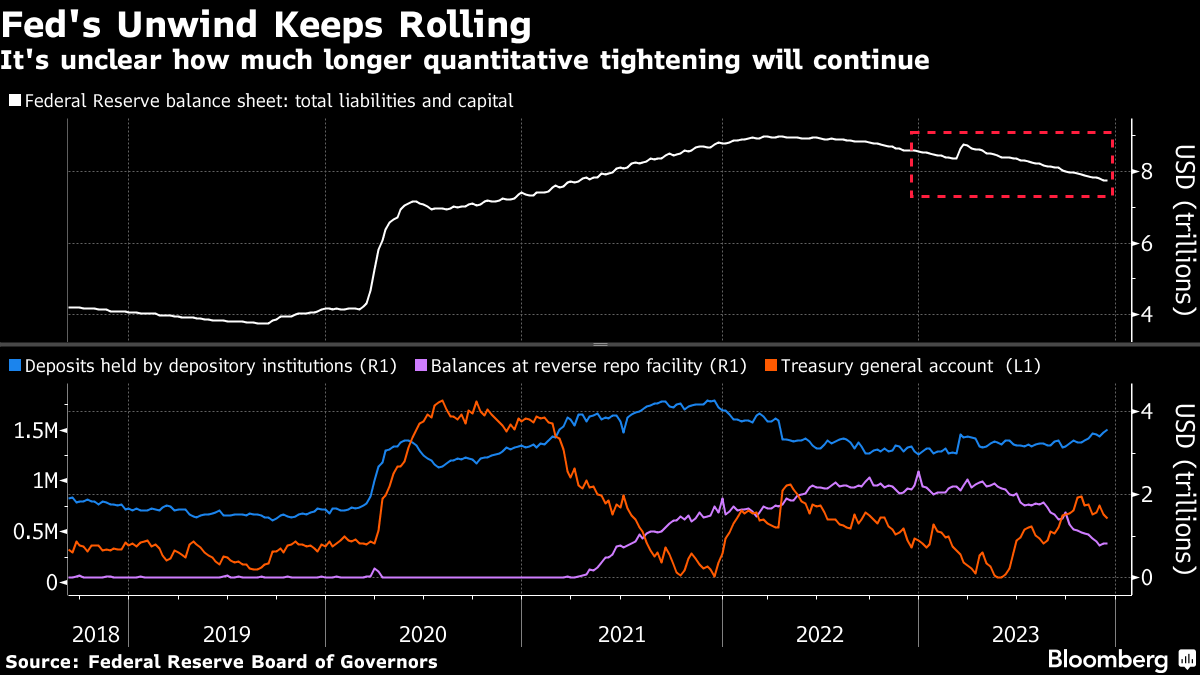
“As they say, everyone has a plan until they get hit,” said Blake Gwinn, head of US interest rate strategy at RBC Capital Markets, which sees the Fed winding down QT in mid-2024. “The last go-round they got ‘hit' by the September 2019 repo blowout and immediately reversed course,” Gwinn said.
For over 18 months, the Fed has been letting as much as $60 billion in Treasuries and as much as $35 billion in agency debt holdings mature every month.
The last time the central bank attempted to halt its balance sheet unwind in 2019, it was only letting as much as $30 billion in Treasuries and as much as $20 billion in agency debt run off — nearly half the size of the current plan. In May of that year, the Fed slashed the reinvestment cap for Treasuries to $15 billion before eliminating the limit entirely in August, while continuing to let its mortgage-backed securities holdings roll down.
Even before that, money market rates had already been signaling that reserves were scarce. The effective fed funds rate — the central bank's policy target — was moving higher, along with other short-term rates, and required policymakers to adjust their tools in order to maintain control.
Recently, after roughly four years of orderly trading — with banks and fund managers locking in funding at the end of each month, quarter and year — volatility has erupted again. Gyrations in repo rates sent one benchmark to a record in the past week, while the market for short-term loans collateralized by Treasuries fluctuated.
To be sure, the latest disruptions were of a lesser degree than those four years ago and required no intervention. Still, the recent episodes shine a light on the increasingly delicate balance between the Fed, banks and other institutions that helps the overnight funding market function properly.
Volatility in short-term funding markets can hinder central bankers' ability to manage monetary policy. Funding dysfunction also poses risks to the broader economy by potentially pressuring borrowing costs for the government and beyond — at a time when benchmark interest rates in the US are already at two-decade highs.
“The Fed is like a scout: they always want to be prepared,” said Gennadiy Goldberg, head of US interest rate strategy at TD Securities. “On the one hand, the earlier prep for ending QT is a good thing. On the other, they have to figure out how to do so without signaling to markets that the end of QT is nigh,” Goldberg said.
More stories like this are available on bloomberg.com
©2024 Bloomberg L.P.

-
Getting To Work Costs Women More | The Reason Why

It is not just about women paying more than men. It is about women paying much more in cities than in villages.
-
AI Bias In Investing Cannot Be Eliminated, But It Can Be Governed
Framing is a particularly important example as identical financial information presented in terms of gains rather than losses can lead an LLM to reach a different assessment.
-
Joining The Dots | Dark Skies, Steady Diya: Why Hope Holds This Diwali
With war, a weak rupee and foreign outflows weighing on sentiment, policymakers at the NDTV World Summit and market veterans at NDTV Profit Ignite: Diwali Edition offered the same advice: stay invested and filter out the noise.
-
The Curious Case of Equitas Small Finance Bank And A CEO Who Quit For Stock
PN Vasudevan believes persistent investor concerns over a perceived conflict of interest had become a governance overhang on Equitas Small Finance Bank's stock, even as the lender improved profitability and asset quality.
-
Talking Points This Week: AI Cash Burn, A Tiger Comeback And An India That Still Finds Its Own Path
India is not immune to higher oil or tighter global liquidity, yet its earnings base is broader, its domestic policy levers are still available.
-
Foreign Investors Own Half Of HDFC Bank and ICICI Bank. An LTCG Cut Could Matter Most Here
Foreign portfolio investors have US$115 billion parked in HDFC Bank, ICICI Bank. If the government cuts long-term capital gains tax, Jefferies says returning foreign money could land here first.
-
'Never Seen This Level Of Negativity': Sandeep Tandon Says The Next Rally May Be Closer Than You Think
Veteran investor Sandeep Tandon says foreign selling is easing, large-caps are due a comeback and mid-caps are crowded, while he turns positive on gold, power and pharma this Diwali.
-
Indians Stay With Family, Not In Hotels | The Reason Why
India still lacks enough clean, reliable and affordable hotels for budget-conscious travellers.
-
The Economic Imperative: Analysing The Material Driving Force Behind India-Canada Strategic Reset
This economic complementarity is further reinforced by deep institutional investment ties and talent mobility, which form the bedrock of the bilateral framework.
-
Medicine Pricing: Where Must Profit Stop?
India must confront excessive margins, hidden incentives and regulatory gaps that threaten the integrity of medicine.










