A ‘Clerical Error’ In Lyft’s Outlook Triggered 67% Stock Run-Up
(Bloomberg) -- It was, without a doubt, a strong earnings report.
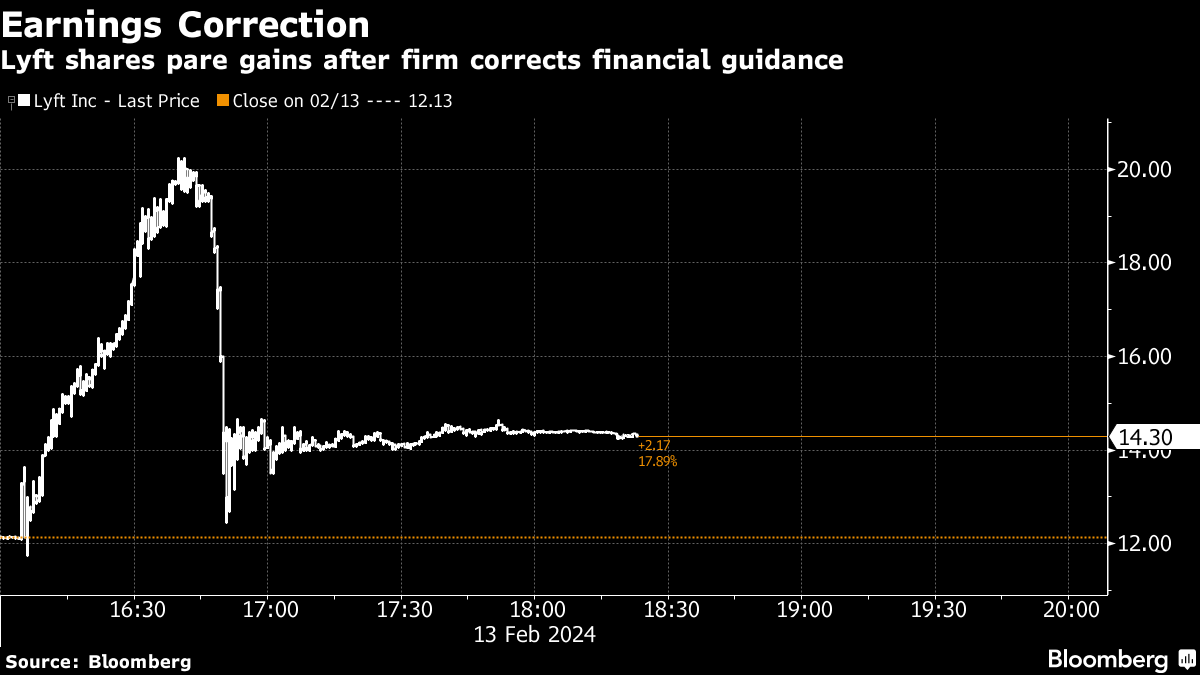
Lyft Inc. projected adjusted earnings as much as 11% higher than analysts' estimates, and reported bookings ahead of expectations. And then there was the outlook for profitability: Margins, the ride-hailing provider said in an initial press release, were set to expand this year by an eye-watering 500 basis points. Shares surged 67% in after-hours trading, a move that could've nearly doubled Lyft's market value if it had held up.
But the projection was off. Way off.
Less than an hour after issuing the statement, Lyft Chief Financial Officer Erin Brewer joined a call with analysts and said the company is actually expecting margins to expand by 50 basis points — not 500 — acknowledging, when asked by an analyst, that the press release was incorrect. A company spokesperson later attributed the mistake to a “clerical error” and noted the figure would be corrected in filings. It was unclear when the revisions would be filed, but shares almost immediately began giving up gains. By 8 p.m. New York time, they were largely unchanged, raising the potential for market complaints.
It's a “black-eye moment” for Lyft, said Dan Ives, an analyst at Wedbush Securities, “a debacle of epic proportions.” He said by email that he'd “never seen an error like this in my almost 25 years on the Street.”
The mistake overshadowed what was otherwise a solid beat on profit and bookings projections that signaled a years-long effort to boost ridership and challenge Uber Technologies Inc. may be paying off.
In fact, both Lyft and Uber delivered strong earnings reports this quarter, suggesting continued growth in overall rider demand since a nationwide plunge during the pandemic. The two have spent fiercely to recruit and retain enough drivers to meet the rise in orders. Lyft Chief Executive Officer David Risher, who took the helm less than a year ago, has focused the operations on customer satisfaction and has emphasized a return to the basics in an effort to close the gap with Uber. Lyft has spent millions of dollars to lure drivers but has had a hard time boosting its rider base.
“Lyft clearly did one thing right – it corrected the error quickly and decisively,” said Brad Foster, a partner specializing in securities litigation at corporate law firm Haynes Boone. “The reality is that people make mistakes, and mistakes are not securities fraud.”
Gross Bookings
In the fourth quarter, Lyft said gross bookings jumped 17% from a year earlier to $3.72 billion, ahead of estimates for $3.67 billion. Revenue was $1.22 billion, up 4% from a year earlier and in line with projections. And it projected adjusted earnings of as much as $55 million in the first three months of the year, topping analysts' estimates of $49.5 million.
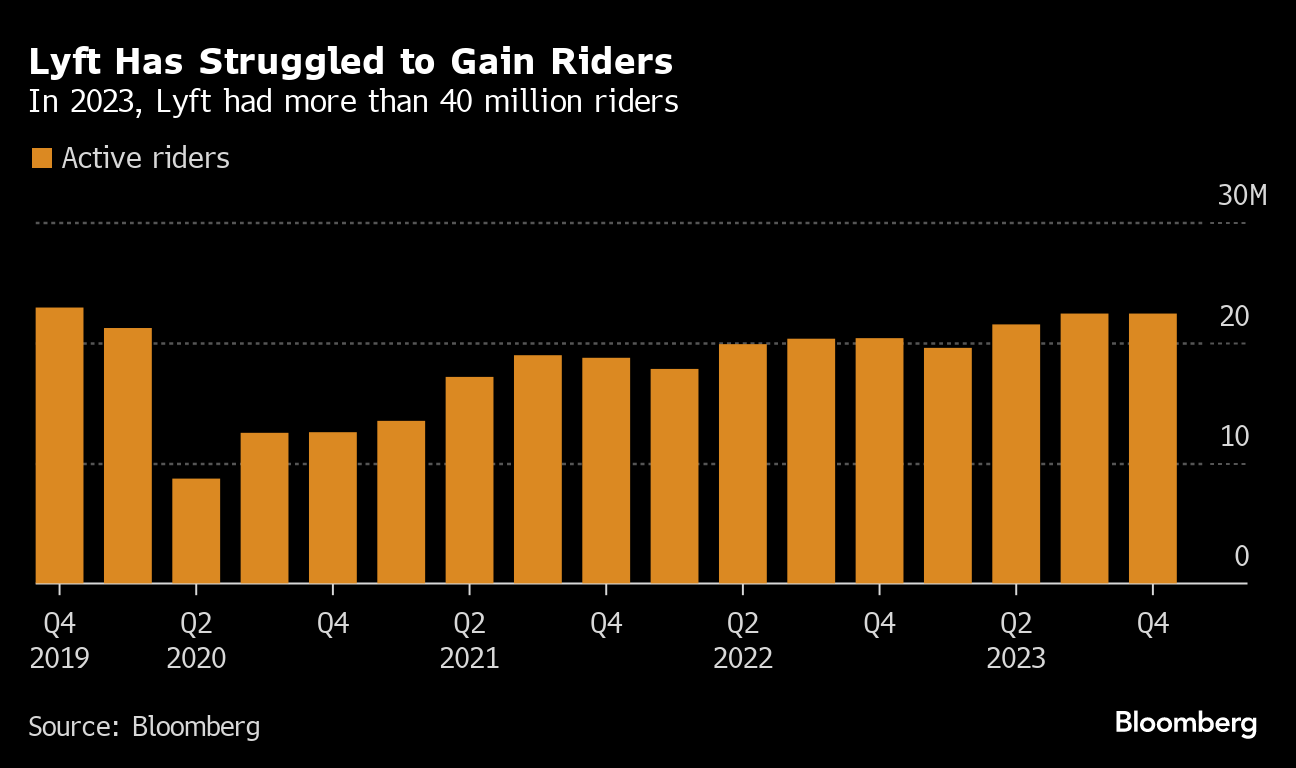
Lyft said the number of active riders on its platform increased 10% in the fourth quarter from a year earlier to 22.4 million. Last year, Lyft had more than 40 million riders, the highest annual ridership in its history.
“We've entered 2024 with a lot of momentum and a clear focus on operational excellence,” CFO Brewer said, positioning the company to “drive meaningful margin expansion and our first full-year of positive free cash flow.”
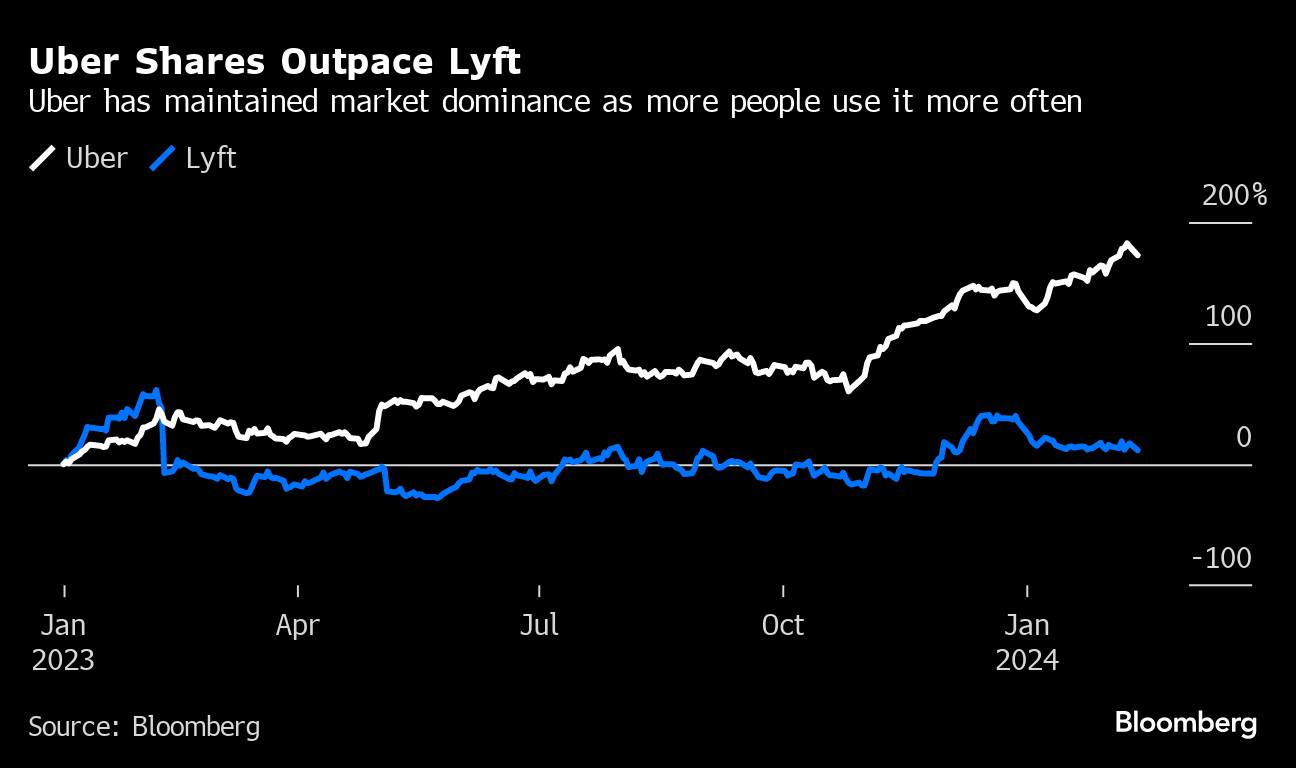
But Lyft still lags behind Uber. According to market research firm YipitData, the company has held around 30% of the US rideshare market compared with 70% for Uber since the second quarter of 2022. Last week, Uber reported its full year of profit as a public company and said trips rose 24% in the quarter to 2.6 billion.
Stabilizing its market share is a critical first step for Lyft in building investors' confidence “in the long-term story,” analysts at Jeffries Capital Management LLC wrote before the company's results were released.
Lyft said adjusted earnings before interest, tax, depreciation and amortization were $66.6 million in the fourth quarter, beating the $56 million estimated by analysts. It reported a net loss of $26.3 million.
Lyft has been making efforts to recruit more drivers and riders to its platform. One project that's gained traction is the Women+ Connect program, which matches women and non-binary drivers and riders. Since the initiative's launch in September, 67% of eligible drivers have opted in and kept the feature on 99% of the time, Lyft said.
The company launched in-app video ads in the fourth quarter, and its media revenue in that period exceeded the level achieved in all of 2022, it said, without giving an exact amount.
And, like many areas of the US economy, Lyft also saw a Taylor Swift bump. High-attendance stadium events such as concerts by Swift and Beyonce, the US Open and football games helped boost rides by 35%, Lyft said.
As part of efforts to retain drivers and promote pay transparency, Lyft earlier this month said drivers will earn at least 70% of the amount that riders pay each week, excluding external fees.
But workers say it doesn't go far enough. Drivers for Uber and Lyft are preparing to strike on Valentine's Day on Wednesday, to call attention to low pay and what they claim is poor treatment by the app companies, according to a coalition representing drivers.
Both Uber and Lyft drivers are considered independent contractors rather than employees, which has driven criticism from states such as New York, Massachusetts and California. Last November, both companies agreed to pay New York drivers a total of $328 million to prevent further litigation over whether drivers should be classified as employees with traditional legal protections.
--With assistance from Natalie Lung.
More stories like this are available on bloomberg.com
©2024 Bloomberg L.P.

-
Getting To Work Costs Women More | The Reason Why

It is not just about women paying more than men. It is about women paying much more in cities than in villages.
-
AI Bias In Investing Cannot Be Eliminated, But It Can Be Governed
Framing is a particularly important example as identical financial information presented in terms of gains rather than losses can lead an LLM to reach a different assessment.
-
Joining The Dots | Dark Skies, Steady Diya: Why Hope Holds This Diwali
With war, a weak rupee and foreign outflows weighing on sentiment, policymakers at the NDTV World Summit and market veterans at NDTV Profit Ignite: Diwali Edition offered the same advice: stay invested and filter out the noise.
-
The Curious Case of Equitas Small Finance Bank And A CEO Who Quit For Stock
PN Vasudevan believes persistent investor concerns over a perceived conflict of interest had become a governance overhang on Equitas Small Finance Bank's stock, even as the lender improved profitability and asset quality.
-
Talking Points This Week: AI Cash Burn, A Tiger Comeback And An India That Still Finds Its Own Path
India is not immune to higher oil or tighter global liquidity, yet its earnings base is broader, its domestic policy levers are still available.
-
Foreign Investors Own Half Of HDFC Bank and ICICI Bank. An LTCG Cut Could Matter Most Here
Foreign portfolio investors have US$115 billion parked in HDFC Bank, ICICI Bank. If the government cuts long-term capital gains tax, Jefferies says returning foreign money could land here first.
-
'Never Seen This Level Of Negativity': Sandeep Tandon Says The Next Rally May Be Closer Than You Think
Veteran investor Sandeep Tandon says foreign selling is easing, large-caps are due a comeback and mid-caps are crowded, while he turns positive on gold, power and pharma this Diwali.
-
Indians Stay With Family, Not In Hotels | The Reason Why
India still lacks enough clean, reliable and affordable hotels for budget-conscious travellers.
-
The Economic Imperative: Analysing The Material Driving Force Behind India-Canada Strategic Reset
This economic complementarity is further reinforced by deep institutional investment ties and talent mobility, which form the bedrock of the bilateral framework.
-
Medicine Pricing: Where Must Profit Stop?
India must confront excessive margins, hidden incentives and regulatory gaps that threaten the integrity of medicine.










