Oil Languishes Near Five-Month Low After Plunging On Glut Fears

(Bloomberg) -- Oil held the bulk of a five-day run of losses that drove prices to the lowest since June on signs that global supplies are eclipsing demand despite plans by OPEC+ to rein in its production into 2024.
Global benchmark Brent edged higher toward $75 a barrel after slumping by 11% in the longest losing run since February. West Texas Intermediate was below $70. Official US data showed another build in crude inventories at the Cushing hub, while oil output held near a record and gasoline demand softened. Widely watched market timespreads are indicating ample near-term supplies.
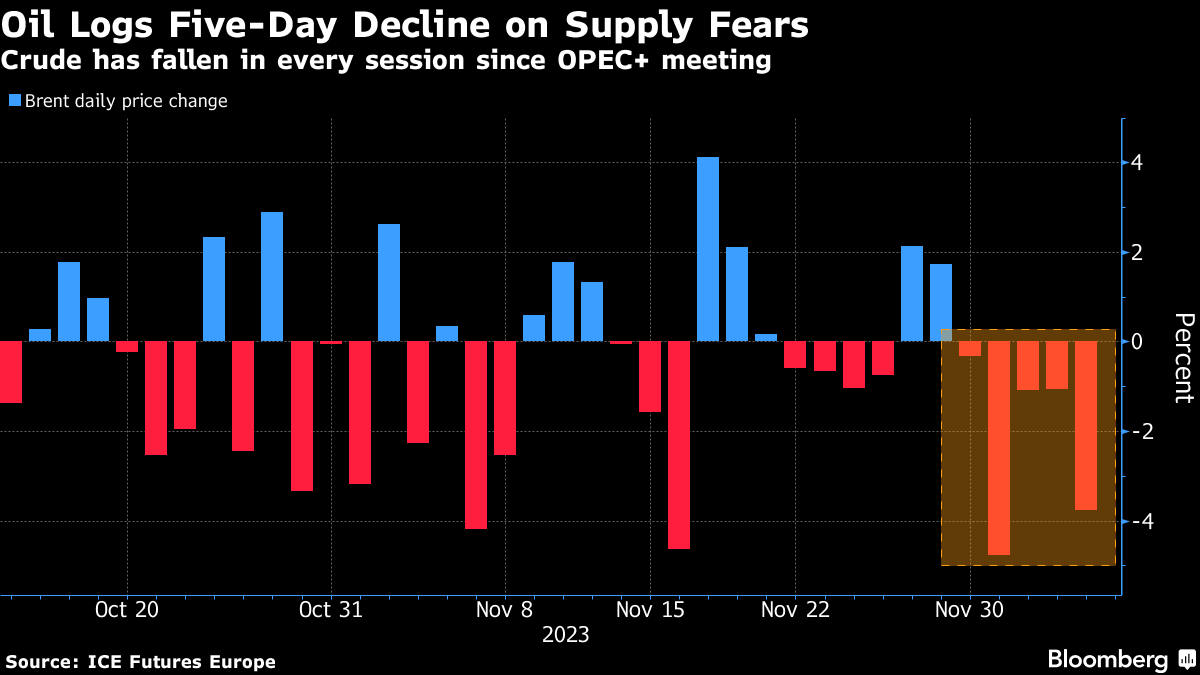
Crude's slide — which helped drag an overall commodity gauge to the lowest since 2021 — has come despite a deal forged last week by the Organization of Petroleum Exporting Countries and its allies to deepen output cuts. Futures have dropped by about a quarter from a peak in September on concern that increased production from outside the group will outstrip demand, while there's speculation OPEC+ members themselves may not fully adhere to the curbs.
A procession of the alliance's producers have made the case that their latest agreement will stick and could be extended. Saudi Arabia said earlier this week that cuts can “absolutely” stay past March, with similar remarks from Russia. While Algeria and Kuwait added to the chorus, crude remains under pressure.
“Markets seem to be completely sidelining” the OPEC+ measures, said Priyanka Sachdeva, senior market analyst at brokerage Phillip Nova Pte in Singapore. In addition, a downgrade of China's outlook by Moody's Investors Service has added to a weakening outlook in the top crude importer, she said.
The agency cut its outlook for Chinese sovereign bonds to negative in a midweek statement, prompting some pushback from China. Meanwhile, data showed that its imports of crude fell last month to the lowest since April as local refiners grappled with limits on fuel exports and poor margins.
Reflecting the wider market's softness, key metrics have been weakening, with Brent and WTI both in contango, where later-dated contracts trading at premiums to nearer ones, all the way out to the middle of next year. Brent's three-month timespread was 19 cents a barrel in contango; a month ago it was 86 cents in backwardation, the opposite bullish pattern.
Oil's selloff could boost the chances that OPEC+ may call an emergency meeting within the next few weeks, according to Citigroup Inc. The market has been “very disappointed” with the group's latest set of measures, which came against a weakening backdrop, the bank's analysts said in a note.
The weekly supply-and-demand snapshot from the US Energy Information Administration raised some eyebrows among market watchers. The figures showed lower exports, although ship-tracking data has suggested robust if not record flows. In addition, the so-called adjustment factor — akin to a margin of error — was the biggest on record.
More stories like this are available on bloomberg.com
©2023 Bloomberg L.P.

-
'Never Seen This Level Of Negativity': Sandeep Tandon Says The Next Rally May Be Closer Than You Think

Veteran investor Sandeep Tandon says foreign selling is easing, large-caps are due a comeback and mid-caps are crowded, while he turns positive on gold, power and pharma this Diwali.
-
Indians Stay With Family, Not In Hotels | The Reason Why
India still lacks enough clean, reliable and affordable hotels for budget-conscious travellers.
-
The Economic Imperative: Analysing The Material Driving Force Behind India-Canada Strategic Reset
This economic complementarity is further reinforced by deep institutional investment ties and talent mobility, which form the bedrock of the bilateral framework.
-
Medicine Pricing: Where Must Profit Stop?
India must confront excessive margins, hidden incentives and regulatory gaps that threaten the integrity of medicine.
-
Why Amazon And Flipkart Are Struggling To Beat Meesho In India's Smaller Cities
With 274 million users and lowest-cost logistics, Meesho is defending its value commerce crown against giants like Amazon and Flipkart.
-
High US Salaries, No Green Card Certainty: The Financial Calculation Facing Indian H-1B Families
The suspension of PERM processing at eight technology employers does not cancel existing H-1B visas. What it does is force a question many Indian families have been avoiding: is the US salary worth tying your career and family plans to one employer?
-
Swiggy vs Eternal: Food Delivery's Two Rivals Are No Longer In The Same Race
Eternal is building a private AI assistant, dark.ai. Swiggy is still working out how to make Instamart pay, with an operating loss of Rs 895 crore in the July-September quarter while Blinkit stayed profitable.
-
Where You Live Shapes How You Get To Work | The Reason Why
Two-wheelers are the most popular way to get to work in India, accounting for nearly 43% of workplace commutes.
-
Unhedged Position: Can India See An Indonesia-Style Time Correction?
The Nifty is trading below levels it first clocked in 2024. Is there, then, as I have suggested in the headline, potential that the current time correction drags on painfully for the next three-five, even ten years?
-
Navigating Friction And Energy Realities: An Analysis Of Marco Rubio's October Visit To India
Occurring at a critical juncture marked by stalled trade negotiations and escalating geopolitical pressures over global energy supplies, the visit offers a profound window into modern US-India relations.










