Jindal Saw Share Price Declines On Lackluster Q3 Earnings
.jpg?downsize=1010:568 "Jindal Saw Share Price Declines On Lackluster Q3 Earnings")
Jindal Saw Ltd.'s share price declined by 3.67% following the company's report of disappointing earnings for the third quarter of fiscal year 2024-25. Despite a slight increase in net profit, the company's overall performance showed signs of weakness as revenues and Ebitda both declined.
For the quarter ending December 31, 2024, Jindal Saw reported a 6.8% drop in revenue, which stood at Rs 5,271 crore compared to Rs 5,651 crore in the same period last year.
On a positive note, the company saw a marginal increase of 0.2% in the net profit, which rose to Rs 527 crore from Rs 526 crore in the previous year. However, this slight profit growth could not offset the overall weakness in other key financial metrics.
The company's earnings before interest, taxes, depreciation, and amortisation also showed a decline of 5%, falling to Rs 939 crore from Rs 987 crore in the corresponding quarter last year. The Ebitda margin saw a modest improvement, rising to 17.8% from 17.5% in the previous year.
The decline in sales and muted profit growth contributed to the drop in Jindal Saw's share price, signaling investor concern over the company's short-term performance amidst a fluctuating market environment.
Jindal Saw Ltd. is an Indian manufacturer and supplier of iron and steel pipes and pellets. It is a subsidiary of the O.P. Jindal Group, a prominent steel producer and exporter in India.
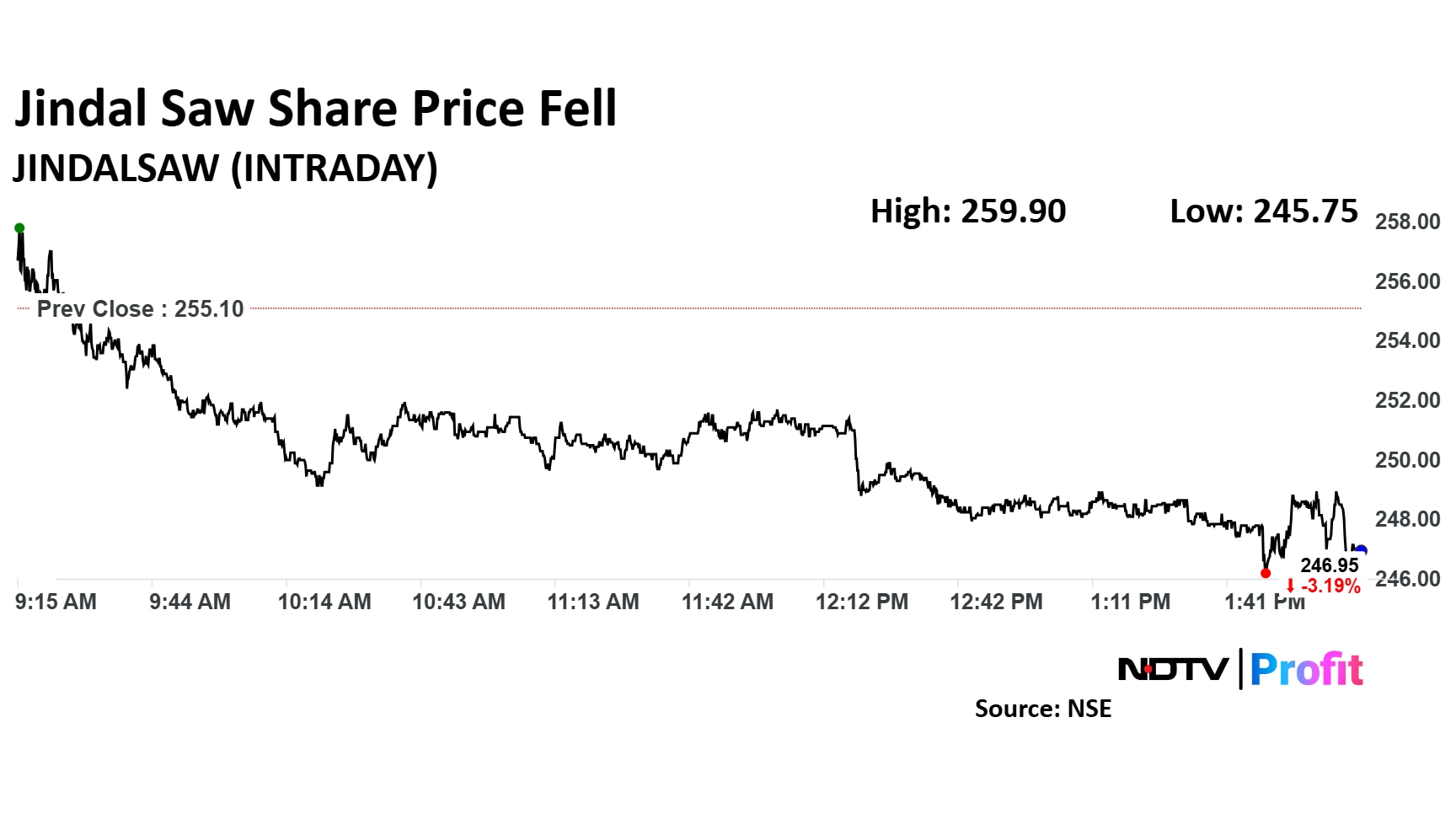
The scrip fell as much as 3.67% to Rs 245.75 apiece. It pared losses to trade 2.59% lower at Rs 248.50 apiece, as of 2:07 p.m.
It has risen 0.50% in the last 12 months. Total traded volume so far in the day stood at 0.6 times its 30-day average. The relative strength index was at 33.
The three analysts tracking the company maintain a 'buy' rating, according to Bloomberg data. The average 12-month consensus price target implies an upside of 82.7%.

-
Getting To Work Costs Women More | The Reason Why

It is not just about women paying more than men. It is about women paying much more in cities than in villages.
-
AI Bias In Investing Cannot Be Eliminated, But It Can Be Governed
Framing is a particularly important example as identical financial information presented in terms of gains rather than losses can lead an LLM to reach a different assessment.
-
Joining The Dots | Dark Skies, Steady Diya: Why Hope Holds This Diwali
With war, a weak rupee and foreign outflows weighing on sentiment, policymakers at the NDTV World Summit and market veterans at NDTV Profit Ignite: Diwali Edition offered the same advice: stay invested and filter out the noise.
-
The Curious Case of Equitas Small Finance Bank And A CEO Who Quit For Stock
PN Vasudevan believes persistent investor concerns over a perceived conflict of interest had become a governance overhang on Equitas Small Finance Bank's stock, even as the lender improved profitability and asset quality.
-
Talking Points This Week: AI Cash Burn, A Tiger Comeback And An India That Still Finds Its Own Path
India is not immune to higher oil or tighter global liquidity, yet its earnings base is broader, its domestic policy levers are still available.
-
Foreign Investors Own Half Of HDFC Bank and ICICI Bank. An LTCG Cut Could Matter Most Here
Foreign portfolio investors have US$115 billion parked in HDFC Bank, ICICI Bank. If the government cuts long-term capital gains tax, Jefferies says returning foreign money could land here first.
-
Why Prashant Jain's 3P Investment Managers Bought 2.5% Stake In This Healthcare Firm
After slowing acquisitions, Entero now has the opportunity to extract greater value from the network. The key, however, will be execution.
-
Taxing A Promise: The Unsettled Story Of GST On Corporate Guarantees
These concerns are particularly relevant for businesses in the infrastructure, real estate, power and EPC sectors, where guarantees run for several years over the duration of the project and involve substantial amounts.
-
Who Will Care When Women Work? That Is The Wrong Question
The debate on women and work becomes strangely patronising when even our most enlightened elites assume that care is a woman's natural duty.
-
AI Disruption Is Exponential, Businesses Need A Margin Of Safety: HDFC AMC's Navneet Munot
According to Munot, one of the biggest challenges in assessing AI's impact is that the pace of change is exponential rather than linear.