Jane Street To Argue That Retail Demand Drove Its India Trades

Jane Street Group LLC is expected to argue that its controversial Indian options trades were a response to outsized demand from retail investors, people familiar with the matter said.
The trading giant has been working on its defense against market manipulation allegations from the Securities and Exchange Board of India. The regulator in early July alleged Jane Street had taken large positions that artificially influenced prices in the country's stock and futures markets, moving them in favor of its options bets on multiple days.
Jane Street said on Monday it has sought an extension to respond to the interim order. Last week, SEBI lifted Jane Street's temporary trading ban after the firm deposited 48.4 billion rupees ($560 million) in alleged “unlawful gains” into an escrow account.
A 105-page order from SEBI detailing its preliminary findings devoted a long section to Jane Street's trading activity on Jan. 17, 2024, which was the firm's most profitable day over a roughly two-year period that the regulator scrutinized.
The New York-based firm is expected to argue it was eager to facilitate options bets from the country's retail investors, knowing it would be largely unhedged, said the people familiar with the matter, who asked not to be identified discussing private information. The firm hedged less in India than in other markets and spread out its hedging activity over multiple hours on that day in January 2024 to reduce its market impact, the people said it is likely to explain.
On that morning, the NSE Nifty Bank Index dropped 3.2% at the open and fell further during the day. SEBI alleged that Jane Street aggressively bought the index's constituent stocks in the cash and futures markets to manipulate the gauge's intraday levels, then reversed the trades in the afternoon to profit from a much larger bearish index options position.
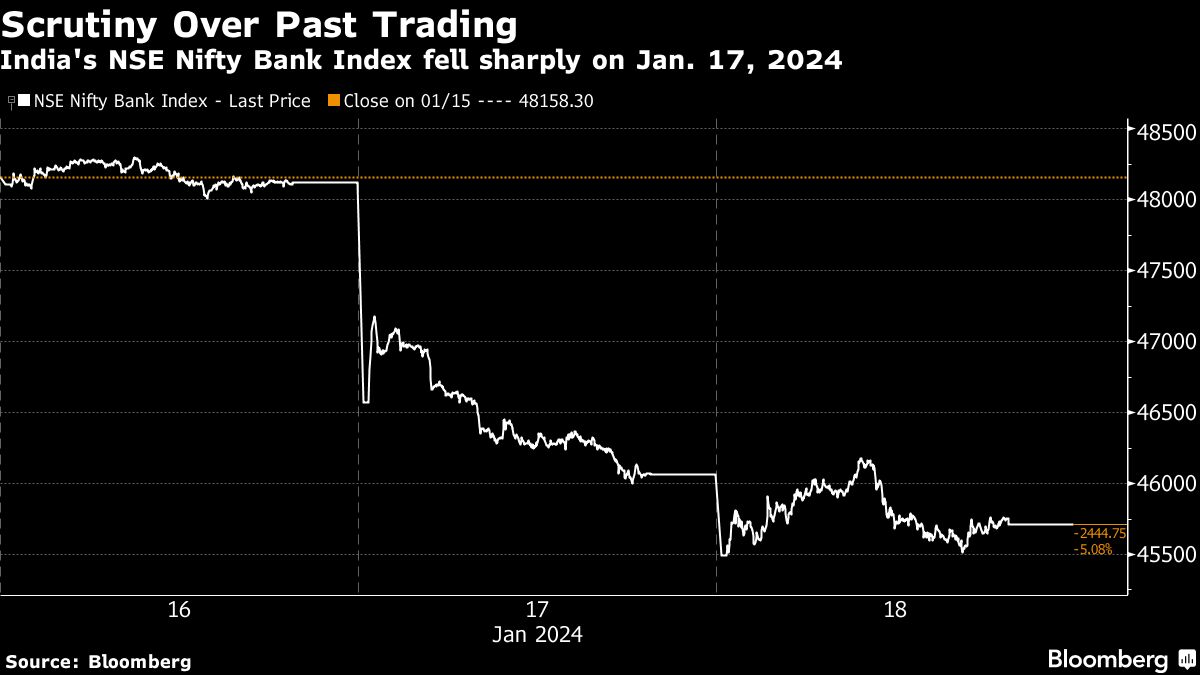
Jane Street is expected to say that high retail demand for options on that index was a key driver behind its trading in the morning, according to the people familiar with the matter. The firm will likely argue that individual traders bought about $4 billion worth of the gauge's stocks using options in the first half hour of trading, and that Jane Street — which was acting as a market maker — facilitated about $1 billion of that demand.
Those numbers are based on net delta positions, which represent the value of cash equities the options positions are equivalent to when taking into account the derivatives' sensitivity to the underlying assets' price moves.
Partial Hedging
SEBI's order said Jane Street's share purchases on that January 2024 morning represented between approximately 16% and 25% of the trading turnover for 10 of the 12 Nifty Bank Index stocks, making the firm by far the single largest net buyer. As Jane Street sold call options and bought puts, it amassed a bearish position that represented 7.3 times the size of its long cash and futures bets, according to the regulator.
Jane Street is expected to argue that the high retail options demand created a gap between prices implied by the options and those reflected by the shares, and the firm sought to close it through a standard arbitrage trade, the people familiar said.
The retail demand was so large that only 10% of it could have been hedged — partial hedging being a common practice among derivatives market makers internationally, the firm is expected to say.
In the afternoon, Jane Street sold the stocks over more than three hours, spreading out its hedging to protect against settlement-price uncertainty as the options were about to expire, also a typical tactic globally, the people said it will argue.
SEBI did not respond to a request for comment.
Huge Turnover
Retail traders' enthusiasm for options has helped turn India into the world's biggest market for listed derivatives by contracts traded, with turnover of more than 300 times that of cash equities. Global trading firms have used their capital and technological edge to profit from that large imbalance, but local investors have cumulatively incurred billions of dollars in losses, leading the regulator to crack down on the trading frenzy.
Critics of Jane Street say the sheer size of its positions built up over a short time would have given the firm market-moving power, even if the trades were within regulatory limits.
Alexander Gerko, the billionaire founder of rival XTX Markets Ltd., has challenged Jane Street to show that its India trading strategy was “legit” by proving it would work better after scaling it down by a factor of a 100.
“Any ‘normal' strategy works worse as it scales up, due to market impact, unless your strategy IS market impact,” he wrote in a LinkedIn post earlier this month.
The regulator's interim order presented serious allegations and a “compelling narrative,” though it is not certain that Jane Street acted inappropriately based on the initial findings, said Abhiraj Arora, a Mumbai-based partner at law firm Saraf and Partners who once worked at SEBI's surveillance and investigations department.
Arora, who isn't involved in the case, said too harsh a crackdown and excessive surveillance of market makers could lead to wider bid-ask spreads, poorer trade execution and increased price swings.
The Jane Street case ultimately “serves as a significant test for India's regulatory framework and its capacity to oversee increasingly complex global trading practices,” he said.

-
The Economic Imperative: Analysing The Material Driving Force Behind India-Canada Strategic Reset

This economic complementarity is further reinforced by deep institutional investment ties and talent mobility, which form the bedrock of the bilateral framework.
-
Medicine Pricing: Where Must Profit Stop?
India must confront excessive margins, hidden incentives and regulatory gaps that threaten the integrity of medicine.
-
Why Amazon And Flipkart Are Struggling To Beat Meesho In India's Smaller Cities
With 274 million users and lowest-cost logistics, Meesho is defending its value commerce crown against giants like Amazon and Flipkart.
-
High US Salaries, No Green Card Certainty: The Financial Calculation Facing Indian H-1B Families
The suspension of PERM processing at eight technology employers does not cancel existing H-1B visas. What it does is force a question many Indian families have been avoiding: is the US salary worth tying your career and family plans to one employer?
-
Swiggy vs Eternal: Food Delivery's Two Rivals Are No Longer In The Same Race
Eternal is building a private AI assistant, dark.ai. Swiggy is still working out how to make Instamart pay, with an operating loss of Rs 895 crore in the July-September quarter while Blinkit stayed profitable.
-
Where You Live Shapes How You Get To Work | The Reason Why
Two-wheelers are the most popular way to get to work in India, accounting for nearly 43% of workplace commutes.
-
Unhedged Position: Can India See An Indonesia-Style Time Correction?
The Nifty is trading below levels it first clocked in 2024. Is there, then, as I have suggested in the headline, potential that the current time correction drags on painfully for the next three-five, even ten years?
-
Navigating Friction And Energy Realities: An Analysis Of Marco Rubio's October Visit To India
Occurring at a critical juncture marked by stalled trade negotiations and escalating geopolitical pressures over global energy supplies, the visit offers a profound window into modern US-India relations.
-
India Exports Capital. Why Not Export Trusteeship?
The big question, then, is whether India can build an institution that global borrowers, investors, banks, and lawyers can trust, even without an Indian connection.
-
France's Economy & Politics Are In Crisis | The Reason Why
Let's look at how the French economy and politics evolved under Nicolas Sarkozy, Franois Hollande and Emmanuel Macron.










