IndiaMart Shares Fall After BofA Slashes Target Price
Shares of IndiaMart InterMesh Ltd. fell over 4% on Tuesday after BofA Securities cut its target price citing near-term impact on growth.
BofA has reiterated 'underperform' on IndiaMart, with target price reduced to Rs 2,100 per share from Rs 2,175 apiece earlier. This implies a downside of 20% from the current market price.
The global brokerage expects IndiaMart to report softer net adds in Q4, led by higher-than-expected churn with overall collections growth to slow down. The combined impact of all these things may lead to a slower year-on-year standalone and consolidated growth of 18% in the fourth quarter, an April 1 note said.
The brokerage sees the near-term impact on growth as the company looks to defocus on a monthly plan. But, the better margin on lower opex will aid overall growth, it said.
"Given sustained higher churn, the overall net adds continue to remain weak. We see limited visibility on how to arrest chum. Furthermore, lower collections growth is likely expected to impact revenue growth for FY25."
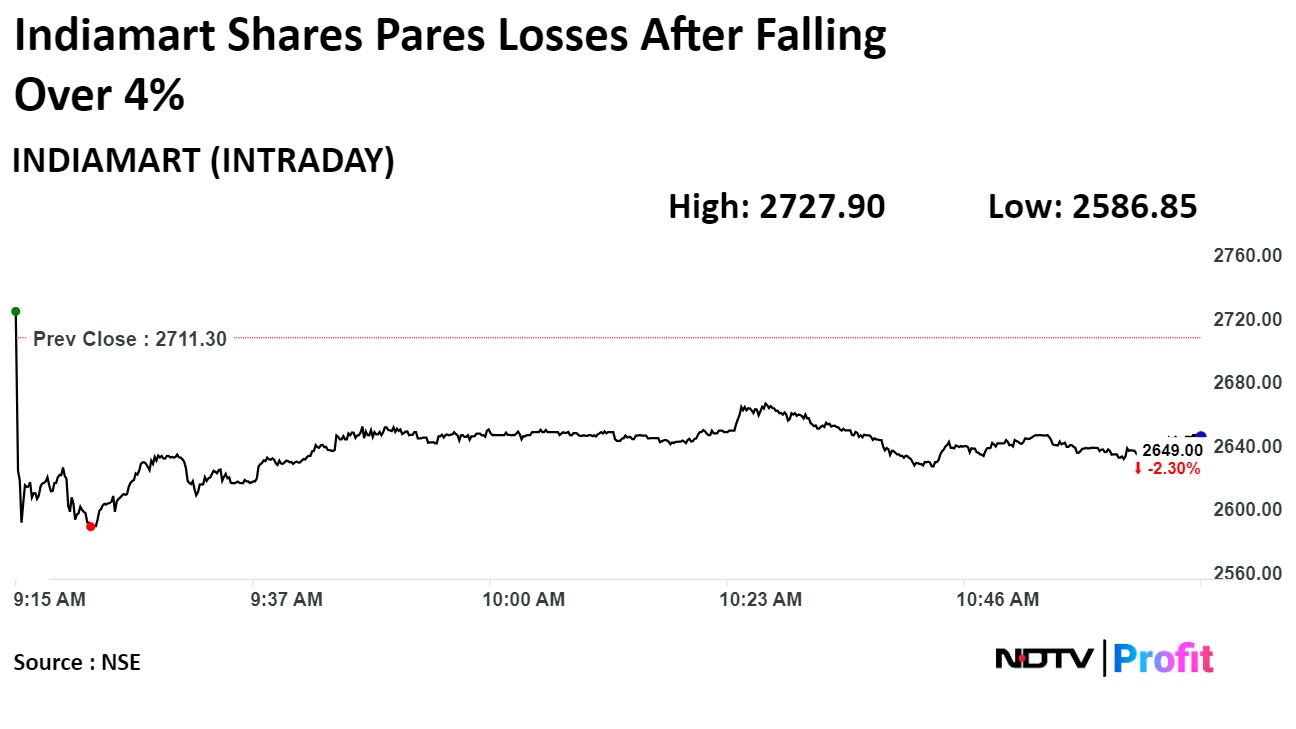
Shares of IndiaMart fell as much as 4.59%, before paring loss to trade 2.79% lower at 11:06 a.m., compared to a 0.14% decline in the benchmark Nifty 50.
The stock has risen 5.08% in the past 12 months. Total traded volume so far in the day stood at 3.8 times its 30-day average. The relative strength index was at 49.2.
Of the 24 analysts tracking the company, 17 have a 'buy' rating, two recommend a 'hold' and five suggest a 'sell', according to Bloomberg data. The average 12-month analysts' price targets implies a potential upside of 21.7%.

-
AI Agents Are Gaining Power. Who Governs Them?

Artificial intelligence agents promise to transform productivity by moving machines from assisting decisions to executing them. But as organisations delegate greater authority to these AI-agents, they must first establish who controls that authority and who remains accountable when things go wrong.
-
Why Swapping Your Old Gold Can Trigger A Rs 5 Lakh Tax Bill, And How You Can Avoid It Legally
Swapping old gold for new is taxed as a sale and a fresh purchase. Getting your own gold remade can cut most of that bill, though it has its own costs.
-
The AI Trade is Done. The Real Opportunity for Investors Starts in 2027 | Unhedged Position
As pureplay AI stocks plunge and circular, capex-led financing unwinds, 2027 is set to be a year of reckoning for AI companies. Yet the bust clears the way for a better opportunity for investors in 2027 -- shifting the spotlight from AI builders to the companies using AI.
-
Leadership As Mission: Why The Age Of AI Demands More Human Leadership
Debjani Ghosh examines how AI is changing leadership, arguing that its success must be measured by its impact on people and the accountability of those guiding its use.
-
We May Need Another Tukaram Mundhe To Fight Air Pollution | The Reason Why
Developers may install basic measures such as sprinklers and green nets, resume work, and continue violating rules when this equipment stops working.
-
Extracting Value From Battery Scrap Could Be Challenging For India | The Reason Why
A discarded lithium-ion battery still contains valuable materials such as lithium, nickel and cobalt. These can be recovered and reused. When such batteries are crushed and shredded, they produce a dark powder called black mass.
-
One El Nino, India Can Handle. Two Could Break The Granary
India's grain stocks can absorb one bad year, but a second El Nino could drain the buffer in two to three years, economists say.
-
India's Troika Of Good Luck | Joining The Dots
As Jensen Huang's exit drags Nvidia down, a cooling AI trade and resilient earnings have revived investor interest in India. A likely RBI rate hike looms.
-
Talking Points This Week: Leadership Shock At Nvidia, Earnings Strength, And The Fog Over Hormuz
The Anthropic IPO pricing and first trading day, Nvidia's upcoming earnings, and any fresh signals from Iran will set the tone for the following week.
-
Signature Play: The Classic Cocktail Is Dead. Or Is It?
Classic cocktails are disappearing from India's cocktail menus. But they're still being ordered, taught to bartenders and borrowed from. So, who's really having the last drink?









