India Swaps At Lowest Since 2022 As Easing Bets Brought Forward
Investors are positioning for earlier rate cuts in India, driven by easing local inflation and concerns over economic growth.
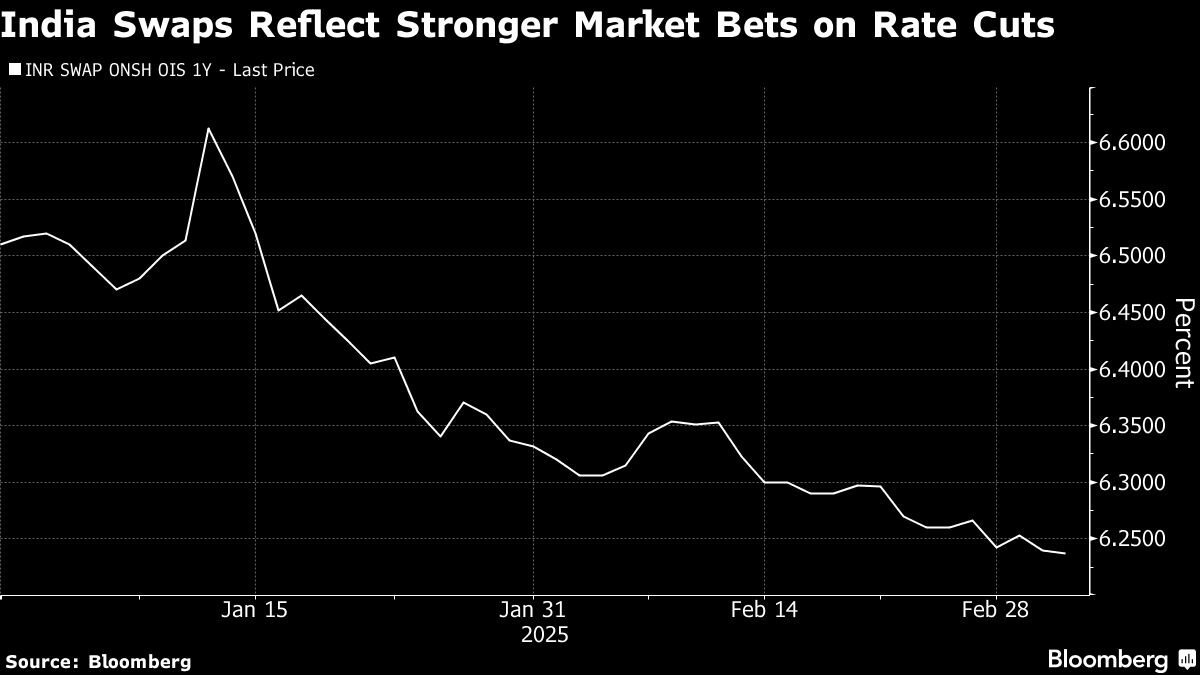
India's one-year overnight index swap rate stood at 6.23% on Wednesday, its lowest level since August 2022. The rate has declined 28 basis points so far in 2025, now trading below the central bank's policy rate of 6.25%.
“The swap market has come to price in an April rate cut fully, with the second cut assumed to happen around October,” said Abhishek Upadhyay, an economist at ICICI Securities Primary Dealership in Mumbai. “This is a shift from earlier, when the curve was only partly pricing in an April cut, with follow-up action in December.”
The Reserve Bank of India kicked off its easing cycle with a 25-basis point reduction on Feb. 7. However, investors were uncertain over the extent of future cuts in borrowing costs, given the central bank's decision last month to refrain from shifting to an accommodative policy stance.
Minutes from the RBI's meeting released late February gave swap traders reason to wager on further cuts, as the authority's rate-setting panel flagged growth risks from maintaining a restrictive policy. More recently, expectations of further declines in inflation have driven the fall in swap rates.
Consumer price index inflation is tracking close to 4% in February, down from 4.3% a month ago, largely due to a drop in vegetable prices, Deutsche Bank economists led by Kaushik Das noted. Inflation data for February is due next week, with the RBI's target at 4%.
Additionally, signs of economic weakness in the US, accompanied by a slide in Treasury yields, have weighed on local swap rates. This has strengthened Nomura Holdings analysts' conviction in further declines.
“Conditions are ripe for a breakout move lower in INR rates,” strategist Nathan Sribalasundaram wrote in a note Tuesday.

-
Foreign Investors Own Half Of HDFC Bank and ICICI Bank. An LTCG Cut Could Matter Most Here

Foreign portfolio investors have US$115 billion parked in HDFC Bank, ICICI Bank. If the government cuts long-term capital gains tax, Jefferies says returning foreign money could land here first.
-
'Never Seen This Level Of Negativity': Sandeep Tandon Says The Next Rally May Be Closer Than You Think
Veteran investor Sandeep Tandon says foreign selling is easing, large-caps are due a comeback and mid-caps are crowded, while he turns positive on gold, power and pharma this Diwali.
-
Indians Stay With Family, Not In Hotels | The Reason Why
India still lacks enough clean, reliable and affordable hotels for budget-conscious travellers.
-
The Economic Imperative: Analysing The Material Driving Force Behind India-Canada Strategic Reset
This economic complementarity is further reinforced by deep institutional investment ties and talent mobility, which form the bedrock of the bilateral framework.
-
Medicine Pricing: Where Must Profit Stop?
India must confront excessive margins, hidden incentives and regulatory gaps that threaten the integrity of medicine.
-
Why Amazon And Flipkart Are Struggling To Beat Meesho In India's Smaller Cities
With 274 million users and lowest-cost logistics, Meesho is defending its value commerce crown against giants like Amazon and Flipkart.
-
High US Salaries, No Green Card Certainty: The Financial Calculation Facing Indian H-1B Families
The suspension of PERM processing at eight technology employers does not cancel existing H-1B visas. What it does is force a question many Indian families have been avoiding: is the US salary worth tying your career and family plans to one employer?
-
Swiggy vs Eternal: Food Delivery's Two Rivals Are No Longer In The Same Race
Eternal is building a private AI assistant, dark.ai. Swiggy is still working out how to make Instamart pay, with an operating loss of Rs 895 crore in the July-September quarter while Blinkit stayed profitable.
-
Where You Live Shapes How You Get To Work | The Reason Why
Two-wheelers are the most popular way to get to work in India, accounting for nearly 43% of workplace commutes.
-
Unhedged Position: Can India See An Indonesia-Style Time Correction?
The Nifty is trading below levels it first clocked in 2024. Is there, then, as I have suggested in the headline, potential that the current time correction drags on painfully for the next three-five, even ten years?










