India Stock Value Tops $4 Trillion, Narrowing Gap With Hong Kong

(Bloomberg) --
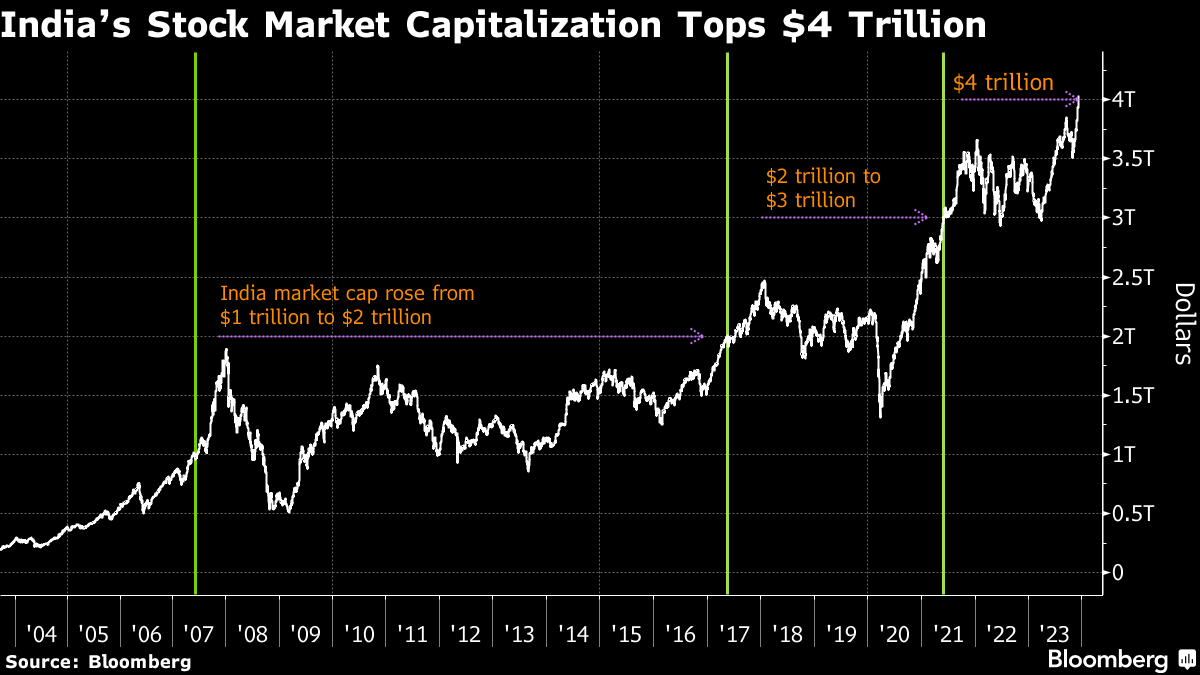
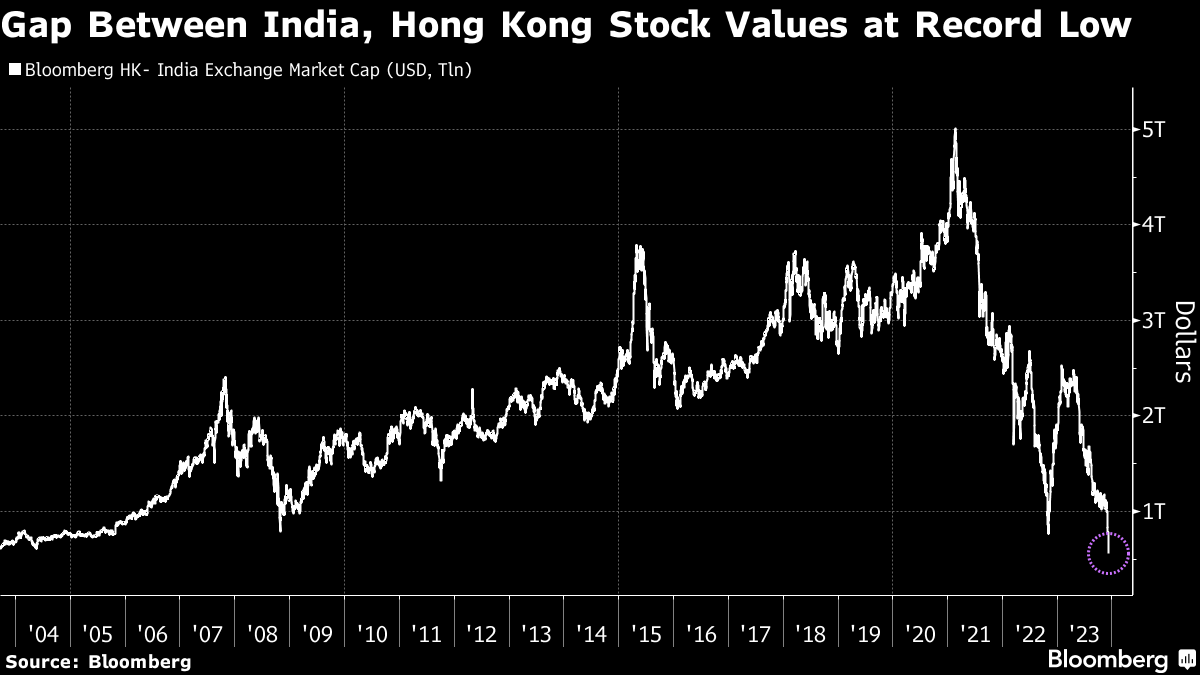
India's stock market value reached more than $4 trillion Tuesday for the first time, marking a key milestone for the world's fifth-biggest equity market as it rapidly narrows the gap with slumping Hong Kong.
The market capitalization of companies listed on India's exchanges has risen by $1 trillion in less than three years, as the South Asian market emerges as one of the best performers in the region as well as the emerging world.
Already trading at all-time high levels, India's key stocks benchmarks have risen more than 13% this year and are headed for an unprecedented eighth-straight year of gains. In contrast, the key Hong Kong equity measure has fallen 17%, with the market's total value dropping to less than $4.7 trillion.
India toppled China to become the worlds' most populous nation earlier this year and has emerged as the fastest-growing major economy. Touting political stability and strong domestic growth potential, India has been making efforts to increase global investment in its capital markets as well as industrial production.
Foreign investors have bought more than $15 billion of the nation's stocks this year on a net basis, while domestic funds have poured in more than $20 billion. This institutional support has been supplemented by a boom in retail trading since the pandemic.
India has been moving from being a consumption-oriented economy to an economy led by consumption as well as investment, and “markets have reacted positively and rightly to this potential strength of the country,” Ashish Gupta, chief investment officer at Axis Mutual Fund, wrote in a note.
The nation's economic growth stands out against a slowing global macro backdrop, with its gross domestic product jumping 7.6% in the three months to September from a year ago. That's seen bolstering the prospects for Prime Minister Narendra Modi to retain power in elections next year.
Some experts caution that the vote still poses risks for the stock market, while others note the high valuations of Indian shares as a reason for concern. The S&P BSE Sensex Index is trading at 20 times forward earnings estimates, slightly above its five-year average and higher than the 16 times for a gauge of global stocks. And volatility has risen along with stock benchmarks, a sign that some investors may be starting to hedge more aggressively given the extent of the rally.
Others are still optimistic, like Goldman Sachs Group Inc. which upgraded India to overweight last month as “the best structural growth prospects in the region”. Nomura Holdings Inc. maintained its overweight recommendation on India in its latest Asia ex-Japan strategy report.
“Structurally, we would be buyers on dips assuming political/policy continuity,” Nomura strategists led by Chetan Seth wrote in a note dated Tuesday.
--With assistance from Alex Gabriel Simon.
More stories like this are available on bloomberg.com
©2023 Bloomberg L.P.

-
'Never Seen This Level Of Negativity': Sandeep Tandon Says The Next Rally May Be Closer Than You Think

Veteran investor Sandeep Tandon says foreign selling is easing, large-caps are due a comeback and mid-caps are crowded, while he turns positive on gold, power and pharma this Diwali.
-
Indians Stay With Family, Not In Hotels | The Reason Why
India still lacks enough clean, reliable and affordable hotels for budget-conscious travellers.
-
The Economic Imperative: Analysing The Material Driving Force Behind India-Canada Strategic Reset
This economic complementarity is further reinforced by deep institutional investment ties and talent mobility, which form the bedrock of the bilateral framework.
-
Medicine Pricing: Where Must Profit Stop?
India must confront excessive margins, hidden incentives and regulatory gaps that threaten the integrity of medicine.
-
Why Amazon And Flipkart Are Struggling To Beat Meesho In India's Smaller Cities
With 274 million users and lowest-cost logistics, Meesho is defending its value commerce crown against giants like Amazon and Flipkart.
-
High US Salaries, No Green Card Certainty: The Financial Calculation Facing Indian H-1B Families
The suspension of PERM processing at eight technology employers does not cancel existing H-1B visas. What it does is force a question many Indian families have been avoiding: is the US salary worth tying your career and family plans to one employer?
-
Swiggy vs Eternal: Food Delivery's Two Rivals Are No Longer In The Same Race
Eternal is building a private AI assistant, dark.ai. Swiggy is still working out how to make Instamart pay, with an operating loss of Rs 895 crore in the July-September quarter while Blinkit stayed profitable.
-
Where You Live Shapes How You Get To Work | The Reason Why
Two-wheelers are the most popular way to get to work in India, accounting for nearly 43% of workplace commutes.
-
Unhedged Position: Can India See An Indonesia-Style Time Correction?
The Nifty is trading below levels it first clocked in 2024. Is there, then, as I have suggested in the headline, potential that the current time correction drags on painfully for the next three-five, even ten years?
-
Navigating Friction And Energy Realities: An Analysis Of Marco Rubio's October Visit To India
Occurring at a critical juncture marked by stalled trade negotiations and escalating geopolitical pressures over global energy supplies, the visit offers a profound window into modern US-India relations.










