India Set To Close In On China As Emerging-Market Stock Anchor
(Bloomberg) -- India is poised to narrow the gap with China in MSCI Inc.'s gauge for developing nations.
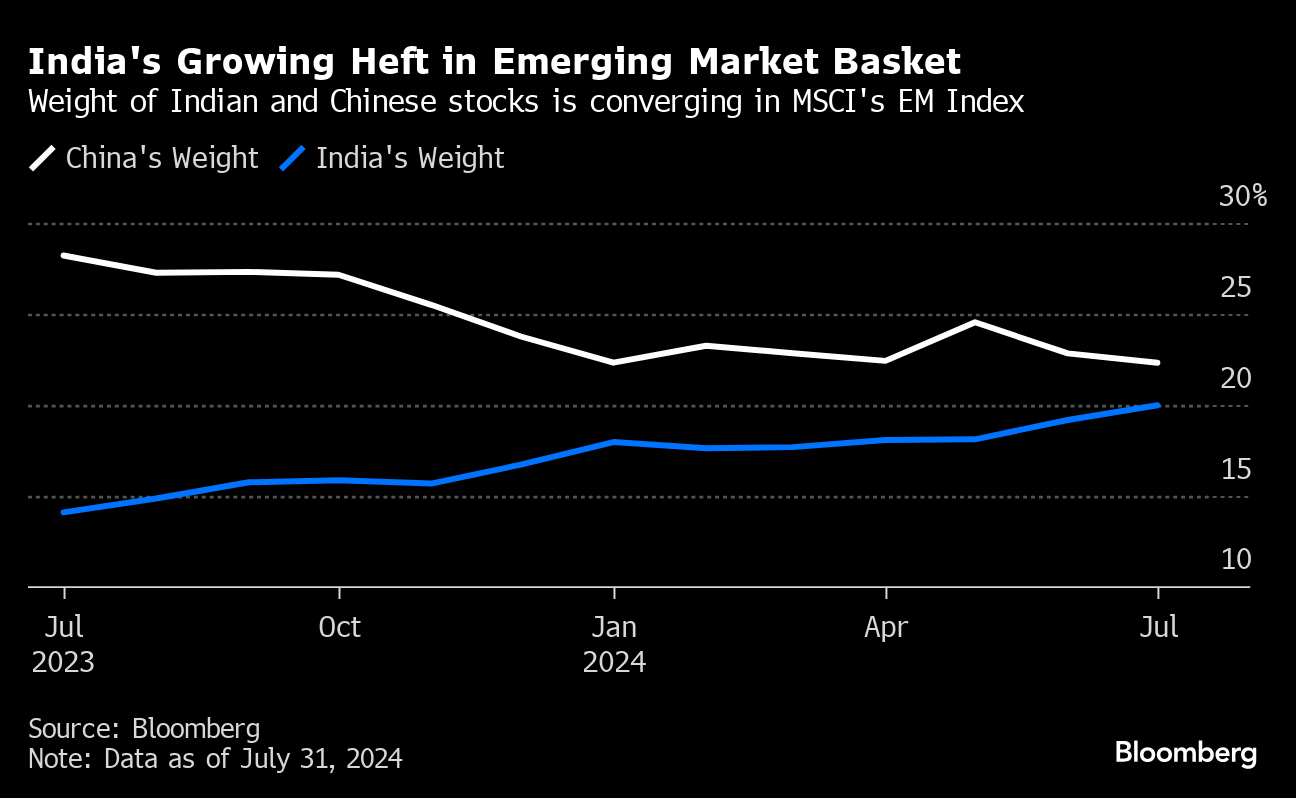
Analysts from firms including Smartkarma and IIFL Securities Ltd. expect India's weight in the MSCI Emerging Markets Index to rise by at least one percentage point following the index provider's review this week. This would bring the country almost on par with China, which currently accounts for 22.33% of the benchmark. India lags at 19.99%.
A higher weighting for India will position it to become the new anchor for emerging market equities, likely driving increased flows into the country. Fund managers say that India's rising heft may make the EM gauge more appealing to global investors who have been wary due to China's sway over the index.
“It can make the EM index more balanced, where secular growth stories like India receive higher allocation” compared with more cyclical markets like China and Korea, said Vivek Dhawan, portfolio manager at Candriam Belgian NV.
This shift has a side effect: index followers may be forced to allocate funds to India's already-expensive stocks at a time when crowded trades are taking a hit due to the turmoil in global markets.
India — long touted as the “next China” — has emerged as a favorite among investors, driven by its robust economic growth, a growing middle class and burgeoning manufacturing sector. Meanwhile, China is dealing with long-term economic challenges and increasingly strained relations with the West.
“Many global investors who didn't look at India as a standalone allocation in the past would now look at it more favorably,” said Hiren Dasani, co-head of Emerging Markets Equity and lead portfolio manager of India Equity strategies at Goldman Sachs Asset Management.
China's standing in emerging markets has shrunk in the past few years, while India's has steadily expanded. At its peak in 2020, China accounted for 40% of the MSCI EM Index, but that weighting has dropped amid Beijing's regulatory crackdowns and efforts to deleverage its indebted property sector.
As of end of July, India's weight was just 2.34 percentage points away from China's in the MSCI Asia Pacific Index, a regional benchmark, a recurring pattern across most gauges from major index providers. MSCI didn't respond to an email seeking comment outside of regular business hours.
“With a rising equity market, increase in free float for companies and new large listings in India, the gap in the weightings should continue to narrow heading into year-end,”said Brian Freitas, an analyst at Smartkarma.
Read: Ola Electric Jumps by 20% After Biggest India IPO in Two Years
In its review, MSCI is likely to add six stocks, including Samsung Electronics Co. supplier Dixon Technologies (India) Ltd. and property developer Oberoi Realty Ltd., according to Abhilash Pagaria, head of Nuvama Alternative & Quantitative Research Analysis. HDFC Bank Ltd., India's largest by market value, may also see a gradual increase in its weighting, he wrote.
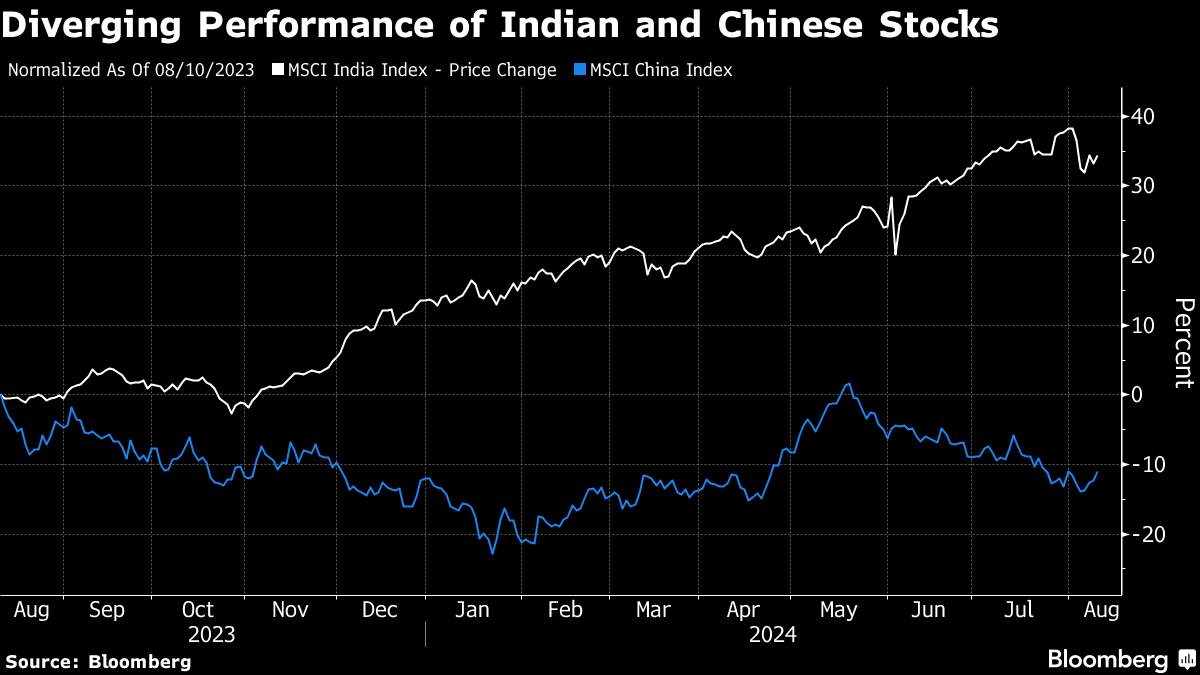
While Chinese stocks have struggled, India's NSE Nifty 50 Index has risen 12% this year, following Prime Minister Narendra Modi's third consecutive term in the office. The benchmark gauge is set for a ninth straight year of annual gains.
The contrasting trajectories highlights investors' preference for India even as China's equities remain very cheap. It also underscores Beijing's inability to stem the downtrend in its markets.
“We do look at India as a bit of a diversifier against some of China's weakness,” said Seema Shah, chief global strategist at Principal Asset Management. “A lot of the potential that people have been speaking about for years and years is now looking to be fulfilled.”
--With assistance from John Cheng and Alex Gabriel Simon.
More stories like this are available on bloomberg.com
©2024 Bloomberg L.P.

-
Talking Points This Week: Leadership Shock At Nvidia, Earnings Strength, And The Fog Over Hormuz

The Anthropic IPO pricing and first trading day, Nvidia's upcoming earnings, and any fresh signals from Iran will set the tone for the following week.
-
Signature Play: The Classic Cocktail Is Dead. Or Is It?
Classic cocktails are disappearing from India's cocktail menus. But they're still being ordered, taught to bartenders and borrowed from. So, who's really having the last drink?
-
A New Samvat Wishlist: Inclusive Prosperity And Human Development
India has strengthened its economic foundations through infrastructure, digital access and enterprise. Its next growth chapter must deepen productivity, create better livelihoods and widen participation in prosperity.
-
Love, Sex Aur Dhokha: The Audacious Plot To Spy On Jensen Huang
A Taipei dinner, a Singapore chip buyer and a suspected Chinese asset: inside the alleged spy operation that got close to NVIDIA's Jensen Huang.
-
Ten Things I Learnt This Samvat
Patience can be a trap. Cheap stocks can stay cheap. Leverage can wipe you out. What did Samvat 2082 teach us? Niraj Shah writes on 10 lessons from the year gone by.
-
Talking Points This Week: Tech Nerves, FII Buying, And A Faraway Banking Shock
The global markets are not shining this Diwali. The exception in the large markets is, India.
-
Midterm Rally Lasted A Day. The Hard Reality Of A Divided US May Last Two Years | Opinion
Between a contested AI boom, a debt ceiling that arrives in 2027 and a president with every incentive to act alone, the next two years may prove more volatile than the first day's rally suggests.
-
Blue Wave Will Derail the AI Trade but Won't Dismantle the AI Era | Unhedged Position
The Democrats' sweep of the US Congress will see politics collide with economic forces both over the long and short term.
-
It's Time To Take The GST Council's Bet On Trust Global
Payment records can prove India's services exports, and clear, proportionate rules can bring foreign digital sellers into the tax net.
-
Opinion | India at 38: From Innovation Overperformer to Innovation Powerhouse
India now has 453 VC-backed deep science startups, 18 of them late-stage, after 117 percent growth since 2020. Laurus Labs, at USD 9.3 billion, is the most valuable deep science company in any middle-income economy outside China.









