India Stocks On Verge of Record $4 Trillion Valuation

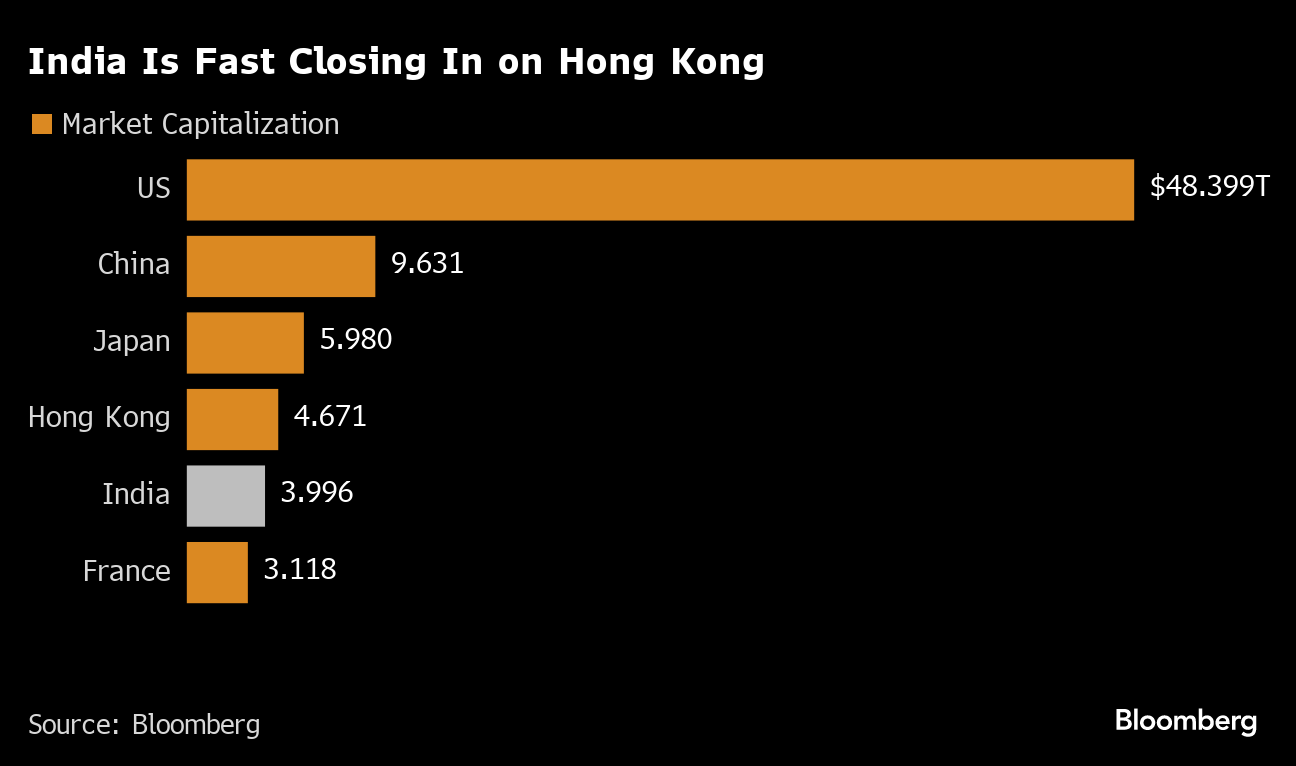
(Bloomberg) -- A surge in investments by retail traders and resurgent foreign inflows have put India's stock market — the world's fifth biggest — on the verge of a $4 trillion valuation for the first time.
The market capitalization of securities listed on the nation's exchanges has tripled since the March 2020 pandemic low to reach a whisker short of the $4 trillion mark as of Monday, according to data compiled by Bloomberg.
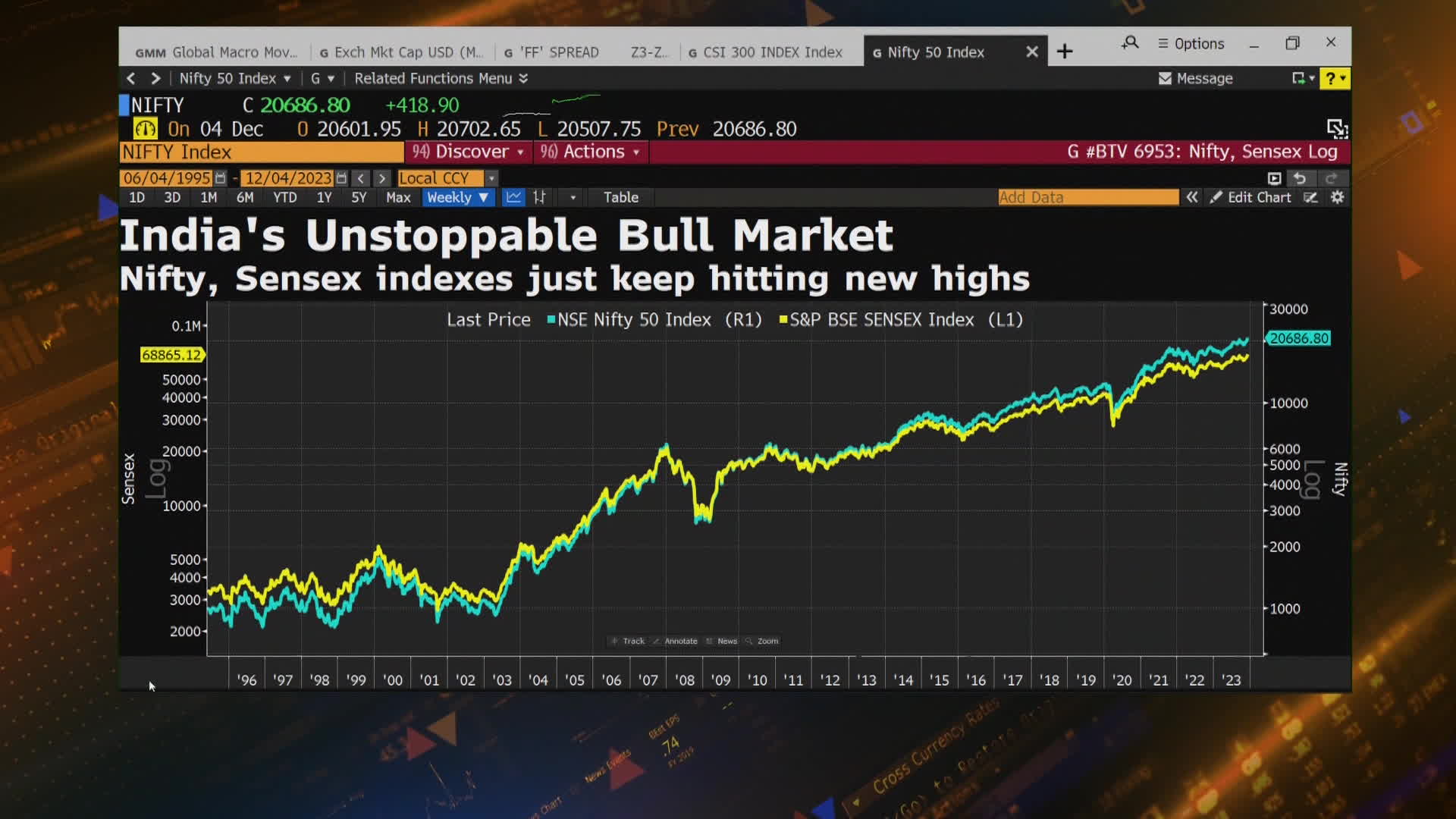
India's benchmark NSE Nifty 50 Index jumped 2.1% on Monday, leading gains in Asia, after Prime Minister Narendra Modi's ruling party won three crucial state elections. The victories removed an element of political risk for investors by bolstering Modi's position ahead of nationwide polls next year, increasing bets for continuity in government policy.
The feat for India's stock market comes as the world's fastest-growing major economy positions itself as an alternative to China for global investors and companies alike. Overseas funds have piled $15 billion into local shares this year, with the market also getting a steady boost from the retail investing boom that took off during the pandemic. Up 14% in 2023, the Nifty gauge is heading for an unprecedented eighth straight year of gains.
India's economy stands out amid slowing global growth — gross domestic product jumped 7.6% in the three months to September from a year ago — with its appeal further burnished by China's tepid post-pandemic recovery and its tensions with the West.
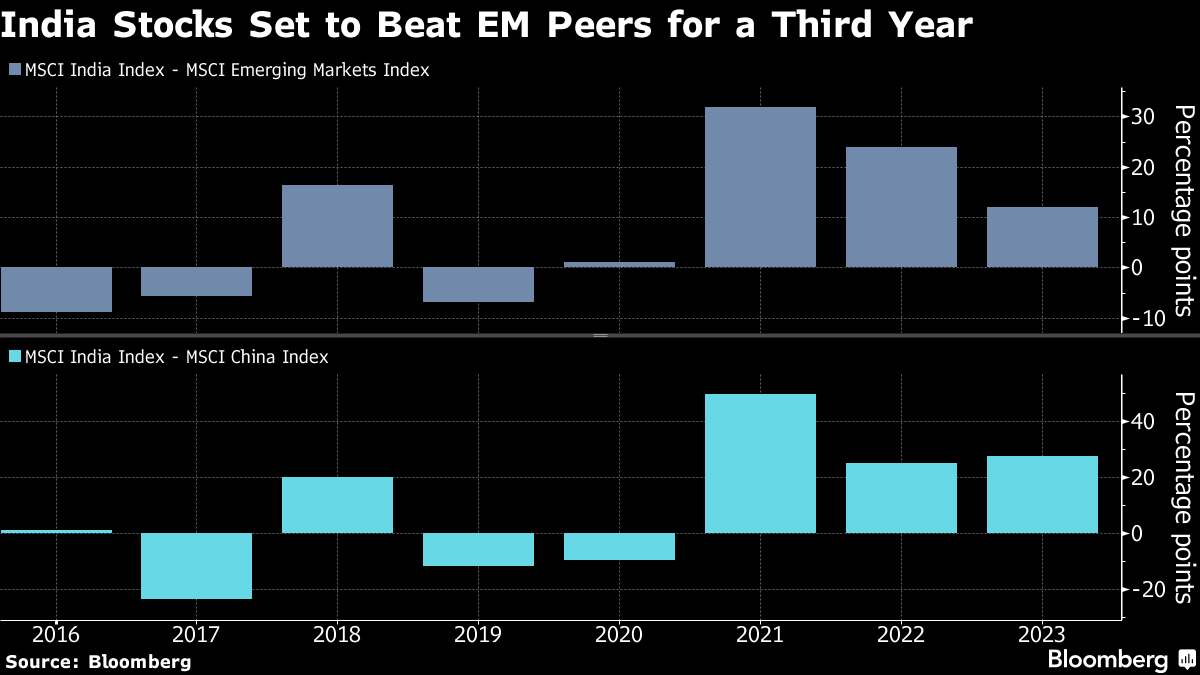
The same holds true for Indian stocks, with an MSCI Inc. gauge of local shares on track to beat a global emerging-markets measure by more than 10 percentage points for a third year in a row. The outperformance versus Chinese peers is even more stark, with the Indian gauge poised to outstrip the MSCI China Index by more than 20 percentage points for a third year.
“The Indian market for the last 10 years has seen unparalleled growth, be it in the corporate sector or the broader indices,” said Tanvi Kanchan, head of UAE business at India's Anand Rathi Shares and Stock Brokers Ltd. “This year, we've seen small and mid cap companies outperforming and they are contributing to the broader economy's capex recovery.”
READ: Modi's Nation-Building Push Spurs $125 Billion Industrials Rally
India's young population and Modi's efforts to capture a bigger share of global supply chains are helping lure companies such as Apple Inc. to its shores. Meanwhile, global pension and sovereign wealth managers are flocking to India while growing hesitant on China, according to a new study London-based think-tank Official Monetary and Financial Institutions Forum.
The stock market's boom has also sparked a frenzy for initial public offerings, with some of new listings posting stellar gains in recent days.
“Besides the structural promise, near-term factors that we believe will drive markets higher are robust activity data, impressive corporate earnings, easing oil prices, strong domestic flows,” JPMorgan Chase & Co. strategists led by Rajiv Batra wrote in a Nov. 30 note.
The risk for India could come from its high valuations. Several investors have voiced concerns the market is overvalued and that the India trade is getting too crowded, raising the odds of a pullback. At the same time, the rising participation of individual investors, many of whom are drawing on advice from unauthorized financial advisers and social media “gurus,” is becoming a concern for the market regulator.
For now though, Modi's victories in state elections are seen aiding sentiment and raising India's appeal for foreign investors, who turned buyers of local stocks in November for the first time in three months.
“What it does is give investors increased confidence, and duration to the India trade,” Matthew Haupt, portfolio manager at Wilson Asset Management in Sydney said on Monday. “We will likely see continued capital inflows to India.”
NOTE: The market capitalization is calculated from all shares outstanding. ALLX WCAU data does not include ETFs and ADRs as they do not directly represent companies. It includes only actively traded, primary securities on the country's exchanges to avoid double counting as well. Therefore the values will be significantly lower than market capitalization values of a country's exchanges from other sources.
--With assistance from Ishika Mookerjee.
(Updates throughout.)
More stories like this are available on bloomberg.com
©2023 Bloomberg L.P.

-
'Never Seen This Level Of Negativity': Sandeep Tandon Says The Next Rally May Be Closer Than You Think

Veteran investor Sandeep Tandon says foreign selling is easing, large-caps are due a comeback and mid-caps are crowded, while he turns positive on gold, power and pharma this Diwali.
-
Indians Stay With Family, Not In Hotels | The Reason Why
India still lacks enough clean, reliable and affordable hotels for budget-conscious travellers.
-
The Economic Imperative: Analysing The Material Driving Force Behind India-Canada Strategic Reset
This economic complementarity is further reinforced by deep institutional investment ties and talent mobility, which form the bedrock of the bilateral framework.
-
Medicine Pricing: Where Must Profit Stop?
India must confront excessive margins, hidden incentives and regulatory gaps that threaten the integrity of medicine.
-
Why Amazon And Flipkart Are Struggling To Beat Meesho In India's Smaller Cities
With 274 million users and lowest-cost logistics, Meesho is defending its value commerce crown against giants like Amazon and Flipkart.
-
High US Salaries, No Green Card Certainty: The Financial Calculation Facing Indian H-1B Families
The suspension of PERM processing at eight technology employers does not cancel existing H-1B visas. What it does is force a question many Indian families have been avoiding: is the US salary worth tying your career and family plans to one employer?
-
Swiggy vs Eternal: Food Delivery's Two Rivals Are No Longer In The Same Race
Eternal is building a private AI assistant, dark.ai. Swiggy is still working out how to make Instamart pay, with an operating loss of Rs 895 crore in the July-September quarter while Blinkit stayed profitable.
-
Where You Live Shapes How You Get To Work | The Reason Why
Two-wheelers are the most popular way to get to work in India, accounting for nearly 43% of workplace commutes.
-
Unhedged Position: Can India See An Indonesia-Style Time Correction?
The Nifty is trading below levels it first clocked in 2024. Is there, then, as I have suggested in the headline, potential that the current time correction drags on painfully for the next three-five, even ten years?
-
Navigating Friction And Energy Realities: An Analysis Of Marco Rubio's October Visit To India
Occurring at a critical juncture marked by stalled trade negotiations and escalating geopolitical pressures over global energy supplies, the visit offers a profound window into modern US-India relations.










