India Bonds Gain As Lower Debt Supply Boosts Sentiment
India announced a borrowing plan for the first half of the next fiscal year that's lower than market expectations, triggering gains in longer-maturity bonds.
The government plans to sell eight trillion rupees ($93.2 billion) of bonds in the six months to September, the Ministry of Finance said in a statement after trading ended on Thursday. That's lower than the 8.4 trillion rupees estimated in a Bloomberg News survey.
Lower borrowings may help bonds extend this year's gains driven by growing bets of a cut in interest rates at the Reserve Bank of India's policy review on April 9.
“The total borrowing is a bit lower than market expectation, and long end as a proportion of overall supply has been adjusted lower,” said Suyash Choudhary, head of fixed income at Bandhan AMC Ltd. “The market price action is reflecting both these.”
The yield on the ultra-long 7.34% 2064 bond fell four basis points to 6.95% on Friday, while the yield on the 10-year note was down two basis points.
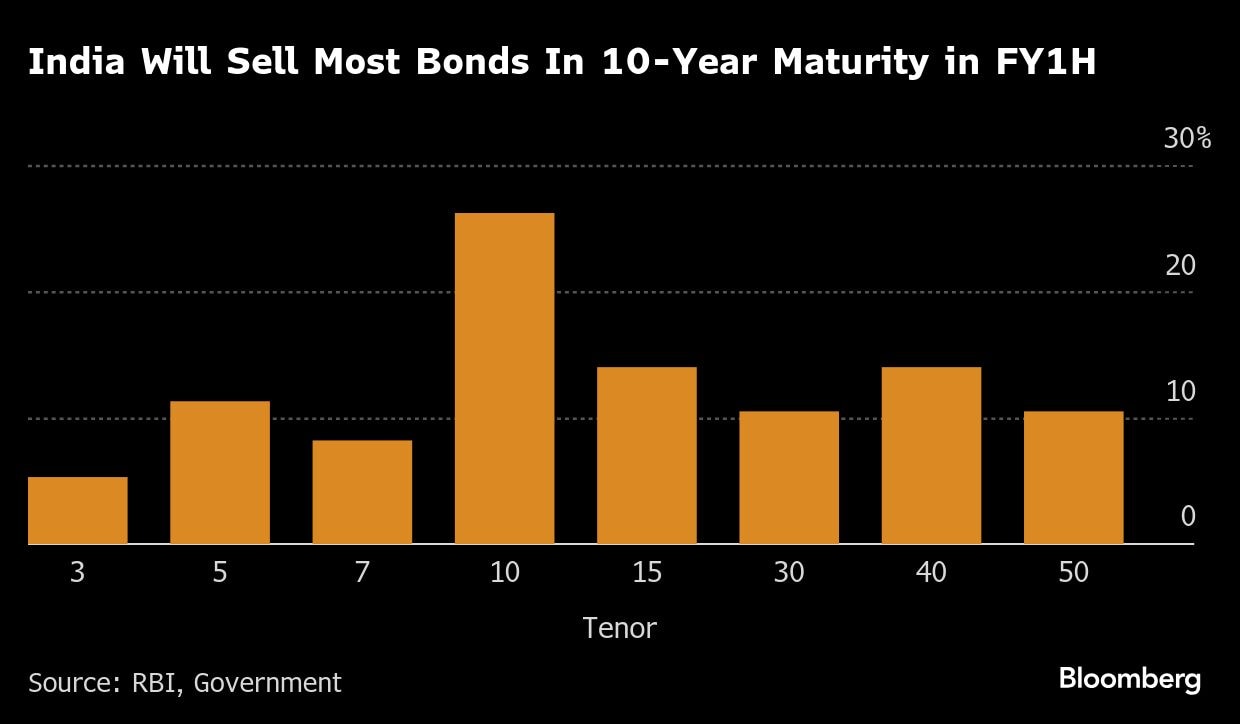
New Delhi plans to sell about 35% of the bonds in the 30-50 year segment of total issuances in the first half starting April 1, as against 38% a year ago, according to the statement. The government aims to sell around 25% of the bonds in the less-than-10-year bucket, while the benchmark 10-year bond will account for 26.2%, the government said.
“We expect bond yields to drift lower, supported by policy rate and stance easing, liquidity-easing measures and foreign inflows through the course of the year,” Upasna Bhardwaj, chief economist at Kotak Mahindra Bank Ltd., wrote in a note.
The yield on benchmark 10-year bond is likely to trade in the 6.35%-6.65% range in the fiscal first half, she wrote.
The first-half borrowing will account for 54% of the full-year target of 14.8 trillion rupees, according to the statement. That compares with about 60% of total debt the government usually issues for the period.
RBI Measures
The RBI has injected over $60 billion worth of liquidity over the last two months to curb the cash crunch that widened to a more-than-decade high of 3.3 trillion rupees in January. It was at 200 billion rupees as of March 26, as per a Bloomberg Economics index.
Indian bonds have also benefited in recent years from a surge in purchases from insurance and pension funds. Foreigners have also raised holdings of sovereign bonds with JPMorgan Chase & Co. adding India to its emerging market debt indices in June last year.
While foreign investor interest may slow with India gaining full weight in the JPMorgan index in March, the central bank is expected to remain a big buyer of local bonds in the coming fiscal year, according to IDFC First Bank Ltd.
The government will sell 190 billion rupees of treasury bills for thirteen weeks through April-June, according to the statement.

-
'Never Seen This Level Of Negativity': Sandeep Tandon Says The Next Rally May Be Closer Than You Think

Veteran investor Sandeep Tandon says foreign selling is easing, large-caps are due a comeback and mid-caps are crowded, while he turns positive on gold, power and pharma this Diwali.
-
Indians Stay With Family, Not In Hotels | The Reason Why
India still lacks enough clean, reliable and affordable hotels for budget-conscious travellers.
-
The Economic Imperative: Analysing The Material Driving Force Behind India-Canada Strategic Reset
This economic complementarity is further reinforced by deep institutional investment ties and talent mobility, which form the bedrock of the bilateral framework.
-
Medicine Pricing: Where Must Profit Stop?
India must confront excessive margins, hidden incentives and regulatory gaps that threaten the integrity of medicine.
-
Why Amazon And Flipkart Are Struggling To Beat Meesho In India's Smaller Cities
With 274 million users and lowest-cost logistics, Meesho is defending its value commerce crown against giants like Amazon and Flipkart.
-
High US Salaries, No Green Card Certainty: The Financial Calculation Facing Indian H-1B Families
The suspension of PERM processing at eight technology employers does not cancel existing H-1B visas. What it does is force a question many Indian families have been avoiding: is the US salary worth tying your career and family plans to one employer?
-
Swiggy vs Eternal: Food Delivery's Two Rivals Are No Longer In The Same Race
Eternal is building a private AI assistant, dark.ai. Swiggy is still working out how to make Instamart pay, with an operating loss of Rs 895 crore in the July-September quarter while Blinkit stayed profitable.
-
Where You Live Shapes How You Get To Work | The Reason Why
Two-wheelers are the most popular way to get to work in India, accounting for nearly 43% of workplace commutes.
-
Unhedged Position: Can India See An Indonesia-Style Time Correction?
The Nifty is trading below levels it first clocked in 2024. Is there, then, as I have suggested in the headline, potential that the current time correction drags on painfully for the next three-five, even ten years?
-
Navigating Friction And Energy Realities: An Analysis Of Marco Rubio's October Visit To India
Occurring at a critical juncture marked by stalled trade negotiations and escalating geopolitical pressures over global energy supplies, the visit offers a profound window into modern US-India relations.










