Foreign Investors Own Half Of HDFC Bank and ICICI Bank. An LTCG Cut Could Matter Most Here
Foreign portfolio investors have US$115 billion parked in HDFC Bank, ICICI Bank. If the government cuts long-term capital gains tax, Jefferies says returning foreign money could land here first.
Foreign portfolio investors (FPIs) hold about US$115 billion worth of HDFC Bank and ICICI Bank, roughly half of each lender's market value, according to a Jefferies report dated October 28. These are the two largest foreign holdings in Indian equities, so they stand to feel it most if foreign money responds to a cut in long-term capital gains (LTCG) tax on shares. The government has discussed such a cut but has not announced one.
FPIs sold a net US$59 billion of Indian equities between October 2024 and September 2026. Financials lost the most at US$16 billion, followed by IT and consumer staples at US$10 billion each. Outflows were US$21 billion in FY26 and US$16.5 billion so far in FY27, up to October 23. Add exits by foreign private equity funds and promoters, and equity-linked foreign outflows come to US$110 billion since April 2025.
Jefferies says foreign positioning in India is already light. Its analysis of 70 large emerging market funds, which together manage US$380 billion, puts India 0.3 percentage points underweight against the benchmark. The 10-year average is 2.2 points overweight. Underweight means a fund holds less than the benchmark index does. About 64% of the funds are underweight on India.
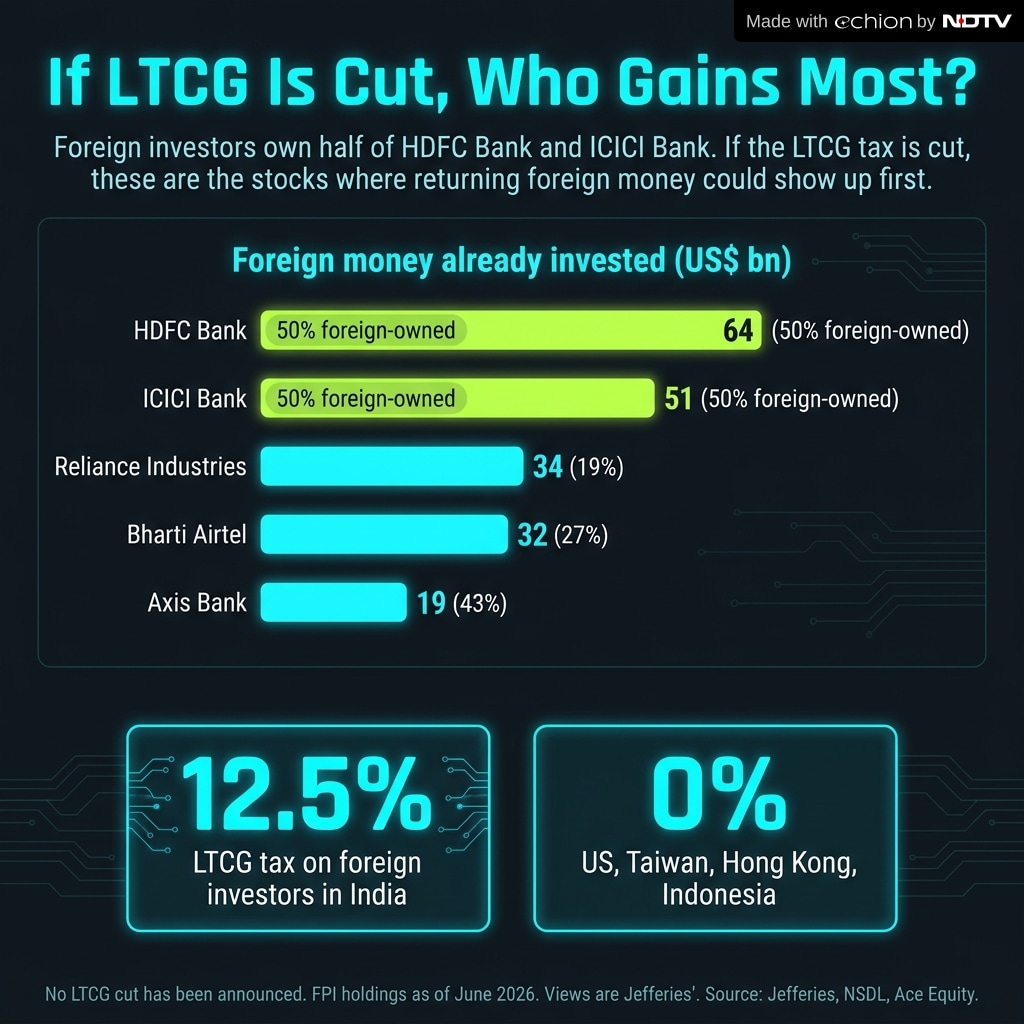
Jefferies points out the five companies that can gain most from an LTCG cut
Photo Credit: NDTV Profit
India taxes foreign investors at 12.5% on long-term gains, meaning shares held for a year or more, and 20% on short-term gains. The US, Taiwan, Hong Kong and Indonesia exempt them. The treaty routes that once let FPIs invest through low-tax countries have been largely shut since April 2019.
ALSO READ: 'Foreign Investors Are Baraatis': Raamdeo Agrawal On LTCG Tax
Finance Minister Nirmala Sitharaman said on October 13 that the debate on LTCG, the securities transaction tax (STT) and treating all asset classes alike was a healthy one. The Economic Times reported, as cited by Jefferies, that the government on October 26 sought views from investors, market participants and tax experts as it reassesses capital market levies. Also on October 26, the Finance Ministry clarified that brokerage paid by overseas clients, including FPIs, non-resident Indians (NRIs) and overseas citizens of India (OCIs), from repatriable rupee accounts will count as exports and will not attract goods and services tax (GST).
There is a precedent. On June 6, the government cut to zero the tax on interest and capital gains from government bonds for eligible foreign investors. Debt FPIs then put in US$9 billion over June and July. Jefferies says an equity cut could similarly lift sentiment and support the rupee.
The report does not name HDFC Bank or ICICI Bank as the top beneficiaries. It says large-cap sectors such as financials, energy and consumer tech could gain most if FPI flows rise. Banks are its top preference, along with Reliance Industries, utilities and real estate, and it favours large caps over mid-caps. A cut that applies only to FPIs would help most directly where they hold the biggest stakes.
A cut would cost the exchequer. LTCG on equities brought in Rs 1.3 lakh crore in FY25, when markets peaked, and STT is running at about Rs 85,000 crore a year in FY27. Together they made up 8% of direct tax and 5% of gross tax revenue in FY25. Jefferies lists three options: an across-the-board cut, a cut for FPIs only, or computing FPIs' gains in dollar terms. A change can come through an ordinance, outside the Budget.
ALSO READ: Jefferies Cautious On IT: TCS Rated Underperform, Infosys Hold After $10 Billion FPI Outflow
-
'Never Seen This Level Of Negativity': Sandeep Tandon Says The Next Rally May Be Closer Than You Think

Veteran investor Sandeep Tandon says foreign selling is easing, large-caps are due a comeback and mid-caps are crowded, while he turns positive on gold, power and pharma this Diwali.
-
Indians Stay With Family, Not In Hotels | The Reason Why
India still lacks enough clean, reliable and affordable hotels for budget-conscious travellers.
-
The Economic Imperative: Analysing The Material Driving Force Behind India-Canada Strategic Reset
This economic complementarity is further reinforced by deep institutional investment ties and talent mobility, which form the bedrock of the bilateral framework.
-
Medicine Pricing: Where Must Profit Stop?
India must confront excessive margins, hidden incentives and regulatory gaps that threaten the integrity of medicine.
-
Why Amazon And Flipkart Are Struggling To Beat Meesho In India's Smaller Cities
With 274 million users and lowest-cost logistics, Meesho is defending its value commerce crown against giants like Amazon and Flipkart.
-
High US Salaries, No Green Card Certainty: The Financial Calculation Facing Indian H-1B Families
The suspension of PERM processing at eight technology employers does not cancel existing H-1B visas. What it does is force a question many Indian families have been avoiding: is the US salary worth tying your career and family plans to one employer?
-
Swiggy vs Eternal: Food Delivery's Two Rivals Are No Longer In The Same Race
Eternal is building a private AI assistant, dark.ai. Swiggy is still working out how to make Instamart pay, with an operating loss of Rs 895 crore in the July-September quarter while Blinkit stayed profitable.
-
Where You Live Shapes How You Get To Work | The Reason Why
Two-wheelers are the most popular way to get to work in India, accounting for nearly 43% of workplace commutes.
-
Unhedged Position: Can India See An Indonesia-Style Time Correction?
The Nifty is trading below levels it first clocked in 2024. Is there, then, as I have suggested in the headline, potential that the current time correction drags on painfully for the next three-five, even ten years?
-
Navigating Friction And Energy Realities: An Analysis Of Marco Rubio's October Visit To India
Occurring at a critical juncture marked by stalled trade negotiations and escalating geopolitical pressures over global energy supplies, the visit offers a profound window into modern US-India relations.










