HUL Q3 Results: Profit Rises 19%, Volume Growth At 4% As Demand Picks Up
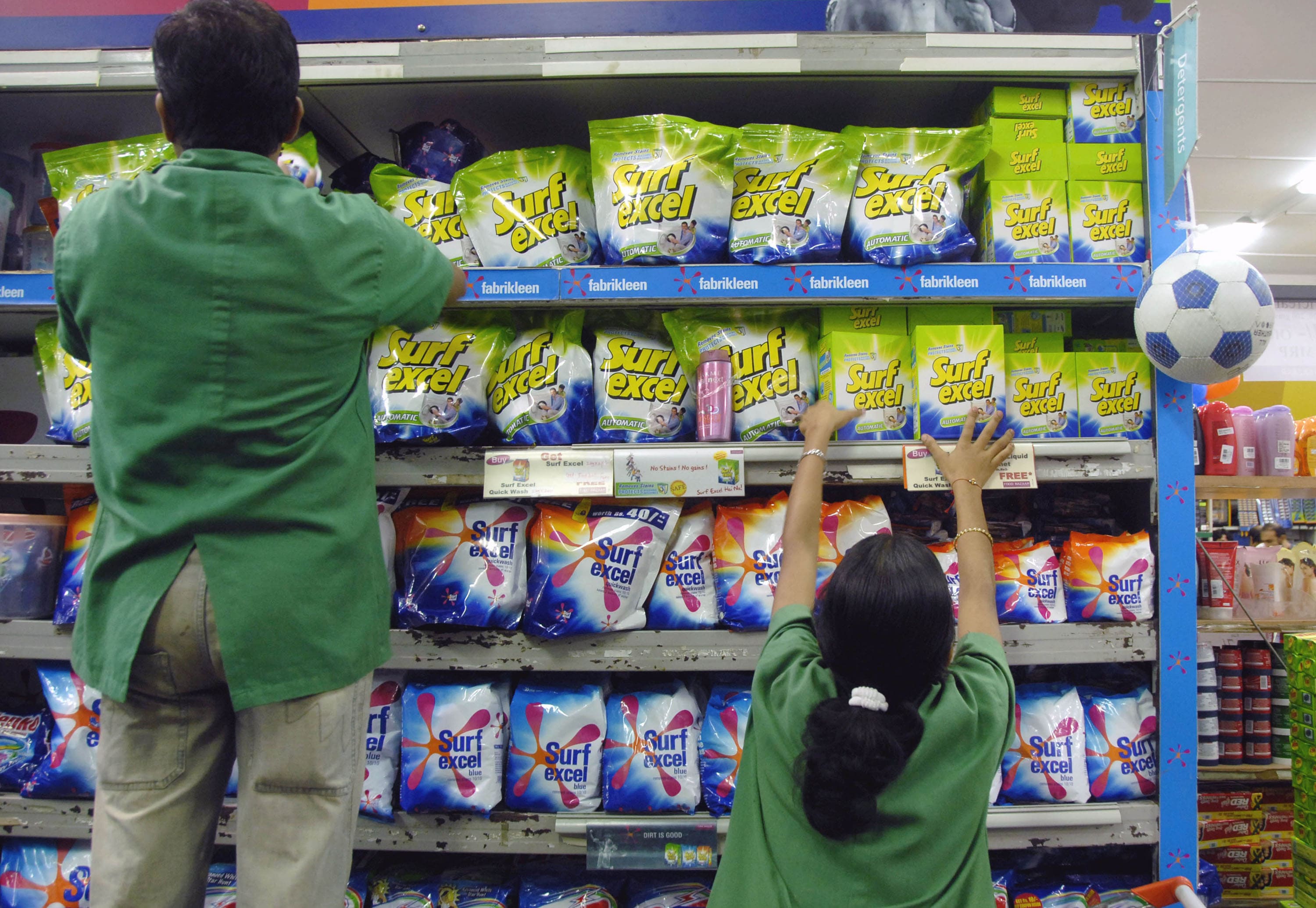
Hindustan Unilever Ltd.'s quarterly profit, revenue and volumes rose as the nation continued to lift the lockdown curbs.
Net profit of India's largest consumer goods company rose 18.8% over the year earlier to Rs 1,921 crore in the quarter ended December, according to an exchange filing. That compares with the Rs 2,052.5-crore consensus estimate of analysts tracked by Bloomberg. The bottom line was also aided by HUL's acquisition of Horlicks in April.
The company's volumes growth during the quarter stood at 4%, excluding the acquisition of GSK.
The volume growth signals a recovery during the festival season as India continued to reopen the economy after imposing one of the world's harshest Covid-19 lockdowns.
Other highlights (year-on-year)
- Revenue rose 20.94% to Rs 11,862 crore—compared with the estimated Rs 11,276 crore.
- Operating profit rose 16.72% to Rs 2,854 crore.
- Margin contracted to 24% from 24.9%.
Commodity costs, especially tea and palm oil, were inflated during the quarter. HUL took a double-digit price hike in tea, and a 2.5% increase in skin cleansing portfolio during the period. Currently, HUL is in the process of taking another price rise of 2.5% for skin cleansing products.
“If you look at skin cleansing, one would have to actually (increase) price somewhere between 7% and 9% to just recover the cost. That is the magnitude of inflation which has happened,” Srinivas Phatak, chief financial officer at HUL, told reporters after announcing the third-quarter results. “This level of inflation does require us to be judicious with pricing and we will continue to do that.”
Rural growth continued to outpace urban during the quarter, and is growing in double digits. “If you see a quarter ago, urban was struggling for multiple reasons and was looking flat to negative, and earlier parts of the previous quarter was in deep negative,” Phatak said, adding urban growth has come back to the positive territory.
HUL's premium portfolio has grown in high single digit.
Also, the company's product assortment has increased compared to the pre-Covid levels, said Sanjiv Mehta, chairman and managing director. The discretionary category, he said, witnessed a recovery during the quarter to end at flattish levels. Out-of-home consumption has also improved.
The company will also continue to focus on innovation and there will be launches in the beauty and personal care space, as well as in the health category.
Shares of HUL fell 0.35% before the results were announced compared with the benchmark Nifty 50's 1.91% drop.

-
The Economic Imperative: Analysing The Material Driving Force Behind India-Canada Strategic Reset

This economic complementarity is further reinforced by deep institutional investment ties and talent mobility, which form the bedrock of the bilateral framework.
-
Medicine Pricing: Where Must Profit Stop?
India must confront excessive margins, hidden incentives and regulatory gaps that threaten the integrity of medicine.
-
Why Amazon And Flipkart Are Struggling To Beat Meesho In India's Smaller Cities
With 274 million users and lowest-cost logistics, Meesho is defending its value commerce crown against giants like Amazon and Flipkart.
-
High US Salaries, No Green Card Certainty: The Financial Calculation Facing Indian H-1B Families
The suspension of PERM processing at eight technology employers does not cancel existing H-1B visas. What it does is force a question many Indian families have been avoiding: is the US salary worth tying your career and family plans to one employer?
-
Swiggy vs Eternal: Food Delivery's Two Rivals Are No Longer In The Same Race
Eternal is building a private AI assistant, dark.ai. Swiggy is still working out how to make Instamart pay, with an operating loss of Rs 895 crore in the July-September quarter while Blinkit stayed profitable.
-
Where You Live Shapes How You Get To Work | The Reason Why
Two-wheelers are the most popular way to get to work in India, accounting for nearly 43% of workplace commutes.
-
Unhedged Position: Can India See An Indonesia-Style Time Correction?
The Nifty is trading below levels it first clocked in 2024. Is there, then, as I have suggested in the headline, potential that the current time correction drags on painfully for the next three-five, even ten years?
-
Navigating Friction And Energy Realities: An Analysis Of Marco Rubio's October Visit To India
Occurring at a critical juncture marked by stalled trade negotiations and escalating geopolitical pressures over global energy supplies, the visit offers a profound window into modern US-India relations.
-
India Exports Capital. Why Not Export Trusteeship?
The big question, then, is whether India can build an institution that global borrowers, investors, banks, and lawyers can trust, even without an Indian connection.
-
France's Economy & Politics Are In Crisis | The Reason Why
Let's look at how the French economy and politics evolved under Nicolas Sarkozy, Franois Hollande and Emmanuel Macron.










