Hard-Landing Dread Eclipses Brief Rally in Emerging Stocks

(Bloomberg) -- The nascent rebound from a two-year low in emerging-market stocks is faltering on concern the Federal Reserve and other global policy makers will fail to orchestrate a soft landing for the world economy.
“It's too early to say this is the bottom. Too early to say the only way is up,” said Wei Li, global chief investment strategist at BlackRock Inc. “We need to see a dovish pivot from the Fed” before buying-the-dip returns, she said.
The MSCI Emerging Markets Index has rebounded 7.3% since hitting a two-year low on May 12, turning positive last month after the longest losing streak in four years. So far in June, however, the stocks gauge is again trailing developed-market peers.
Fed Chair Jerome Powell warned last month that the US will keep raising interest rates until there is “clear and convincing” evidence that inflation is in retreat. His tough stance was supported on Friday by better-than-expected US data that signaled economic optimism even as monetary support is stripped back. Still, concern about the world's economic outlook is keeping a lid on emerging-market stock valuations.
State Street Global Markets said a bigger rally in developing-market equities may not be on the cards this year, while Goldman Sachs Group Inc. said investor focus is on risks to growth as central banks act to cool surging prices.
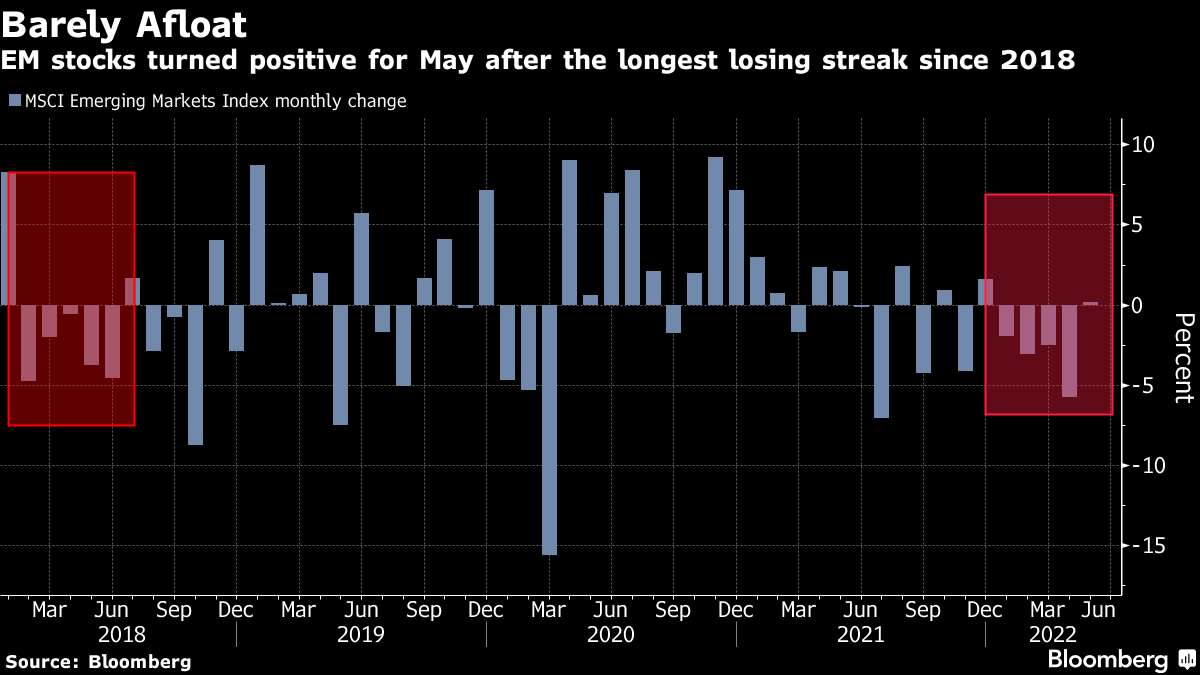
The MSCI gauge has dropped 14% this year, roughly in line with dollar-term returns from the Stoxx Europe 600 index and the S&P 500. Emerging stocks advanced in May on news from China, which relaxed Covid restrictions and moved toward peace with big tech firms, as well as inflows targeted at the safest, least volatile companies.
The iShares MSCI Emerging Markets Minimum Volatility Factor ETF (EEMV) saw a record $2.4 billion of inflows last month. But the biggest US exchange-traded fund tracking the MSCI EM index lost $474 million in May, its fourth month of outflows this year.
Most Vulnerable
Developing countries, where consumers generally have lower disposable incomes and are more affected by surging prices, are grappling with multiple headwinds stoked by soaring energy and commodity costs, supply-chain issues as well as slower growth in the developed world. This is worsening the outlook for company earnings, especially for retailers and consumer-facing staples.
“Discretionary companies will see margin pressure given higher input costs and slower growth if they try to pass higher prices on to the already pinched consumers,” said Daniel Grana, a portfolio manager at Janus Henderson Investors in Boston. “That is particularly true for consumer facing sectors in commodity importing countries” as raw-material exporters benefit from higher prices, he said.
Consumer-price readouts from China, Egypt and Mexico this week is set to shed more light on just how entrenched inflation has become across developing nations, potentially piling more pressure on central bankers to act decisively to reduce price growth without derailing their economies.
“Like all risky assets, emerging markets equities are facing the ‘narrow path' predicament with policy makers aiming to engineer a soft landing,” Goldman Sachs strategist Caesar Maasry said. “Cooling inflationary data would certainly take pressure off equity markets, but growth risks are still in focus.”
Future Prospects
There are some exciting long-term prospects in emerging equities, “but the second half is going be too early for that,” said Daniel Gerard, a senior multi-asset strategist at State Street Global Markets. “We need to see the impact of quantitative tightening” and “get some sense that inflation is in check,” he said.
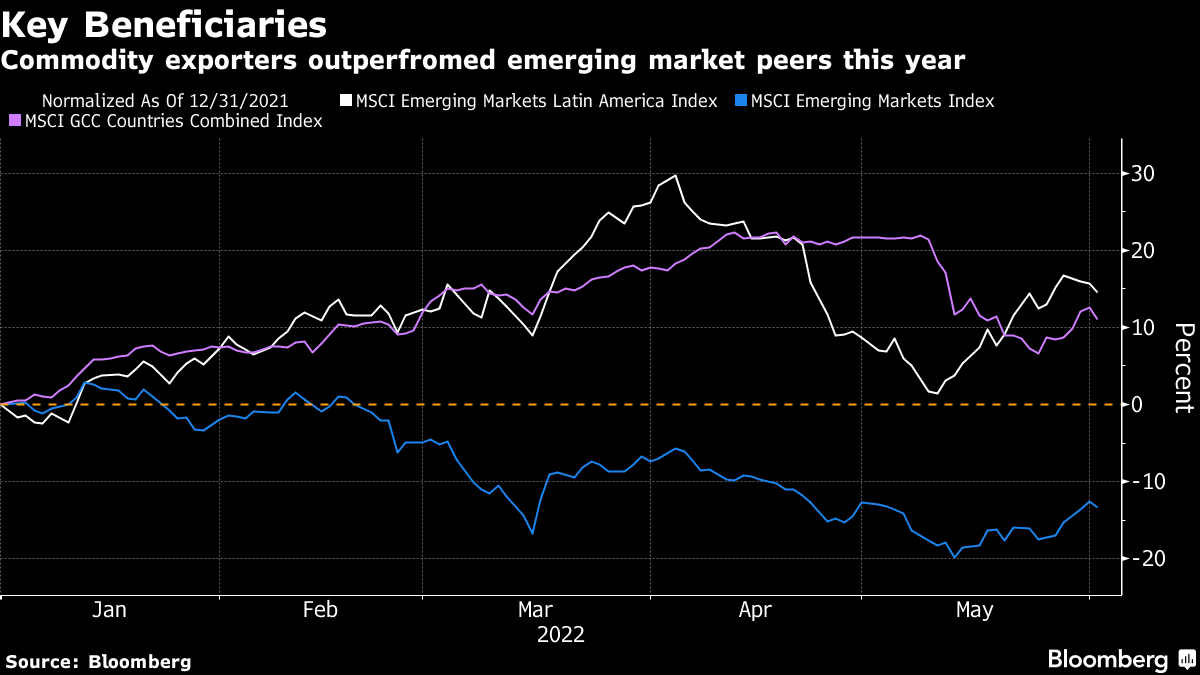
Gerard is betting on Latin America to continue to be the most attractive emerging region due to its exposure to materials and commodities as well as defensive sectors like telecommunication. The MSCI Emerging Markets Latin America Index is up about 15% year-to-date, with Brazilian stocks returning 23%.
Here are the main things to watch in emerging markets in the week ahead:
- Russia is likely to cut interest rates by 100 basis points as policy makers focus their attention on the strength of the exchange rate and cushioning the blow to the economy
- China's PMIs for May suggested the economy is moving out of the worst part of its slump; A barrage of data in the week ahead will probably give further indications that the recovery will be a struggle
- In Chile, the central bank to expected to increase its benchmark interest rate by 75 basis points to 9.0% on Thursday; its quarterly monetary policy report is likely to point to additional hikes and a more challenging outlook
- For Brazil, the coming week brings May inflation print, which may show a slight deceleration in consumer prices, and April retail sales
More stories like this are available on bloomberg.com
©2022 Bloomberg L.P.

-
Talking Points This Week: Leadership Shock At Nvidia, Earnings Strength, And The Fog Over Hormuz

The Anthropic IPO pricing and first trading day, Nvidia's upcoming earnings, and any fresh signals from Iran will set the tone for the following week.
-
Signature Play: The Classic Cocktail Is Dead. Or Is It?
Classic cocktails are disappearing from India's cocktail menus. But they're still being ordered, taught to bartenders and borrowed from. So, who's really having the last drink?
-
A New Samvat Wishlist: Inclusive Prosperity And Human Development
India has strengthened its economic foundations through infrastructure, digital access and enterprise. Its next growth chapter must deepen productivity, create better livelihoods and widen participation in prosperity.
-
Love, Sex Aur Dhokha: The Audacious Plot To Spy On Jensen Huang
A Taipei dinner, a Singapore chip buyer and a suspected Chinese asset: inside the alleged spy operation that got close to NVIDIA's Jensen Huang.
-
Ten Things I Learnt This Samvat
Patience can be a trap. Cheap stocks can stay cheap. Leverage can wipe you out. What did Samvat 2082 teach us? Niraj Shah writes on 10 lessons from the year gone by.
-
Talking Points This Week: Tech Nerves, FII Buying, And A Faraway Banking Shock
The global markets are not shining this Diwali. The exception in the large markets is, India.
-
Midterm Rally Lasted A Day. The Hard Reality Of A Divided US May Last Two Years | Opinion
Between a contested AI boom, a debt ceiling that arrives in 2027 and a president with every incentive to act alone, the next two years may prove more volatile than the first day's rally suggests.
-
Blue Wave Will Derail the AI Trade but Won't Dismantle the AI Era | Unhedged Position
The Democrats' sweep of the US Congress will see politics collide with economic forces both over the long and short term.
-
It's Time To Take The GST Council's Bet On Trust Global
Payment records can prove India's services exports, and clear, proportionate rules can bring foreign digital sellers into the tax net.
-
Opinion | India at 38: From Innovation Overperformer to Innovation Powerhouse
India now has 453 VC-backed deep science startups, 18 of them late-stage, after 117 percent growth since 2020. Laurus Labs, at USD 9.3 billion, is the most valuable deep science company in any middle-income economy outside China.









