HAL Share Price Rises After Winning Bid To Make Small Rockets For ISRO
Shares of Hindustan Aeronautics Ltd. rose nearly 2% on Friday after it won a bid to make small rockets for Indian Space Research Organisation.
The aerospace and defence company will be making two small rockets for ISRO in the next two years, Indian National Space Promotion and Authorisation Centre Chairman, Pawan Goenka, said in a press conference according to a report by Bloomberg.
This comes a day after the company announced that its board is set to meet on June 27 to consider the final dividend for financial year 2025. This marks the second dividend that HAL will issue this fiscal. The defence PSU had paid an interim dividend of Rs 25 per share in February.
The government signed two contracts worth Rs 62,700 crore with HAL in April, for 156 light combat helicopters Prachand for the armed forces. Preceding this, the company received the first of the nearly hundred F404-IN20 engines from US defence major GE Aerospace for the Tejas Light Combat Aircraft Mk-1A variant after years of delay.
Analysts at JPMorgan said the estimated order book in the financial year ending March 31, 2025, stood at Rs 1.9 lakh crore. The focus will now be on the pace of execution of orders.
Moreover, new contracts such as for Su-30MKI upgrade, Tejas Mk2 variant, multi-role helicopters and advanced medium combat aircraft might land on HAL as the sole domestic supplier.
Hindustan Aeronautics Share Price Today
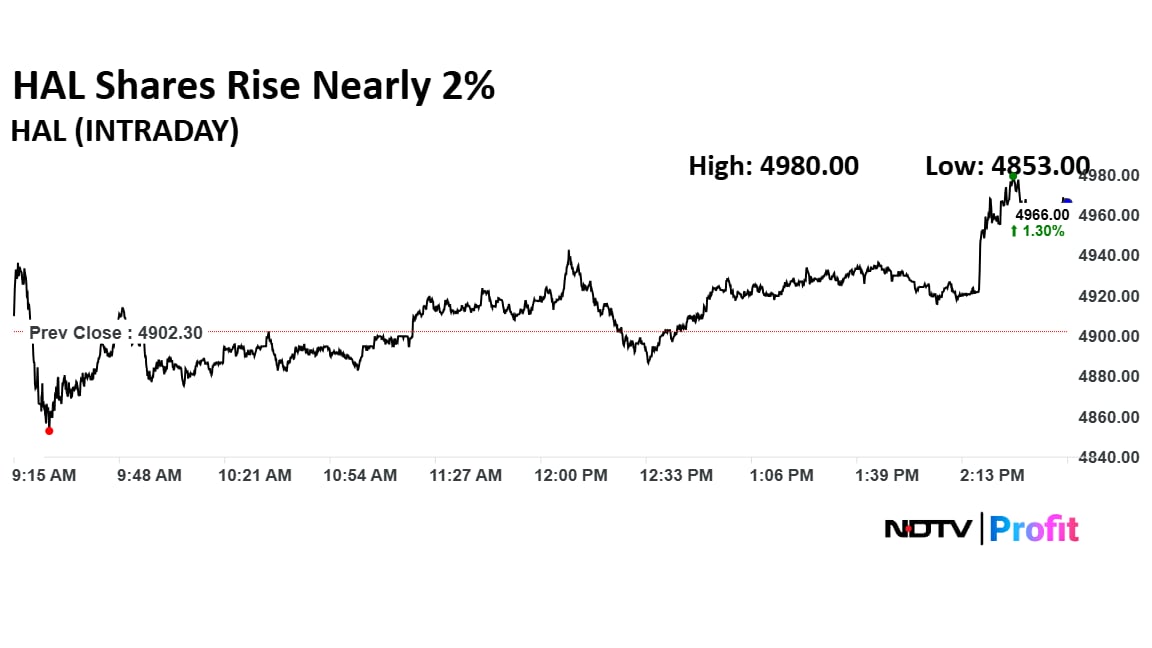
Shares of HAL rose as much as 1.58% to Rs 4,980 apiece, the highest level since June 19. They pared gains to trade 1.14% higher at Rs 4,956.90 apiece, as of 2:42 p.m. This compares to a 1.02% advance in the NSE Nifty 50.
The stock has fallen 6.26% in the last 12 months and risen 18.66% year-to-date. Total traded volume so far in the day stood at 2.74 times its 30-day average. The relative strength index was at 52.92.
Out of 20 analysts tracking the company, 15 maintain a 'buy' rating, three recommend a 'hold' and two suggest 'sell', according to Bloomberg data. The average 12-month consensus price target implies an upside of 13.9%.

-
A New Samvat Wishlist: Inclusive Prosperity And Human Development

India has strengthened its economic foundations through infrastructure, digital access and enterprise. Its next growth chapter must deepen productivity, create better livelihoods and widen participation in prosperity.
-
Love, Sex Aur Dhokha: The Audacious Plot To Spy On Jensen Huang
A Taipei dinner, a Singapore chip buyer and a suspected Chinese asset: inside the alleged spy operation that got close to NVIDIA's Jensen Huang.
-
Ten Things I Learnt This Samvat
Patience can be a trap. Cheap stocks can stay cheap. Leverage can wipe you out. What did Samvat 2082 teach us? Niraj Shah writes on 10 lessons from the year gone by.
-
Talking Points This Week: Tech Nerves, FII Buying, And A Faraway Banking Shock
The global markets are not shining this Diwali. The exception in the large markets is, India.
-
Midterm Rally Lasted A Day. The Hard Reality Of A Divided US May Last Two Years | Opinion
Between a contested AI boom, a debt ceiling that arrives in 2027 and a president with every incentive to act alone, the next two years may prove more volatile than the first day's rally suggests.
-
Blue Wave Will Derail the AI Trade but Won't Dismantle the AI Era | Unhedged Position
The Democrats' sweep of the US Congress will see politics collide with economic forces both over the long and short term.
-
It's Time To Take The GST Council's Bet On Trust Global
Payment records can prove India's services exports, and clear, proportionate rules can bring foreign digital sellers into the tax net.
-
Opinion | India at 38: From Innovation Overperformer to Innovation Powerhouse
India now has 453 VC-backed deep science startups, 18 of them late-stage, after 117 percent growth since 2020. Laurus Labs, at USD 9.3 billion, is the most valuable deep science company in any middle-income economy outside China.
-
Navigating Energy Crossroads: S Jaishankar's Call For Diversified Supply Chains At G20 Ministerial Meeting
As geopolitical fault lines continue to test maritime trade routes and commodity flows, Jaishankar's message remains pertinent: true economic resilience requires open markets, protected transit lines, and a genuine commitment to multilateral cooperation rather than coercion.









