Good Monsoon May Dampen Power Companies’ Second Quarter Performance
The July to September quarter is expected to be a dull one for power utilities. Sluggish energy demand triggered by the strong monsoon and absence of favourable base effect are likely to impact the performance.
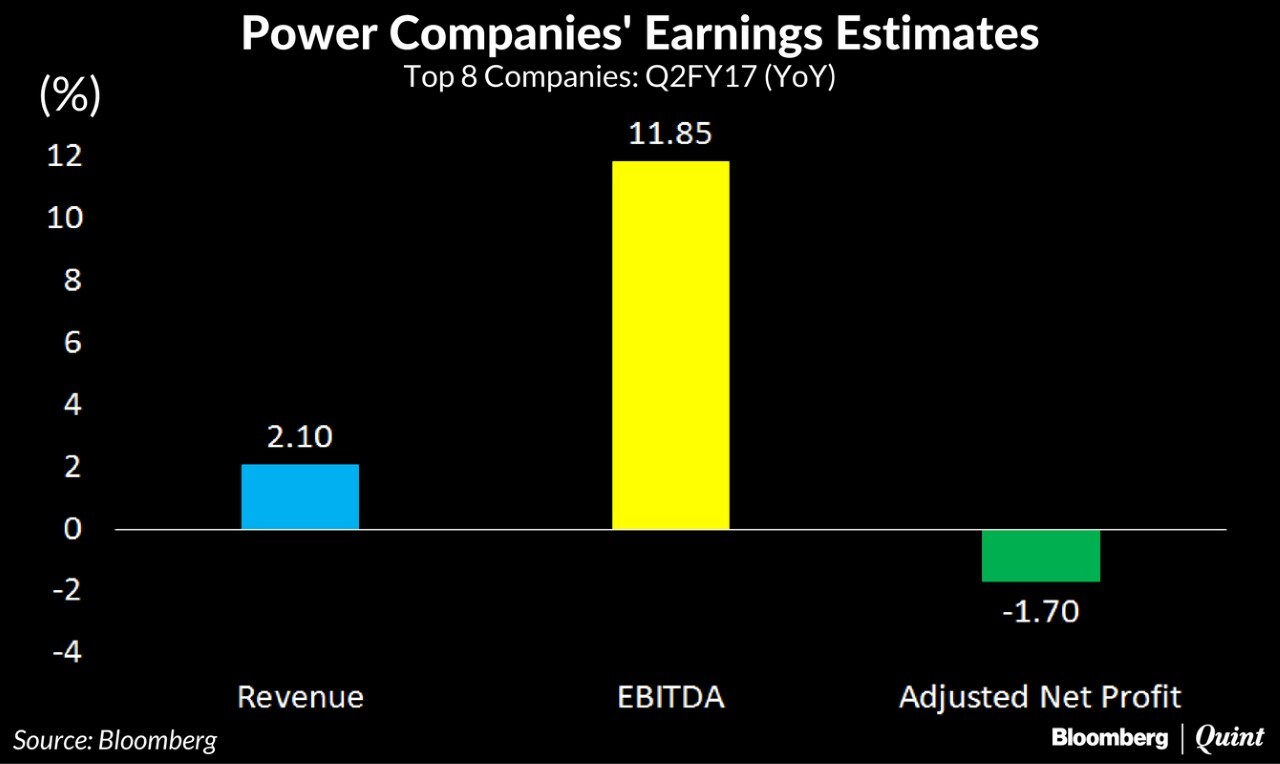
The top eight power companies are expected to report 2.1 percent growth in revenue for the September-ended quarter compared to the corresponding quarter last year, according to Bloomberg consensus estimates. The earnings before interest, tax, depreciation and amortisation (EBITDA) is likely to grow 11.85 percent while net profit is expected to decline 1.70 percent.
Profitability Problem?
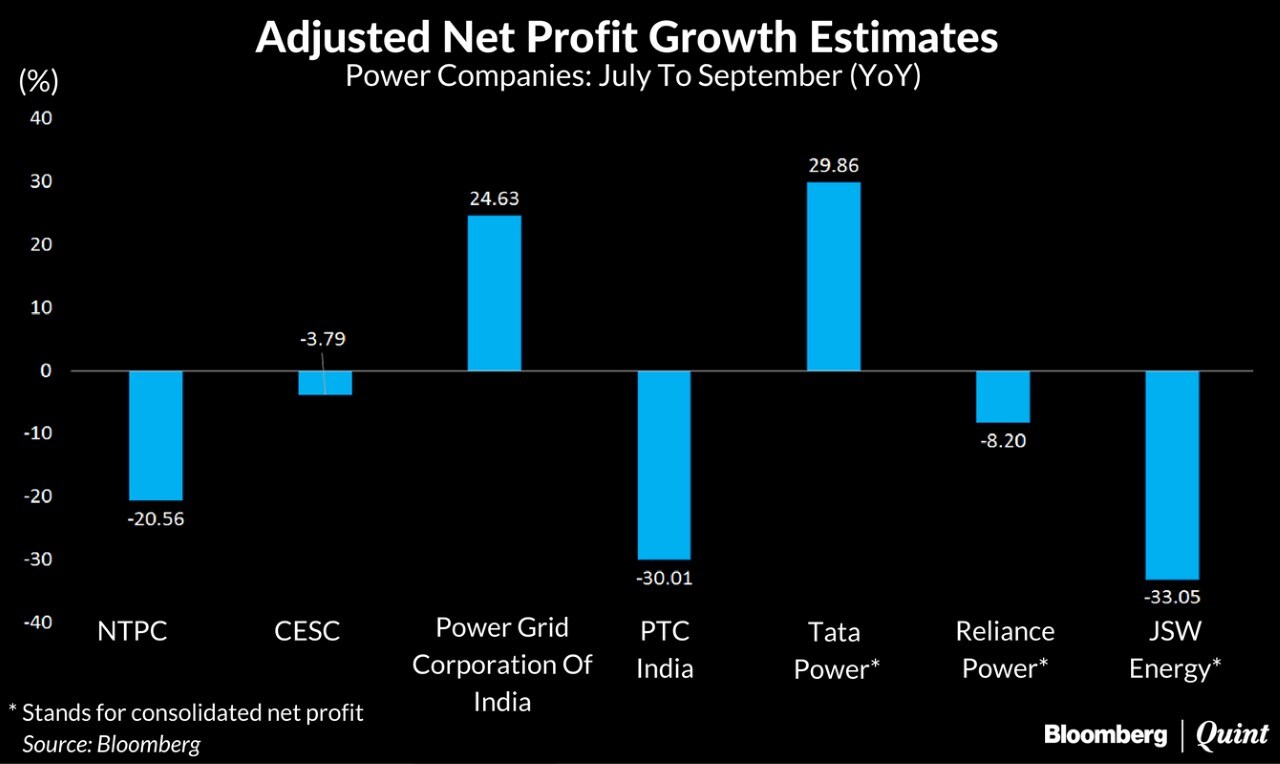
Only two out of the top seven power companies - Power Grid Corporation of India Ltd. and Tata Power Ltd. - are expected to report profit growth in the September quarter.
PGCIL's profit is seen rising 24.63 percent driven by the impact of the Rs 31,780 crore capital expenditure the company undertook in financial year 2015-16, while Tata Power's profit is seen increasing 29 percent due to reduction in depreciation and finance costs, and a lower tax rate.
Demand Dented?
Sluggish power demand is expected to drag power generation growth lower by 1.3 percent in the quarter, corroborating the belief that the impact of the Narendra Modi government's Ujwal DISCOM Assurance Yojana will be weaker than previously predicted. This is in stark contrast to the 9.1 percent growth in power generation in the April to June quarter.
Heavy rainfall and a slow pick up in industrial activity, as reflected in Index of Industrial Production growth of just 0.6 percent year-to-date, is likely to have dented electricity demand.
Plant Load Factor
The industry's plant load factor is seen declining 438 bps to 42.7 percent due to moderate demand. PLF may decline across coal and hydro segments, but is expected to rise in the gas and nuclear segment due to improved fuel supply and low base effect, brokerage house Emkay Securities wrote in a note to clients. Strong generation growth across the gas segment was driven by the government's push to supply gas at subsidised rates to stranded plants under the gas pooling mechanism, Emkay added.
Key Monitorables
NTPC
- Management commentary on implementation of gross calorific value measurement for coal at wagon unloading point and the resultant fuel cost under-recovery.
- Impact of recent tariff orders passed by Central Electricity Regulatory Commission, allowing fuel cost recovery only as per ‘as billed' method.
- Updated plant commissioning schedule along with details about power purchase agreement tie-up of upcoming solar capacity.
PGCIL
- Management's guidance on commissioning timeline and capital expenditure for financial year 2016-17.
- Update on status of Champa-Kurukshetra high-voltage, direct current project.
- Clarity on project pipeline under the 13th Five-Year Plan.
Tata Power
- Update on quantum and timing of recognition of relief provided under force majeure clause by Appellate Tribunal for Electricity.
- Update on coal mine sale deal closure.
JSW Energy
- Management's guidance on short-term power rates.
- Update on commencement of power supply to Karnataka from Vijayanagar power plant under the medium term power purchase agreement.
Reliance Power
- Update on progress of the gas-based power project in Bangladesh.
- Management commentary on various ongoing litigations including force majeure applicability to rupee depreciation, coal block de-allocation, and Sasan commercial operational date issue.
CESC
- Update on commencement of 187 mega watt power supply from Chandrapura plant.
- Management's guidance on expected coal cost under-recovery in financial year 2016-17 and the break-even of the company's retail business.
- Expected advertising spend by group companies on Indian Premier League franchise and losses related to the franchise.
PTC India
- Future investment plans
- Update on wind power investment
- Update on PTC India's partnership with Solar Energy Corporation of India and Indian Railways and consultancy income earned from these partnerships.
Overall, half-yearly balance sheet would be keenly watched to assess the impact of implementation of new accounting standards Ind-AS.
(These expectations have been compiled from reports of HDFC Institutional Research, Antique Stock Broking, ICICI Direct, and Kotak Institutional Securities.)

-
The Economic Imperative: Analysing The Material Driving Force Behind India-Canada Strategic Reset

This economic complementarity is further reinforced by deep institutional investment ties and talent mobility, which form the bedrock of the bilateral framework.
-
Medicine Pricing: Where Must Profit Stop?
India must confront excessive margins, hidden incentives and regulatory gaps that threaten the integrity of medicine.
-
Why Amazon And Flipkart Are Struggling To Beat Meesho In India's Smaller Cities
With 274 million users and lowest-cost logistics, Meesho is defending its value commerce crown against giants like Amazon and Flipkart.
-
High US Salaries, No Green Card Certainty: The Financial Calculation Facing Indian H-1B Families
The suspension of PERM processing at eight technology employers does not cancel existing H-1B visas. What it does is force a question many Indian families have been avoiding: is the US salary worth tying your career and family plans to one employer?
-
Swiggy vs Eternal: Food Delivery's Two Rivals Are No Longer In The Same Race
Eternal is building a private AI assistant, dark.ai. Swiggy is still working out how to make Instamart pay, with an operating loss of Rs 895 crore in the July-September quarter while Blinkit stayed profitable.
-
Where You Live Shapes How You Get To Work | The Reason Why
Two-wheelers are the most popular way to get to work in India, accounting for nearly 43% of workplace commutes.
-
Unhedged Position: Can India See An Indonesia-Style Time Correction?
The Nifty is trading below levels it first clocked in 2024. Is there, then, as I have suggested in the headline, potential that the current time correction drags on painfully for the next three-five, even ten years?
-
Navigating Friction And Energy Realities: An Analysis Of Marco Rubio's October Visit To India
Occurring at a critical juncture marked by stalled trade negotiations and escalating geopolitical pressures over global energy supplies, the visit offers a profound window into modern US-India relations.
-
India Exports Capital. Why Not Export Trusteeship?
The big question, then, is whether India can build an institution that global borrowers, investors, banks, and lawyers can trust, even without an Indian connection.
-
France's Economy & Politics Are In Crisis | The Reason Why
Let's look at how the French economy and politics evolved under Nicolas Sarkozy, Franois Hollande and Emmanuel Macron.










