US Stock Rally Sputters As Trump Ends Canada Talks: Markets Wrap

Wall Street traders weighing a flurry of tariff headlines saw gains in stocks waning as President Donald Trump said he was ending all trade discussions with Canada, fueling uncertainties about progress in negotiations with America's top commercial partners. The loonie slipped.
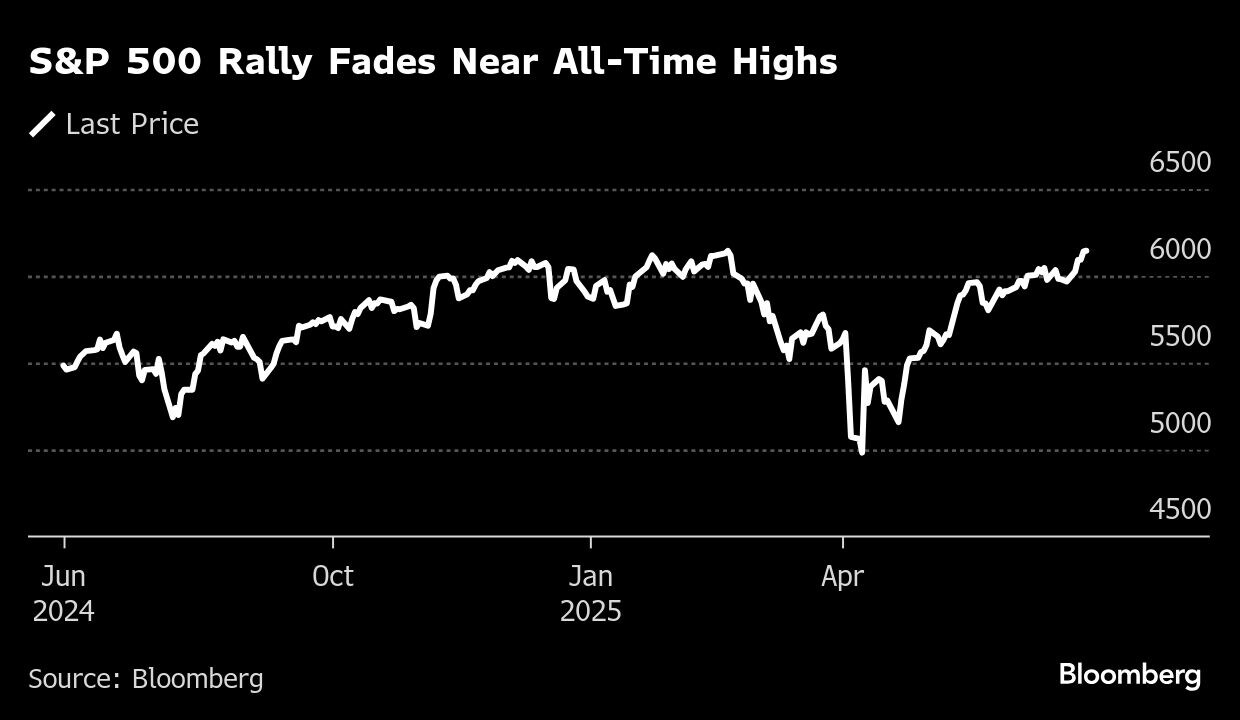
The S&P 500 was little changed after an advance that earlier approached 1%. The equity benchmark hovered near its February closing record of 6,144.15. Trump threatened to impose a fresh tariff rate within the next week on Canada, with the country moving to implement a digital services tax. Bonds wavered after a solid rally in the past few days. The US dollar rose.
An earlier rally in stocks was in part driven by Trump's remarks that the US had made trade deals with “probably four or five different countries,” naming agreements with China and the UK. That's even as he hardened his threat to raise tariffs on certain countries by the July 9 deadline.
“There's the upcoming deadline, when the current reciprocal tariff truce is due to expire. Unless it's extended — or replaced by something more concrete — we could be in for another wave of trade tensions,” said Fawad Razaqzada at City Index and Forex.com.
Trump in April put tariffs on dozens of American trading partners on pause for three months a week after declaring them, when markets panicked over the possibility they could trigger a global recession. Since then, the fast equity rebound has defied Wall Street expectations, underscoring investor conviction that the economy is withstanding policy uncertainty.
Treasury Secretary Scott Bessent signaled there may be some extensions to wrap up major pacts by Labor Day. European Commission President Ursula von der Leyen told EU leaders behind closed doors she was confident a deal could be reached before the deadline, according to people familiar with the matter. And China confirmed details of a trade framework with Washington.
On the economic front, consumer sentiment rose sharply in June to a four-month high and inflation expectations improved notably. Data also showed that while the core personal consumption expenditures price index rose slightly more than expected, the pace was seen as consistent with tame price pressures that will allow the Federal Reserve to resume its rate cuts later this year.
“A window of opportunity is more likely to open at one of the final three policy meetings of the year — in September, October or December — when the impact of tariff increases on inflation becomes clearer,' said Gary Schlossberg at Wells Fargo Investment Institute.
Fed Chair Jerome Powell told lawmakers this week that he expects inflation to pick up in June, July and August as tariffs become increasingly reflected in consumer prices, though he added if that prediction fails to materialize, the US central bank could resume rate reductions sooner rather than later.
Money markets continued to project at least two Fed cuts by the end of this year. Wagers on a third reduction could gain momentum if next Thursday's jobs report is weak.
To Bret Kenwell at eToro, the latest PCE reading showed that inflation is still not spiraling out of control. However, it did snap a three-month streak of lower year-over-year readings, while last month's figures were revised higher.
“Today's inflation report shouldn't be enough to give markets a significant scare, but it probably dashes the slim hopes investors had for a July rate cut,” Kenwell said. “Further, it may give investors a bit of hesitation with stocks surging into record high territory as we near quarter-end.”
Kenwell says that stocks can do pretty well in a mild-inflationary environment.
“The key will be a reassuring earnings cycle and a strong consumer as we go into the second half of the year,” he noted.
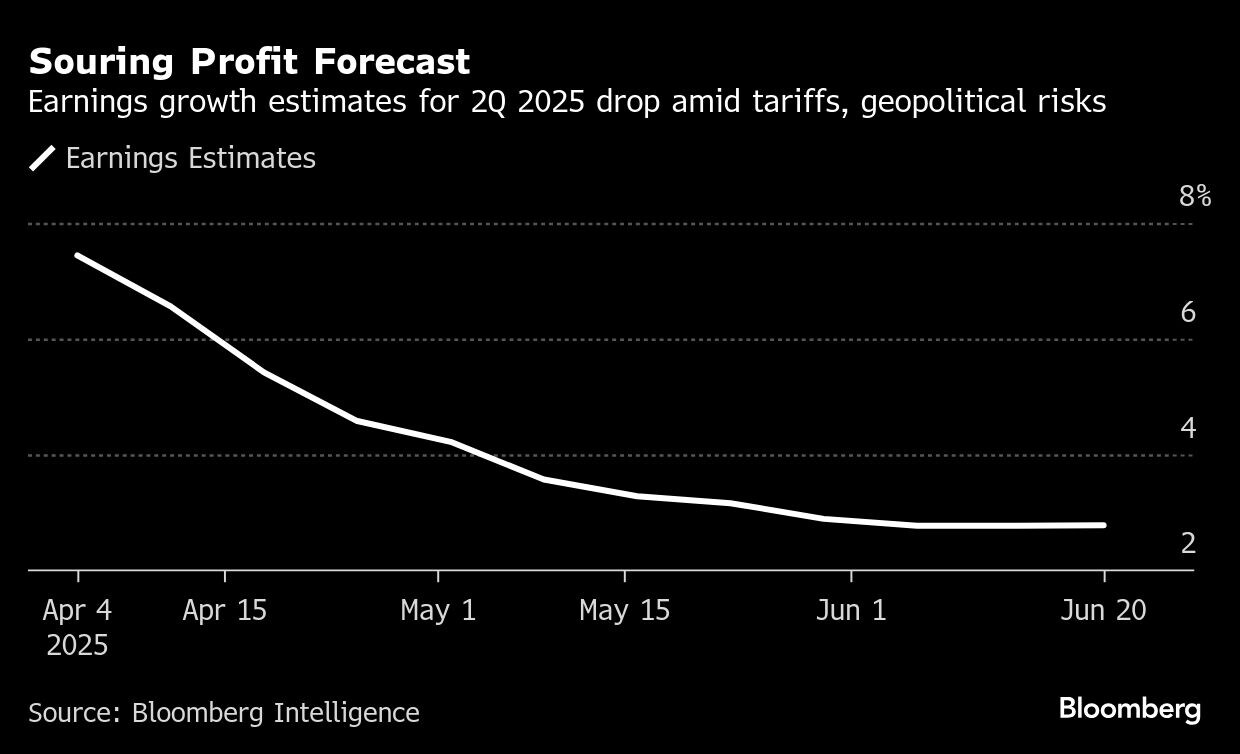
Indeed, with earnings season just weeks away, stocks will get a major test. Wall Street sees profit growth of 2.8% year-over-year for the second quarter for the benchmark, according to data compiled by Bloomberg Intelligence. That would be the smallest jump in two years. The lackluster forecasts magnify concerns from some market watchers that valuations are stretched.
The risk of a speculative stock bubble is increasing as expectations of rate cuts draw massive investment flows, according to Bank of America Corp.'s Michael Hartnett. Already this year, $164 billion has flowed into US equities, on course for the third-largest annual inflow in history, he said, citing data from EPFR Global.
Stocks
The S&P 500 was little changed as of 2:48 p.m. New York time
The Nasdaq 100 was little changed
The Dow Jones Industrial Average rose 0.6%
The MSCI World Index rose 0.2%
Bloomberg Magnificent 7 Total Return Index fell 0.2%
The Russell 2000 Index fell 0.4%
Currencies
The Bloomberg Dollar Spot Index rose 0.2%
The euro was little changed at $1.1695
The British pound fell 0.3% to $1.3691
The Japanese yen fell 0.2% to 144.75 per dollar
The Canadian dollar fell 0.6% to 1.3728
Cryptocurrencies
Bitcoin fell 1.1% to $106,640.39
Ether fell 2.2% to $2,392.69
Bonds
The yield on 10-year Treasuries advanced four basis points to 4.28%
Germany's 10-year yield advanced two basis points to 2.59%
Britain's 10-year yield advanced three basis points to 4.50%
Commodities
West Texas Intermediate crude rose 0.2% to $65.37 a barrel
Spot gold fell 1.6% to $3,273.15 an ounce

-
Getting To Work Costs Women More | The Reason Why

It is not just about women paying more than men. It is about women paying much more in cities than in villages.
-
AI Bias In Investing Cannot Be Eliminated, But It Can Be Governed
Framing is a particularly important example as identical financial information presented in terms of gains rather than losses can lead an LLM to reach a different assessment.
-
Joining The Dots | Dark Skies, Steady Diya: Why Hope Holds This Diwali
With war, a weak rupee and foreign outflows weighing on sentiment, policymakers at the NDTV World Summit and market veterans at NDTV Profit Ignite: Diwali Edition offered the same advice: stay invested and filter out the noise.
-
The Curious Case of Equitas Small Finance Bank And A CEO Who Quit For Stock
PN Vasudevan believes persistent investor concerns over a perceived conflict of interest had become a governance overhang on Equitas Small Finance Bank's stock, even as the lender improved profitability and asset quality.
-
Talking Points This Week: AI Cash Burn, A Tiger Comeback And An India That Still Finds Its Own Path
India is not immune to higher oil or tighter global liquidity, yet its earnings base is broader, its domestic policy levers are still available.
-
Foreign Investors Own Half Of HDFC Bank and ICICI Bank. An LTCG Cut Could Matter Most Here
Foreign portfolio investors have US$115 billion parked in HDFC Bank, ICICI Bank. If the government cuts long-term capital gains tax, Jefferies says returning foreign money could land here first.
-
'Never Seen This Level Of Negativity': Sandeep Tandon Says The Next Rally May Be Closer Than You Think
Veteran investor Sandeep Tandon says foreign selling is easing, large-caps are due a comeback and mid-caps are crowded, while he turns positive on gold, power and pharma this Diwali.
-
Indians Stay With Family, Not In Hotels | The Reason Why
India still lacks enough clean, reliable and affordable hotels for budget-conscious travellers.
-
The Economic Imperative: Analysing The Material Driving Force Behind India-Canada Strategic Reset
This economic complementarity is further reinforced by deep institutional investment ties and talent mobility, which form the bedrock of the bilateral framework.
-
Medicine Pricing: Where Must Profit Stop?
India must confront excessive margins, hidden incentives and regulatory gaps that threaten the integrity of medicine.










