Five Key Charts to Watch in Global Commodities This Week
(Bloomberg) -- The Organization of Petroleum Exporting Countries and its allies announced a surprise output cut, while Exxon Mobil Corp. is due to update investors on the company's plans to help reduce greenhouse gas emissions in support of a net-zero future. Here are five notable charts to watch in global commodities as the first trading week of April gets underway.
OPEC+
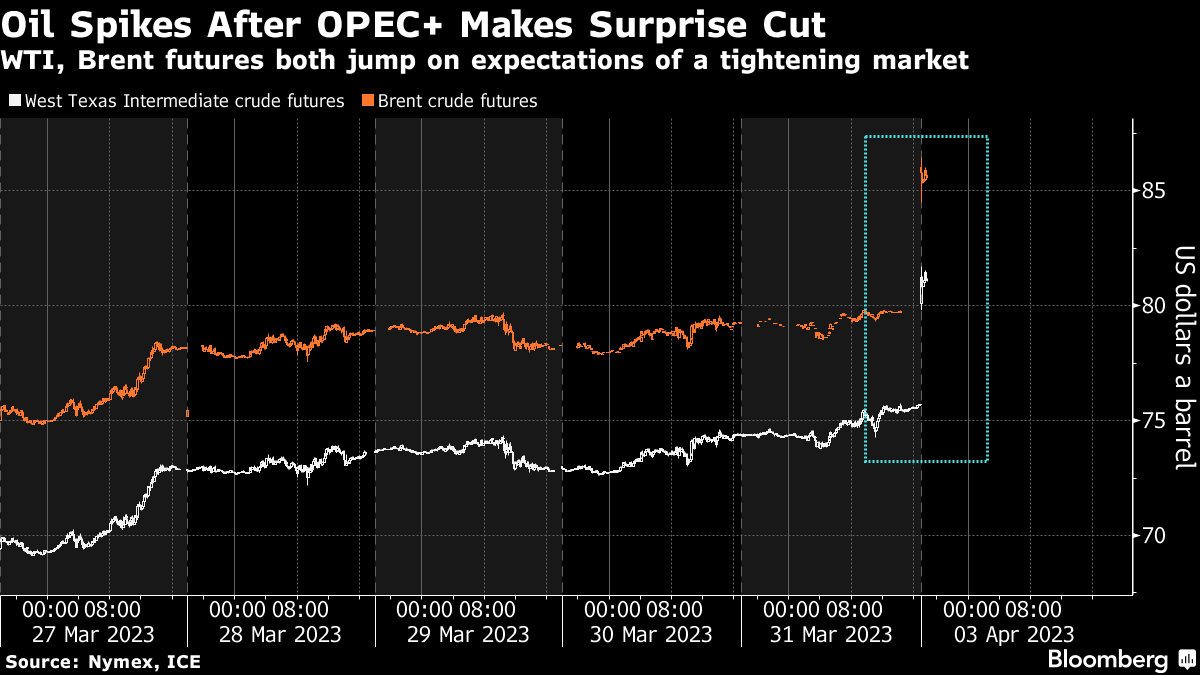
Oil surged to start the week after OPEC+ unexpectedly announced production cuts on Sunday of more than 1 million barrels a day, abandoning previous assurances that it would hold supply steady. It's a significant reduction for a market where supply was looking tight for the latter part of the year. Saudi Arabia led the cartel by pledging its own 500,000 barrel-a-day supply reduction. In response, Goldman Sachs Group Inc. increased its price forecast for Brent at year-end to $95 a barrel.
Big Oil
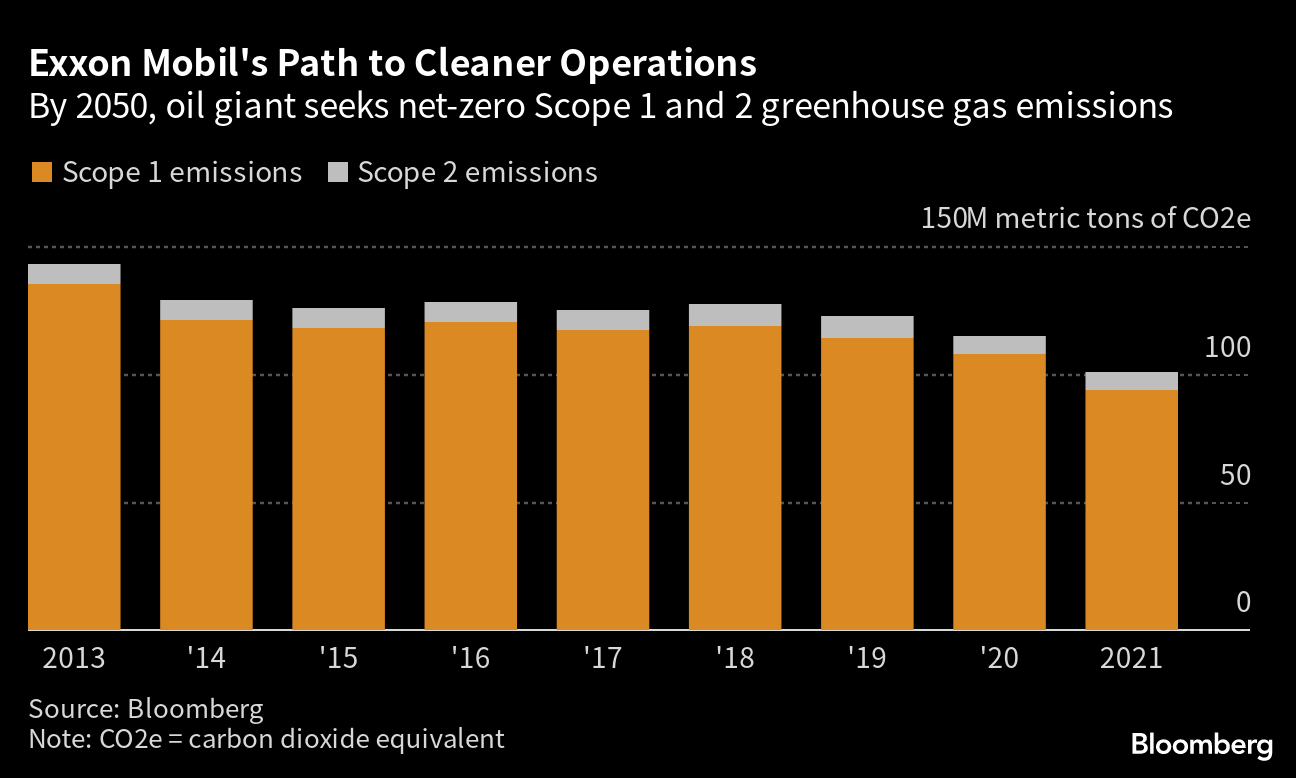
Exxon will provide details of its low-carbon solutions business at an investor event on Tuesday. Through a combination of carbon capture and storage, hydrogen and lower-emission fuels, the oil behemoth aims to achieve net-zero Scope 1 and Scope 2 greenhouse gas emissions from its operated assets by 2050. There is also added financial incentive to achieve these goals: the US Inflation Reduction Act, passed last year, offers generous tax credits for all forms of clean energy including Exxon's favored technology — carbon capture.
Electric Vehicles
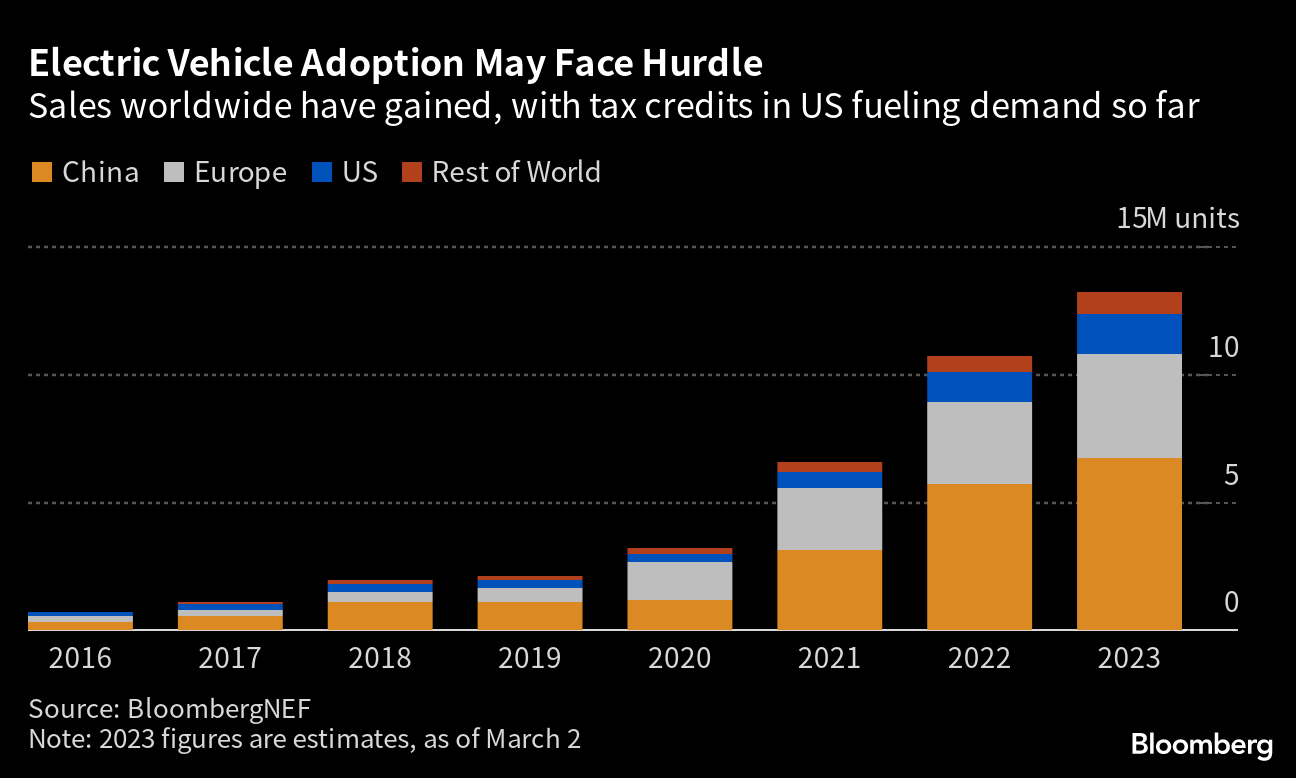
If you're looking to buy an EV in the US, you'd better move quickly. The Biden Administration last week revealed long-awaited criteria to qualify for the full $7,500 tax credit provision in the Inflation Reduction Act, a development that is expected to reduce the number of eligible models. The new rules, which aim to make the US less reliant on batteries and critical minerals shipped from China, will take effect on April 18. Until then, consumers can claim the full credit when they purchase a currently eligible EV. Generous tax incentives so far have led to a jump in adoption in the US.
Food Costs
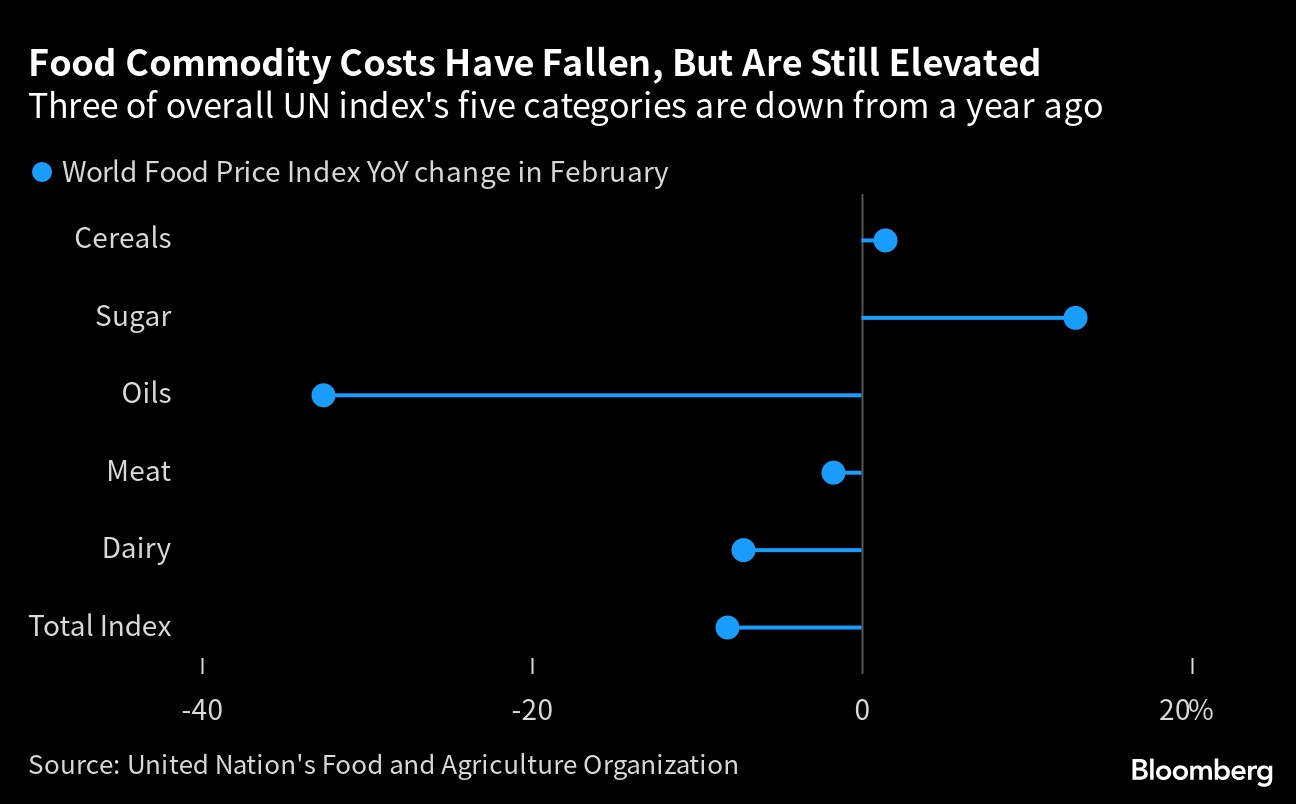
The United Nations is set to release its monthly report on global food costs on Friday. Its price index, which tracks five major exported food commodity groups, fell for 11 straight months in February to the lowest level since September 2021 after surging to a record last year following Russia's invasion of Ukraine. The decline was driven by a huge plunge in cooking oils, as well as drops in dairy and meat. Even so, food inflation is very real — the index is still above the 10-year average — and it takes time for these decreases to filter through to supermarkets, where prices remain elevated due to energy, labor and transport costs.
Shipping
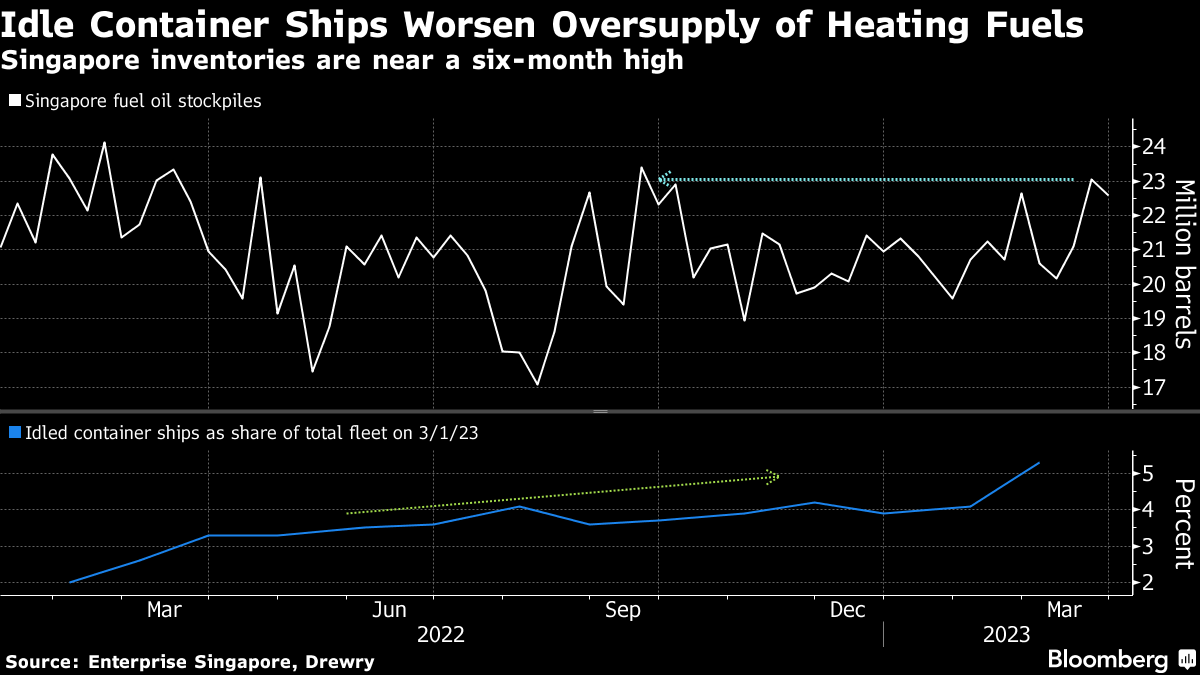
A milder-than-expected winter in Europe has has made it less lucrative for Asian traders to export diesel supplies to the continent amid weaker consumption. That has contributed to a build-up of oil product stockpiles in Singapore, as traders put excess cargoes into storage tanks. The oversupply is being exacerbated by a growing number of idled container ships. As more vessels are temporarily taken out of service globally, demand for bunker fuel that the ships use has also dropped. Stockpiles of fuel oil in Singapore — one of the most popular refueling hubs in Asia — are near a six-month high. Refining margins have taken a hit, and while upcoming plant maintenance could trim the supply, slower demand for shipping could linger for the next few months as the global economy slows.
--With assistance from Julian Lee, Ann Koh, Kevin Crowley and Agnieszka de Sousa.
(Updates with oil prices and more OPEC+ context in second paragraph.)
More stories like this are available on bloomberg.com
©2023 Bloomberg L.P.

-
The Economic Imperative: Analysing The Material Driving Force Behind India-Canada Strategic Reset

This economic complementarity is further reinforced by deep institutional investment ties and talent mobility, which form the bedrock of the bilateral framework.
-
Medicine Pricing: Where Must Profit Stop?
India must confront excessive margins, hidden incentives and regulatory gaps that threaten the integrity of medicine.
-
Why Amazon And Flipkart Are Struggling To Beat Meesho In India's Smaller Cities
With 274 million users and lowest-cost logistics, Meesho is defending its value commerce crown against giants like Amazon and Flipkart.
-
High US Salaries, No Green Card Certainty: The Financial Calculation Facing Indian H-1B Families
The suspension of PERM processing at eight technology employers does not cancel existing H-1B visas. What it does is force a question many Indian families have been avoiding: is the US salary worth tying your career and family plans to one employer?
-
Swiggy vs Eternal: Food Delivery's Two Rivals Are No Longer In The Same Race
Eternal is building a private AI assistant, dark.ai. Swiggy is still working out how to make Instamart pay, with an operating loss of Rs 895 crore in the July-September quarter while Blinkit stayed profitable.
-
Where You Live Shapes How You Get To Work | The Reason Why
Two-wheelers are the most popular way to get to work in India, accounting for nearly 43% of workplace commutes.
-
Unhedged Position: Can India See An Indonesia-Style Time Correction?
The Nifty is trading below levels it first clocked in 2024. Is there, then, as I have suggested in the headline, potential that the current time correction drags on painfully for the next three-five, even ten years?
-
Navigating Friction And Energy Realities: An Analysis Of Marco Rubio's October Visit To India
Occurring at a critical juncture marked by stalled trade negotiations and escalating geopolitical pressures over global energy supplies, the visit offers a profound window into modern US-India relations.
-
India Exports Capital. Why Not Export Trusteeship?
The big question, then, is whether India can build an institution that global borrowers, investors, banks, and lawyers can trust, even without an Indian connection.
-
France's Economy & Politics Are In Crisis | The Reason Why
Let's look at how the French economy and politics evolved under Nicolas Sarkozy, Franois Hollande and Emmanuel Macron.










