Fidelity Manager Dumps Nearly All Treasuries On Growth Optimism

(Bloomberg) -- A Fidelity International money manager has sold the vast majority of US Treasuries from funds he oversees on expectations the world's biggest economy still has room to expand.
Singapore-based George Efstathopoulos, who helps manage about $3 billion of income and growth strategies at Fidelity, sold the bulk of his 10-year and 30-year Treasuries holdings in December. He is now turning to assets that typically do well in times of good economic growth to boost returns.

George Efstathopoulos (Source: Bloomberg)
“We don't expect sort of a recession anymore,” said Efstathopoulos. “The probability of no landing is still small, but it's been increasing. If that increases much more, potentially we will not be talking about Fed cuts anymore” in 2024.
Efstathopoulos is among those cooling on Treasuries as the US economy's resilience forces investors to rethink bets on interest-rate cuts. Some are going a step further, speculating the Federal Reserve's next move may even be a hike, after the recent strong inflation and jobs reports.
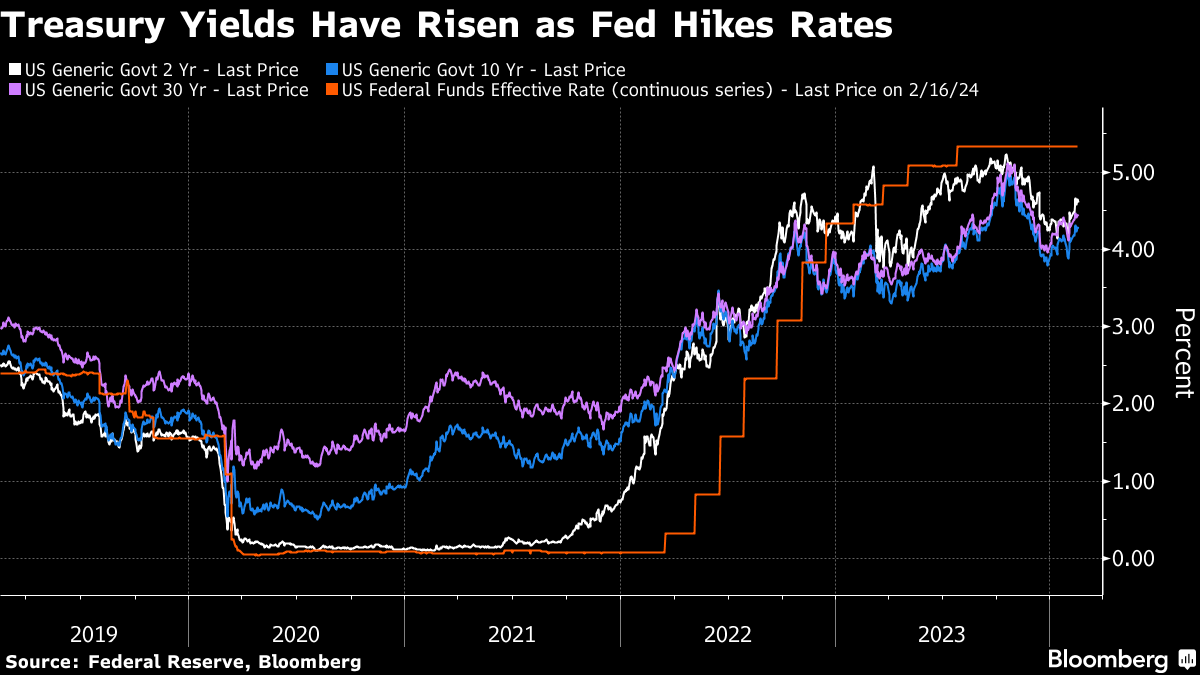
Traders are now pricing under four quarter-point interest-rate cuts in 2024, down from wagers for 150 basis points of cuts this year starting March. Bonds are reflecting the swing in sentiment, with 10-year US yields advancing more than 40 basis points since the start of the year to 4.3%, as comments from Fed officials also reinforce expectations of higher-for-longer rates.
Fed Vice Chair Philip Jefferson warned on Thursday about the dangers of easing too much in response to easing price pressures, while Fed Minneapolis President Neel Kashkari said “we still have some work to do” on inflation.
Efstathopoulos sold Treasuries as concern over US growth faded. The asset is typically less attractive amid elevated borrowing costs, and when prices reflect the Fed's median forecast of three quarter point interest-rate cuts this year.
He also sold bonds from other developed markets, including gilts and bunds, while leaving some exposure to inflation-linked US government debt and an idiosyncratic position in Austrian bonds.
The US economy is showing “more signs of re-acceleration than it is of slowing down,” Efstathopoulos said, adding that “I wouldn't be surprised in a couple of quarters down the road we end up seeing sort of manufacturing PMI in a more expansion sort of territory” in developed markets.
Data on Thursday reinforced his view as US jobless claims dropped to the lowest level in a month, underscoring the strength of the economy.
Still, funds such as Jupiter Asset Management are taking a different view, opting to load up on Treasuries while seeing risks of a hard landing after the Fed's most aggressive tightening cycle in decades.
Prefers Stocks
Efstathopoulos helps oversee a number of strategies, including a global multi-asset growth and income fund that gained 5% in the year to Jan. 31, according to a company factsheet.
In comparison, the Bloomberg Global-Aggregate Total Return Index of worldwide investment-grade bonds rose about 0.9% in the same period. The fund had dropped 2.31% over a three year period, the factsheet showed.
Efstathopoulos took profit on a top money-making bullish India equities trade last month as prices soared, rotating instead to US mid-cap and Greek stocks. He also likes Japanese banks.
The strategy is now more positive on stocks but “very underweight duration,” he said referring to a measure that typically reflects the sensitivity of a bond portfolio to changes in interest rates.
“We've gone through a massive disinflation period and growth seems to be OK, and the labor market seems to be OK,” he said. “If this is where we land, this is a great place.”
(Updates with Fed comments in sixth paragraph.)
More stories like this are available on bloomberg.com
©2024 Bloomberg L.P.

-
Signature Play: The Classic Cocktail Is Dead. Or Is It?

Classic cocktails are disappearing from India's cocktail menus. But they're still being ordered, taught to bartenders and borrowed from. So, who's really having the last drink?
-
A New Samvat Wishlist: Inclusive Prosperity And Human Development
India has strengthened its economic foundations through infrastructure, digital access and enterprise. Its next growth chapter must deepen productivity, create better livelihoods and widen participation in prosperity.
-
Love, Sex Aur Dhokha: The Audacious Plot To Spy On Jensen Huang
A Taipei dinner, a Singapore chip buyer and a suspected Chinese asset: inside the alleged spy operation that got close to NVIDIA's Jensen Huang.
-
Ten Things I Learnt This Samvat
Patience can be a trap. Cheap stocks can stay cheap. Leverage can wipe you out. What did Samvat 2082 teach us? Niraj Shah writes on 10 lessons from the year gone by.
-
Talking Points This Week: Tech Nerves, FII Buying, And A Faraway Banking Shock
The global markets are not shining this Diwali. The exception in the large markets is, India.
-
Midterm Rally Lasted A Day. The Hard Reality Of A Divided US May Last Two Years | Opinion
Between a contested AI boom, a debt ceiling that arrives in 2027 and a president with every incentive to act alone, the next two years may prove more volatile than the first day's rally suggests.
-
Blue Wave Will Derail the AI Trade but Won't Dismantle the AI Era | Unhedged Position
The Democrats' sweep of the US Congress will see politics collide with economic forces both over the long and short term.
-
It's Time To Take The GST Council's Bet On Trust Global
Payment records can prove India's services exports, and clear, proportionate rules can bring foreign digital sellers into the tax net.
-
Opinion | India at 38: From Innovation Overperformer to Innovation Powerhouse
India now has 453 VC-backed deep science startups, 18 of them late-stage, after 117 percent growth since 2020. Laurus Labs, at USD 9.3 billion, is the most valuable deep science company in any middle-income economy outside China.









