FedEx Profit Falls Below Expectations On Drop In Air And Truck Cargo
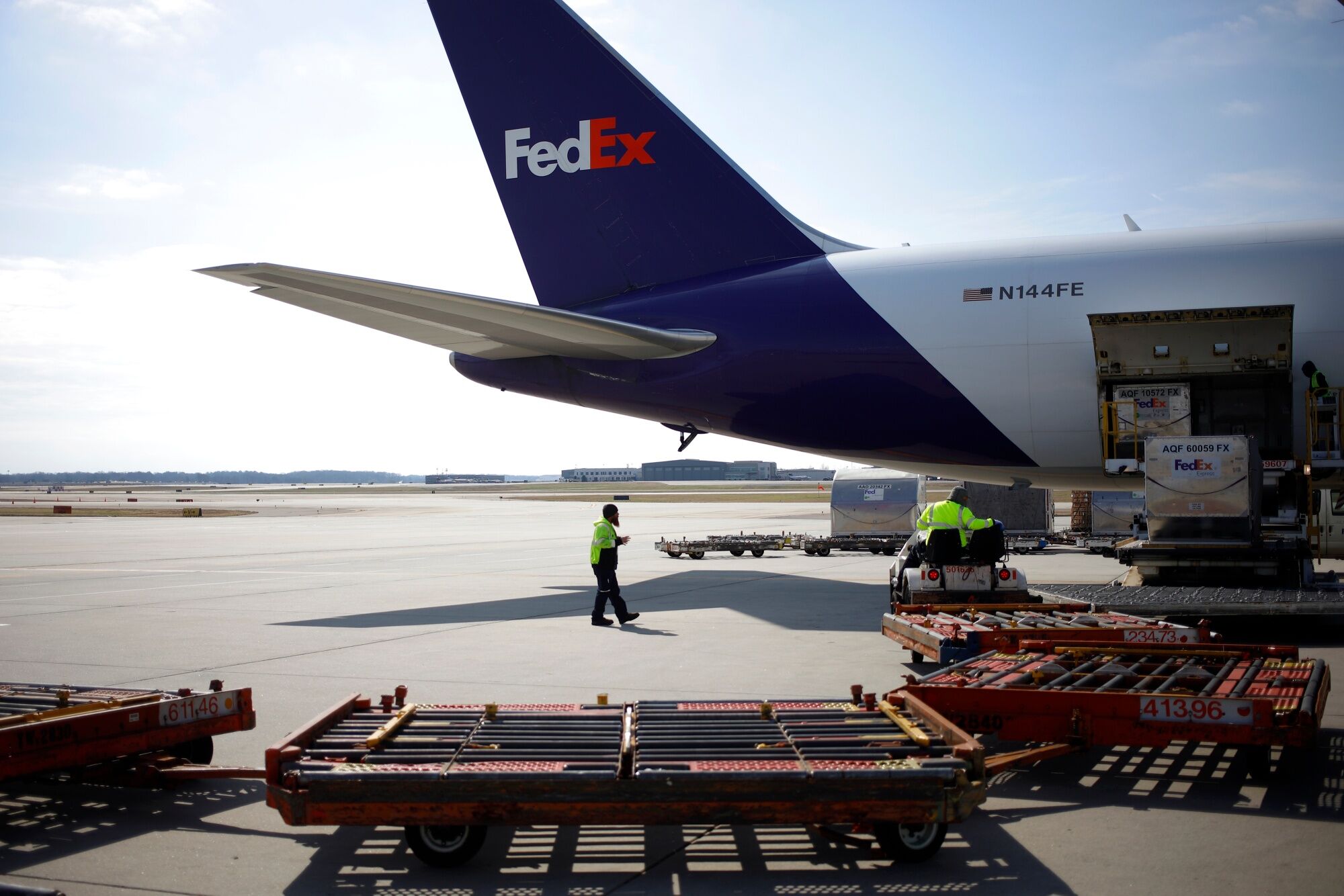
(Bloomberg) -- FedEx Corp. reported profit below analyst expectations as cost cuts weren't enough to make up for volume declines at the air-freight unit amid a lingering cargo recession. The company lowered its sales forecast for the fiscal year ending May 31.
Adjusted earnings were $3.99 a share, the Memphis, Tennessee-based company said in a statement. Analysts had expected $4.19. Sales fell 2.6% to $22.2 billion. Analysts had predicted $22.4 billion.
FedEx Express, the air-freight unit, is still struggling from overcapacity as commercial airliners resume international flights and from sluggish demand in Asia. FedEx's freight unit, one of the largest US trucking companies, has been hurt by a drop in cargo demand and price. That weakness was offset a bit by cargo that carriers picked up from Yellow Corp., which ceased operations earlier this year.
“The miss was driven solely by Express,” said Christian Wetherbee, an analyst with Citigroup in a note. “Ground and Freight profit both beat.”
This year's peak shipping season has been muted as consumers return to stores and contend with inflation and higher interest rates, denting buying power. Nonetheless, FedEx's Ground unit posted gains on volume and price per package, helped by customers who made the switch from United Parcel Service Inc.
The soft market enabled FedEx to improve its on-time delivery performance, which may make it more difficult for UPS to win back lost customers, Garrett Holland, an analyst with Robert W. Baird & Co. wrote in a note. Both UPS and FedEx delivered about 98% of packages on time in the week after Thanksgiving, according to ShipMatrix, a consultancy that gathers industry data.
Shares fell 10% in US postmarket trading to $252.06 in New York, which would be the biggest decrease since Sept. 16, 2022.
FedEx's adjusted operating margin rose to 6.4% from 5.3% a year earlier, spurred by permanent cost reductions that are expected to reach $1.8 billion for the fiscal year, FedEx said.
FedEx is powering through the trough in freight demand with a long-term $6 billion cost-cutting and efficiency plan implemented shortly after Raj Subramaniam took over as chief executive officer from founder Fred Smith in June last year. The cost reductions are already bearing fruit, underpinning a 62% gain in FedEx's stock price this year through Tuesday's close.
The company lowered its sales forecast to a “low-single-digit percentage decline” from an earlier forecast of little changed. The company left unchanged its forecast of adjusted profit of $17 to $18.50 a share.
Ground units sales rose 2.9% to $8.6 billion and operating margins rose to 10.4% from 7.1% a year earlier on higher volume and revenue per package, showing that the courier still has pricing power even as the market cools from the pandemic highs. Cost per package declined 2%, FedEx said.
The Express unit's sales fell 5.6% on lower volume and a shift toward lower-yielding services. Adjusted operating margins tumbled to 1.3% from 3.1% a year earlier. At the Freight unit, sales dropped 3.8% while operating margins rose to nearly 21% from 18%.
Subramaniam announced a restructuring of the Express unit by dividing up uses of its aircraft into three categories that it designated as purple, orange and white. While the Express unit is taking market share from competitors now, the industry is declining, which has put pressure on margins, he said on a conference call with analysts.
“I'm very confident the margins at Express will return and the cost take-out that's continuing to take place will serve us very well especially as the demand profile returns,” Subramaniam said.
FedEx said that this year's peak holiday volume was similar to last year's and that FedEx expects share buybacks of $1 billion in the last two quarters of its current fiscal year.
(Updates throughout.)
More stories like this are available on bloomberg.com
©2023 Bloomberg L.P.

-
Why Swapping Your Old Gold Can Trigger A Rs 5 Lakh Tax Bill, And How You Can Avoid It Legally

Swapping old gold for new is taxed as a sale and a fresh purchase. Getting your own gold remade can cut most of that bill, though it has its own costs.
-
The AI Trade is Done. The Real Opportunity for Investors Starts in 2027 | Unhedged Position
As pureplay AI stocks plunge and circular, capex-led financing unwinds, 2027 is set to be a year of reckoning for AI companies. Yet the bust clears the way for a better opportunity for investors in 2027 -- shifting the spotlight from AI builders to the companies using AI.
-
Leadership As Mission: Why The Age Of AI Demands More Human Leadership
Debjani Ghosh examines how AI is changing leadership, arguing that its success must be measured by its impact on people and the accountability of those guiding its use.
-
We May Need Another Tukaram Mundhe To Fight Air Pollution | The Reason Why
Developers may install basic measures such as sprinklers and green nets, resume work, and continue violating rules when this equipment stops working.
-
Extracting Value From Battery Scrap Could Be Challenging For India | The Reason Why
A discarded lithium-ion battery still contains valuable materials such as lithium, nickel and cobalt. These can be recovered and reused. When such batteries are crushed and shredded, they produce a dark powder called black mass.
-
One El Nino, India Can Handle. Two Could Break The Granary
India's grain stocks can absorb one bad year, but a second El Nino could drain the buffer in two to three years, economists say.
-
India's Troika Of Good Luck | Joining The Dots
As Jensen Huang's exit drags Nvidia down, a cooling AI trade and resilient earnings have revived investor interest in India. A likely RBI rate hike looms.
-
Talking Points This Week: Leadership Shock At Nvidia, Earnings Strength, And The Fog Over Hormuz
The Anthropic IPO pricing and first trading day, Nvidia's upcoming earnings, and any fresh signals from Iran will set the tone for the following week.
-
Signature Play: The Classic Cocktail Is Dead. Or Is It?
Classic cocktails are disappearing from India's cocktail menus. But they're still being ordered, taught to bartenders and borrowed from. So, who's really having the last drink?
-
A New Samvat Wishlist: Inclusive Prosperity And Human Development
India has strengthened its economic foundations through infrastructure, digital access and enterprise. Its next growth chapter must deepen productivity, create better livelihoods and widen participation in prosperity.









