Fed Sees Rates Staying High For Some Time With Cuts Eyed In 2024
(Bloomberg) -- Federal Reserve policymakers agreed last month that it would be appropriate to maintain a restrictive stance “for some time,” while acknowledging they were probably at the peak rate and would begin cutting in 2024.
“Participants viewed the policy rate as likely at or near its peak for this tightening cycle,” according to the minutes of the Dec. 12-13 Federal Open Market Committee meeting released Wednesday.
That said, officials “reaffirmed that it would be appropriate for policy to remain at a restrictive stance for some time until inflation was clearly moving down sustainably.”
The minutes indicated increased optimism among participants about the path of inflation, noting “clear progress.” The committee expressed a willingness to cut the benchmark lending rate in 2024 should that trend continue, though they gave no indication easing could begin as soon as March, as futures traders expect.
“In their submitted projections, almost all participants indicated that, reflecting the improvements in their inflation outlooks, their baseline projections implied that a lower target range for the federal funds rate would be appropriate by the end of 2024,” the minutes said.
Follow the reaction in real time on Bloomberg's TOPLive blog
The S&P 500 remained lower and Treasuries pared losses.
At the meeting, central bankers voted unanimously to hold the benchmark lending rate steady in a range of 5.25% to 5.5% for a third consecutive time. While the FOMC's statement left the door open for another hike, officials' forecasts signaled the end of the most aggressive tightening cycle in a generation.
The quarterly projections implied three interest-rate cuts in 2024 — or some 75 basis points of cuts. The updated outlook, paired with Fed Chair Jerome Powell's comments following the meeting, ignited a rally in stocks and bonds, fueling a broader easing in financial conditions.
“What December taught us is they are willing to pivot,” said Laura Rosner-Warburton, a senior economist and partner at Macropolicy Perspectives LLC. “They see a soft landing in sight, and they are willing to go for it as long as the moderation in inflation continues.”
Read more: Do You Dot Plot? Understanding How the Fed Forecasts: QuickTake
Officials' individual expectations for the federal funds rate at the end of 2024 ranged widely, however. The Fed's “dot plot” showed eight officials saw two quarter-point cuts or less, while 11 officials expected three or more.
A tweak to the Fed's post-meeting statement also highlighted the shift in tone, with officials noting they will monitor a range of data and developments to see if “any” additional policy firming is appropriate.
March Expectation
Futures markets have been anticipating the Fed will cut rates six times this year, beginning with a likely quarter-point reduction in March. Several Fed officials, however, have pushed back against expectations of an imminent policy move in recent weeks.
The FOMC will next meet Jan. 30-31 to discuss policy.
Powell said at the press conference that it was premature to declare victory, though he did acknowledge the question of when to begin “dialing back” policy restraint was discussed.
What Bloomberg Economics Says...
“Even after lowering their median inflation and growth outlooks for 2024, ‘several' FOMC members acknowledged the risk of an abrupt deterioration in conditions spurred by labor-market weakening... The plethora of dovish signs from policymakers bolsters our expectation that policymakers will begin cutting rates in the first quarter of this year as they attempt to navigate a soft landing.”
— Stuart Paul
To read the full report, click here.
Officials slowed the pace of rate increases last year after a series of rapid hikes in 2022. Inflation has cooled considerably, to 3.2% on an annual basis, as measured by the Fed's preferred benchmark minus food and energy.
Read More: Fed Prepares Shift to Rate Cuts in 2024 as Price Pressures Fade
Participants pointed to six-month inflation readings, as well as growing signs of demand and supply coming into better balance. Staff economists appeared even more optimistic on the path of inflation, marking down their forecast and judging inflation would be “less persistent.”
Fed officials debated the role of supply in lowering inflation further. Several officials said help from healing supply chains and increased labor supply was “largely complete” while a few others saw potential for further improvement.
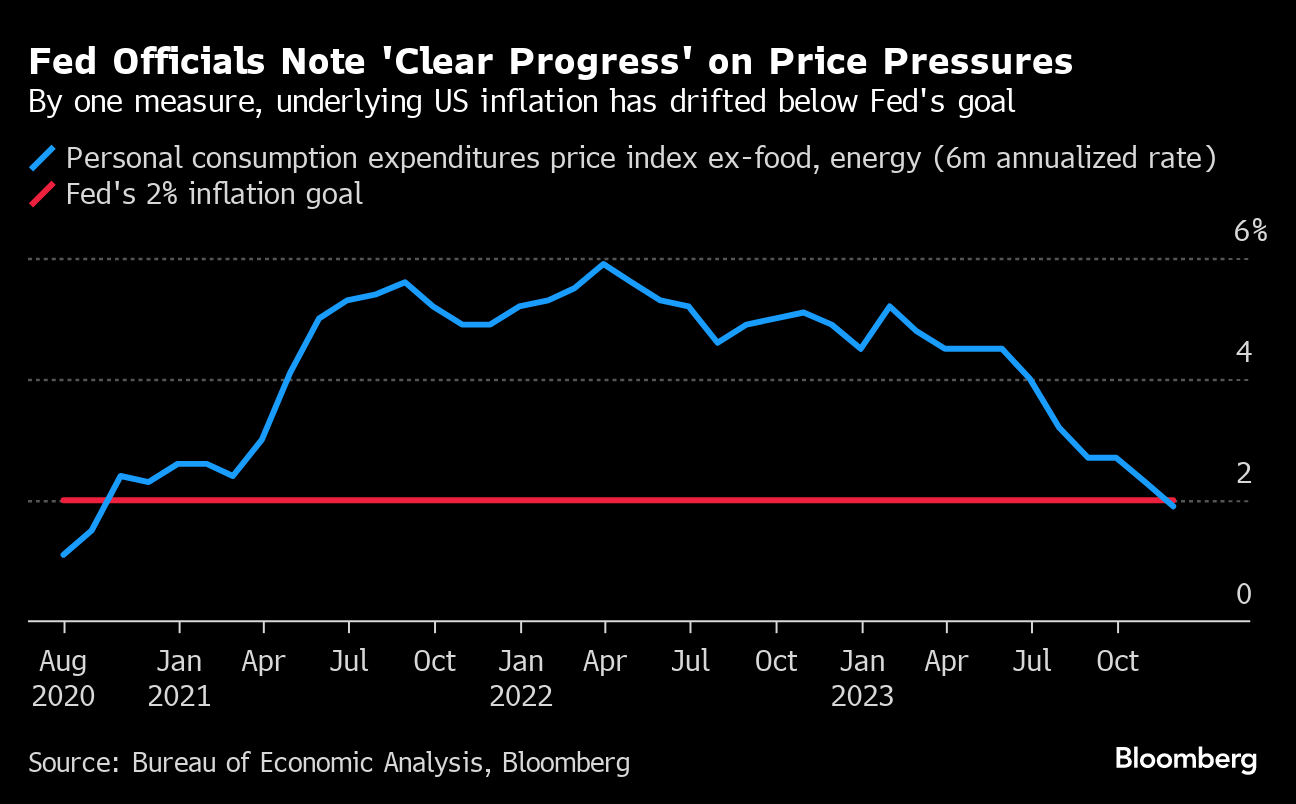
The Fed's preferred underlying inflation gauge rose just 1.9% in November on a six-month annualized basis, the first time in more than three years the measure slipped below the Fed's 2% target.
The labor market, meanwhile, has remained relatively healthy despite higher interest rates. Payrolls grew an average of 204,000 over the most recently reported three months and job openings declined, consistent with a gradual moderation in hiring. December employment figures will be released Friday.
Persistently strong wage gains or unexpectedly buoyant economic growth could slow or even threaten inflation's progress to the central bank's target. Officials' latest projections show the economy expanding at a much slower 1.4% rate in 2024 with little cost to jobs.
“Participants generally perceived a high degree of uncertainty surrounding the economic outlook,” the minutes said.
--With assistance from Kristy Scheuble and Michael Mackenzie.
(Updates with economist comment in the ninth paragraph.)
More stories like this are available on bloomberg.com
©2024 Bloomberg L.P.

-
Getting To Work Costs Women More | The Reason Why

It is not just about women paying more than men. It is about women paying much more in cities than in villages.
-
AI Bias In Investing Cannot Be Eliminated, But It Can Be Governed
Framing is a particularly important example as identical financial information presented in terms of gains rather than losses can lead an LLM to reach a different assessment.
-
Joining The Dots | Dark Skies, Steady Diya: Why Hope Holds This Diwali
With war, a weak rupee and foreign outflows weighing on sentiment, policymakers at the NDTV World Summit and market veterans at NDTV Profit Ignite: Diwali Edition offered the same advice: stay invested and filter out the noise.
-
The Curious Case of Equitas Small Finance Bank And A CEO Who Quit For Stock
PN Vasudevan believes persistent investor concerns over a perceived conflict of interest had become a governance overhang on Equitas Small Finance Bank's stock, even as the lender improved profitability and asset quality.
-
Talking Points This Week: AI Cash Burn, A Tiger Comeback And An India That Still Finds Its Own Path
India is not immune to higher oil or tighter global liquidity, yet its earnings base is broader, its domestic policy levers are still available.
-
Foreign Investors Own Half Of HDFC Bank and ICICI Bank. An LTCG Cut Could Matter Most Here
Foreign portfolio investors have US$115 billion parked in HDFC Bank, ICICI Bank. If the government cuts long-term capital gains tax, Jefferies says returning foreign money could land here first.
-
'Never Seen This Level Of Negativity': Sandeep Tandon Says The Next Rally May Be Closer Than You Think
Veteran investor Sandeep Tandon says foreign selling is easing, large-caps are due a comeback and mid-caps are crowded, while he turns positive on gold, power and pharma this Diwali.
-
Indians Stay With Family, Not In Hotels | The Reason Why
India still lacks enough clean, reliable and affordable hotels for budget-conscious travellers.
-
The Economic Imperative: Analysing The Material Driving Force Behind India-Canada Strategic Reset
This economic complementarity is further reinforced by deep institutional investment ties and talent mobility, which form the bedrock of the bilateral framework.
-
Medicine Pricing: Where Must Profit Stop?
India must confront excessive margins, hidden incentives and regulatory gaps that threaten the integrity of medicine.










