S&P 500 Sees Worst Selloff In 2025 As Bonds Climb: Market Wrap
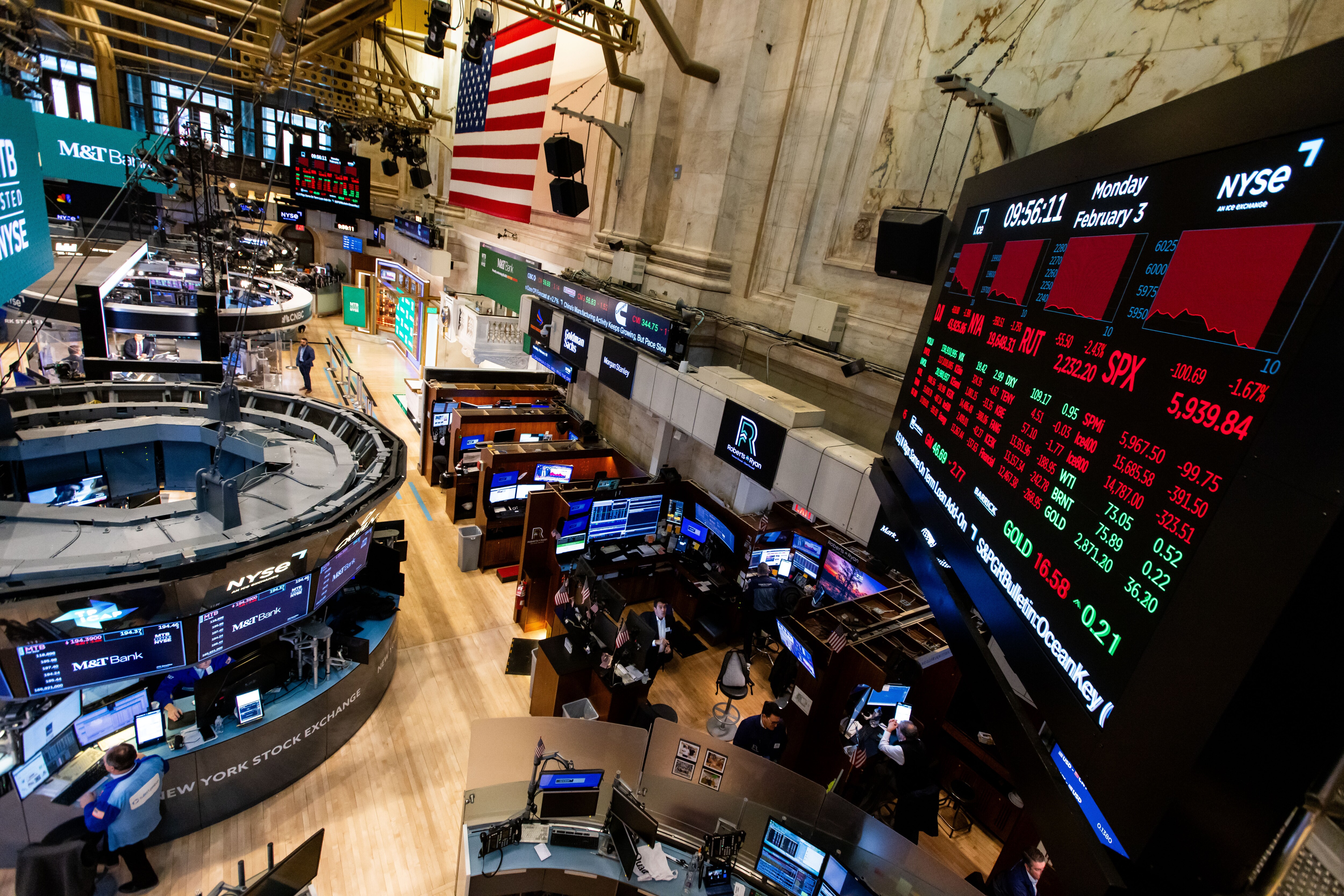
More tepid economic news and a pledge by Donald Trump to push through tariffs on top trading partners stressed Wall Street risk tolerances anew, sending bonds up and stocks to their biggest loss of the year.
The S&P 500 lost nearly 2% as the US president said Mexico and Canada would be unable to negotiate a reprieve from tariffs set to take effect Tuesday. The loonie and the peso slipped. The White House later said Trump also signed an order doubling a tariff on China to 20%. A plunge in big tech weighed heavily on equities, which were also hit by weak manufacturing data.
Stocks erased their Friday runup to push the S&P 500 almost 5% below a record high from Feb. 19. The gauge has alternated between gains and losses of at least 1.5% for three sessions, a stretch of violent reversals not seen since March 2020.
Monday's data was the latest in a slew of disappointing economic reports showing weaker housing, rising unemployment claims and a drop in personal spending. Crypto, a key proxy for risk in post-election markets, tumbled a day after surging when Trump stepped up calls for a digital-asset stockpile.
“It's time to be nervous,” said Callie Cox at Ritholtz Wealth Management. “Not bearish, but nervous. While there isn't enough evidence to think we're on the cusp of a deep pullback, the economy is changing quickly. The headlines are so unrelenting that people don't know what to do.”
The S&P 500 fell 1.8%. The Nasdaq 100 slid 2.2%. The Dow Jones Industrial Average dropped 1.5%. A gauge of the Magnificent Seven shares sank 3.1%. The Russell 2000 lost 2.8%. A UBS basket of US stocks negatively impacted by tariffs slipped 2.9%.
The drop in US shares was in sharp contrast to Europe, where equities staged one of their strongest advances of 2025. The moves extended an international rotation trade that has held sway most of the year.
Wall Street's so-called fear gauge — the VIX — hit the highest since December. All megacaps slipped, with Nvidia Corp. down 8.7%. Taiwan Semiconductor Manufacturing Co. plans to invest an additional $100 billion in US plants that will boost its chip output on American soil and support Trump's goal of increasing domestic manufacturing.
Oil sank as OPEC+ will proceed with plans to revive halted production amid pressure from Trump to lower prices. The yield on 10-year Treasuries fell five basis points to 4.16%. A dollar gauge slid 0.4%. Bitcoin tumbled 9.5%.

To David Kostin at Goldman Sachs Group Inc., any S&P 500 recovery attempt is likely to prove temporary amid economic worries.
Investor exposure declined last week, but it isn't low enough yet to suggest “tactical upside as a result of of depressed positioning,” he said. “An improvement in the US economic growth outlook will be required to fully reverse the recent equity-market weakness.
“Markets have been expressing growing concerns about a potential slowdown in the US,” said Florian Ielpo at Lombard Odier Investment Managers. “The message of caution needs to be heard, and depending on Friday's payroll, this deteriorating macro momentum could cap markets' progression.”
Goldman Sachs' Scott Rubner says he lacks conviction that demand for US stocks is high enough to sustain a rebound.
The tactical flow specialist turned bearish last month amid fading inflows from retail and other supportive buyers. He notes that while the market is in the final stages of a clearing event for positioning, he's “not ready” to sound an all-clear yet. Instead, he recommends investors be “nimble on highest conviction quality themes.”
In a note to clients, Rubner said March 14 “sticks out” to him as a potential low in stocks, with history suggesting that the first half of the month “typically chops around.”

In a backdrop of some softening economic indicators and continuing uncertainty around tariffs, a rotation out of US big tech is likely to continue, according to JPMorgan Chase & Co. strategists led by Mislav Matejka.
The strategists say the rotation out of growth and into value style should help international markets, which are more value-dominated. Still, US market will probably benefit from animal spirits and deregulation, while the US usually holds up better than other regions in risk-off periods.
Morgan Stanley strategist Michael Wilson said equities are likely to be more sensitive to economic growth than to a pullback in bond yields.
US earnings estimates don't fully reflect potential risks from President Trump's proposed tariffs, according to Citigroup strategists led by Scott Chronert wrote.
Still, the outlook is more optimistic when viewed at the single-stock and sector level, they say.
“A high-level emphasis on index earnings and related valuations can be misleading. As we head further into '25, the moniker that it's a market of stocks not a stock market may take on growing importance, particularly as Trump policy impacts become clearer,” they said.

Some of the main moves in markets:
Stocks
The S&P 500 fell 1.8% as of 4 p.m. New York time
The Nasdaq 100 fell 2.2%
The Dow Jones Industrial Average fell 1.5%
The MSCI World Index fell 0.9%
Bloomberg Magnificent 7 Total Return Index fell 3.1%
The Russell 2000 Index fell 2.8%
Currencies
The Bloomberg Dollar Spot Index fell 0.4%
The euro rose 1% to $1.0483
The British pound rose 1% to $1.2699
The Japanese yen rose 0.8% to 149.47 per dollar
Cryptocurrencies
Bitcoin fell 9.5% to $85,314.51
Ether fell 16% to $2,110.13
Bonds
The yield on 10-year Treasuries declined five basis points to 4.16%
Germany's 10-year yield advanced eight basis points to 2.49%
Britain's 10-year yield advanced seven basis points to 4.55%
Commodities
West Texas Intermediate crude fell 2.1% to $68.30 a barrel
Spot gold rose 1.2% to $2,890.91 an ounce
This story was produced with the assistance of Bloomberg Automation.
© 2025 Bloomberg L.P.

-
Foreign Investors Own Half Of HDFC Bank and ICICI Bank. An LTCG Cut Could Matter Most Here

Foreign portfolio investors have US$115 billion parked in HDFC Bank, ICICI Bank. If the government cuts long-term capital gains tax, Jefferies says returning foreign money could land here first.
-
'Never Seen This Level Of Negativity': Sandeep Tandon Says The Next Rally May Be Closer Than You Think
Veteran investor Sandeep Tandon says foreign selling is easing, large-caps are due a comeback and mid-caps are crowded, while he turns positive on gold, power and pharma this Diwali.
-
Indians Stay With Family, Not In Hotels | The Reason Why
India still lacks enough clean, reliable and affordable hotels for budget-conscious travellers.
-
The Economic Imperative: Analysing The Material Driving Force Behind India-Canada Strategic Reset
This economic complementarity is further reinforced by deep institutional investment ties and talent mobility, which form the bedrock of the bilateral framework.
-
Medicine Pricing: Where Must Profit Stop?
India must confront excessive margins, hidden incentives and regulatory gaps that threaten the integrity of medicine.
-
Why Amazon And Flipkart Are Struggling To Beat Meesho In India's Smaller Cities
With 274 million users and lowest-cost logistics, Meesho is defending its value commerce crown against giants like Amazon and Flipkart.
-
High US Salaries, No Green Card Certainty: The Financial Calculation Facing Indian H-1B Families
The suspension of PERM processing at eight technology employers does not cancel existing H-1B visas. What it does is force a question many Indian families have been avoiding: is the US salary worth tying your career and family plans to one employer?
-
Swiggy vs Eternal: Food Delivery's Two Rivals Are No Longer In The Same Race
Eternal is building a private AI assistant, dark.ai. Swiggy is still working out how to make Instamart pay, with an operating loss of Rs 895 crore in the July-September quarter while Blinkit stayed profitable.
-
Where You Live Shapes How You Get To Work | The Reason Why
Two-wheelers are the most popular way to get to work in India, accounting for nearly 43% of workplace commutes.
-
Unhedged Position: Can India See An Indonesia-Style Time Correction?
The Nifty is trading below levels it first clocked in 2024. Is there, then, as I have suggested in the headline, potential that the current time correction drags on painfully for the next three-five, even ten years?










