Nasdaq 100 Climbs 1% as Tech Powers Stock Rebound: Markets Wrap
(Bloomberg) -- A rally in big tech spurred a rebound in stocks, outweighing concerns over higher Treasury yields just a few days ahead of a speech by Federal Reserve Chair Jerome Powell.
The S&P 500 halted a four-day drop while the Nasdaq 100 rose about 1.5%, with Tesla Inc. up the most since March. Nvidia Corp., which helped ignite the artificial-intelligence frenzy that has driven this year's equity surge, jumped over 8%. The chipmaker's results are due Wednesday, and revenue is seen rising 65% from a year earlier, according to data compiled by Bloomberg.
“This is a big week for tech stocks, and optimism is brewing that Nvidia will deliver some good results,” said Ed Moya, senior market analyst for the Americas at Oanda. “Will Nvidia's earnings reignite the AI trade and provide much needed relief to tech stocks?”
In late hours, SoftBank Group Corp. semiconductor unit Arm filed for what is set to be this year's largest US initial public offering. Zoom Video Communications Inc. rallied on a bullish forecast. Charles Schwab Corp. is planning to cut at least $500 million in annual staff, professional services and real estate costs in the latest step by the brokerage to respond to investor pressure.
Bonds resumed their selloff as signs of economic strength bolstered bets on still elevated rates. The yield on 10-year inflation-protected Treasuries pushed over 2% for the first time since 2009. Not long after, the yield on 10-year notes without that protection hit a level last seen in late 2007.
Just because real yields have climbed, it doesn't mean the scenario for stocks is necessarily bad, according to Bespoke Investment Group. Since 1997, average forward returns for equities when real yields hit 52-week highs were just modestly worse than all periods, the strategists wrote. In addition, new highs for real yields broadly tend to lead to pockets of stronger earnings-per-share growth, they noted.
“That's consistent with the view that high real yields represent a stronger economy, even if that has some negative implications for asset price valuation,” Bespoke strategists said.
Powell will speak Friday at the Kansas City Fed's Jackson Hole Economic Policy Symposium after officials last month lifted rates to a range of 5.25% to 5.5%, the highest level in 22 years. Minutes from the gathering showed policymakers still saw significant risks that inflation could remain higher than they expect — which could keep rates elevated.
“Traders will be sifting every sentence from Jerome Powell at this week's Jackson Hole conference for clues about the Fed's disposition,” said Chris Larkin, managing director of trading and investing at E*Trade from Morgan Stanley. “Some investors may have focused on the reality that this economic resilience may extend the Fed's higher-for-longer stance on interest rates.”
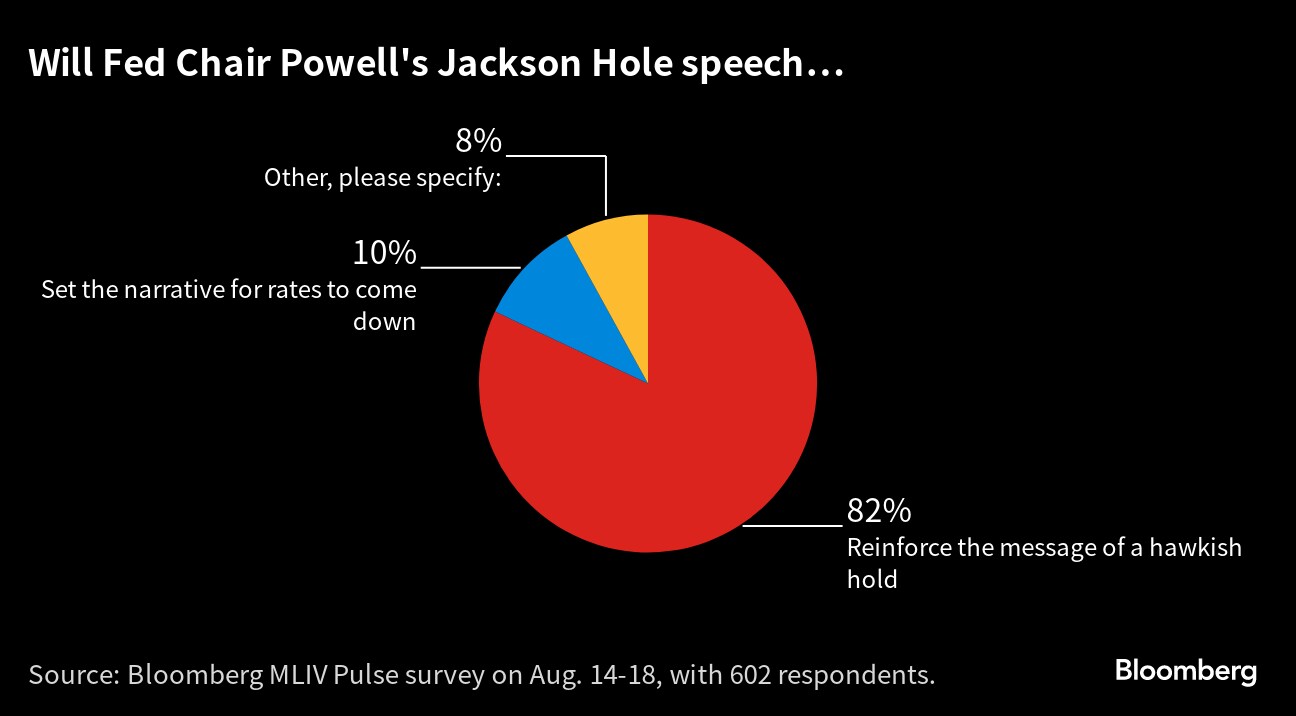
In fact, two-thirds of 602 respondents in Bloomberg's latest Markets Live Pulse survey say the Fed has yet to conquer inflation. And over 80% of those surveyed said Powell's Jackson Hole speech will reinforce the message of a hawkish hold.
“The Fed and investors will soon pivot from a focus on how high the policy rate will go to a concern about how long they will stay at that level — and what the implications are for a ‘higher for longer' scenario,” said Katie Nixon, chief investment officer for the wealth management business at Northern Trust. “In our view, Powell will want to stay on message, and will try to push back against a growing market consensus that rate cuts are on the 2024 horizon.”
Jackson Hole Pattern
The speeches from Fed chiefs at the Jackson Hole conference have typically buoyed stocks since the turn of the millennium, with the S&P 500 gaining 0.4% on average in the following week, data compiled by Bloomberg Intelligence show.
But last year's appearance is still fresh in traders' minds: Equities slumped 3.2% in the week following Powell's remarks, according to BI, after he warned of keeping policy restrictive to battle inflation.
Meantime, two of Wall Street's top strategists are at odds about the outlook for US stocks following a three-week run of declines as debate rages over whether the economy can avoid a recession.
While Morgan Stanley's Michael Wilson — a stalwart equity bear — says sentiment is likely to weaken further if investors are starting to “question the sustainability of the economic resiliency,” his counterpart at Goldman Sachs Group Inc., David Kostin, says there's room for investors to further increase exposure if the economy stays on course for a soft landing.
A bruising August is still poised to end a five-month winning streak for equities. Yet there have been few signs of outright bearishness in the recent rout.
Hedge funds and other large speculators narrowed their net-short positions in S&P 500 futures to the smallest in 14 months, according to the latest batch of Commodity Futures Trading Commission data Friday. And analysts say the drop this month may be a welcome break from the steep gains that pushed valuations to lofty levels.
Other Corporate News
- Cybersecurity firm Palo Alto Networks Inc. surged after projecting stronger billings for the year than Wall Street anticipated, easing fears that a slowdown in demand may weigh on results.
- SentinelOne Inc. climbed after a news report said the company has been exploring options that could include a sale.
- Johnson & Johnson's split-off of most of its $40 billion stake in Kenvue Inc. drew greater investor demand than some on Wall Street expected.
- Broadcom Inc.'s $61 billion takeover of VMware Inc. was cleared by the UK's antitrust watchdog, paving the way for one of the largest-ever tech deals.
- An AMC Entertainment Holdings Inc. stock conversion may proceed this week after the Delaware Supreme Court rejected a request to halt the plan pending an appeal.
- Nikola Corp. fell after the maker of electric big rigs warned it may not reach its full-year delivery target as it grapples with fallout from recent battery incidents.
Key events this week:
- US existing home sales, Tuesday
- Chicago Fed's Austan Goolsbee speaks, Tuesday
- Eurozone S&P Global Services & Manufacturing PMI, consumer confidence, Wednesday
- UK S&P Global / CIPS UK Manufacturing PMI, Wednesday
- US new home sales, S&P Global Manufacturing PMI, Wednesday
- US initial jobless claims, durable goods, Thursday
- Kansas City Fed's annual economic policy symposium in Jackson Hole begins, Thursday
- Japan Tokyo CPI, Friday
- US University of Michigan consumer sentiment, Friday
- Fed Chair Jerome Powell, ECB President Christine Lagarde to address Jackson Hole conference, Friday
Some of the main moves in markets:
Stocks
- The S&P 500 rose 0.7% as of 4 p.m. New York time
- The Nasdaq 100 rose 1.6%
- The Dow Jones Industrial Average fell 0.1%
- The MSCI World index rose 0.4%
Currencies
- The Bloomberg Dollar Spot Index was little changed
- The euro rose 0.2% to $1.0896
- The British pound rose 0.2% to $1.2759
- The Japanese yen fell 0.6% to 146.22 per dollar
Cryptocurrencies
- Bitcoin fell 0.4% to $26,124.17
- Ether fell 1% to $1,673.25
Bonds
- The yield on 10-year Treasuries advanced eight basis points to 4.34%
- Germany's 10-year yield advanced eight basis points to 2.70%
- Britain's 10-year yield advanced five basis points to 4.73%
Commodities
- West Texas Intermediate crude fell 0.6% to $80.80 a barrel
- Gold futures rose 0.4% to $1,923.70 an ounce
This story was produced with the assistance of Bloomberg Automation.
--With assistance from Brett Miller, Tassia Sipahutar, John Viljoen, Sagarika Jaisinghani, Isabelle Lee and Heather Burke.
More stories like this are available on bloomberg.com
©2023 Bloomberg L.P.

-
One Battle After Another: India's Corporate Dynasties Battle For Control

2026 could go down as Corporate India's year of succession wars, governance battles and family fault lines.
-
Rs 50-Lakh Gold In Bank Locker, Rs 3 Lakh Of Protection: The Gap Most Families Don't Know About
The RBI ties a bank's liability to the annual locker rent and families who want to insure their jewellery face a separate question about how to prove what was inside.
-
The More Food Turns Into Fuel, The Harder It Is To Read Agricultural Markets | The Reason Why
A policy designed to reduce dependence on imported fuel can create new pressures elsewhere in the food economy.
-
Your iPhone Costs 12 Grams Of Gold, A Car About 100. What Does Your Life Weigh?
Measured in rupees, almost everything looks more expensive than it did a generation ago. Measured in grams of gold, a lot of it has become cheaper.
-
Gold Is Rs 22,000 Cheaper Than A Month Ago. Should You Buy Amid The Wedding Season?
Gold's potential slide to $3,500 could save around Rs 4,700 per 10 grams, but a soft inflation print could just as easily push prices back up. One way to split the risk is to buy in parts, some now and the rest after the Fed's Dec. 9 decision.
-
AI Agents Are Gaining Power. Who Governs Them?
Artificial intelligence agents promise to transform productivity by moving machines from assisting decisions to executing them. But as organisations delegate greater authority to these AI-agents, they must first establish who controls that authority and who remains accountable when things go wrong.
-
Why Swapping Your Old Gold Can Trigger A Rs 5 Lakh Tax Bill, And How You Can Avoid It Legally
Swapping old gold for new is taxed as a sale and a fresh purchase. Getting your own gold remade can cut most of that bill, though it has its own costs.
-
The AI Trade is Done. The Real Opportunity for Investors Starts in 2027 | Unhedged Position
As pureplay AI stocks plunge and circular, capex-led financing unwinds, 2027 is set to be a year of reckoning for AI companies. Yet the bust clears the way for a better opportunity for investors in 2027 -- shifting the spotlight from AI builders to the companies using AI.
-
Leadership As Mission: Why The Age Of AI Demands More Human Leadership
Debjani Ghosh examines how AI is changing leadership, arguing that its success must be measured by its impact on people and the accountability of those guiding its use.
-
We May Need Another Tukaram Mundhe To Fight Air Pollution | The Reason Why
Developers may install basic measures such as sprinklers and green nets, resume work, and continue violating rules when this equipment stops working.









