A 99% Stock Crash And Surprise Default Raise Alarm In Thailand
(Bloomberg) -- Only a year ago Stark Corp. looked like a Thai corporate success story. Backed by a wealthy local businessman, the nearly $2 billion maker of electrical cables was an aggressive acquirer making its first major push beyond Asia.
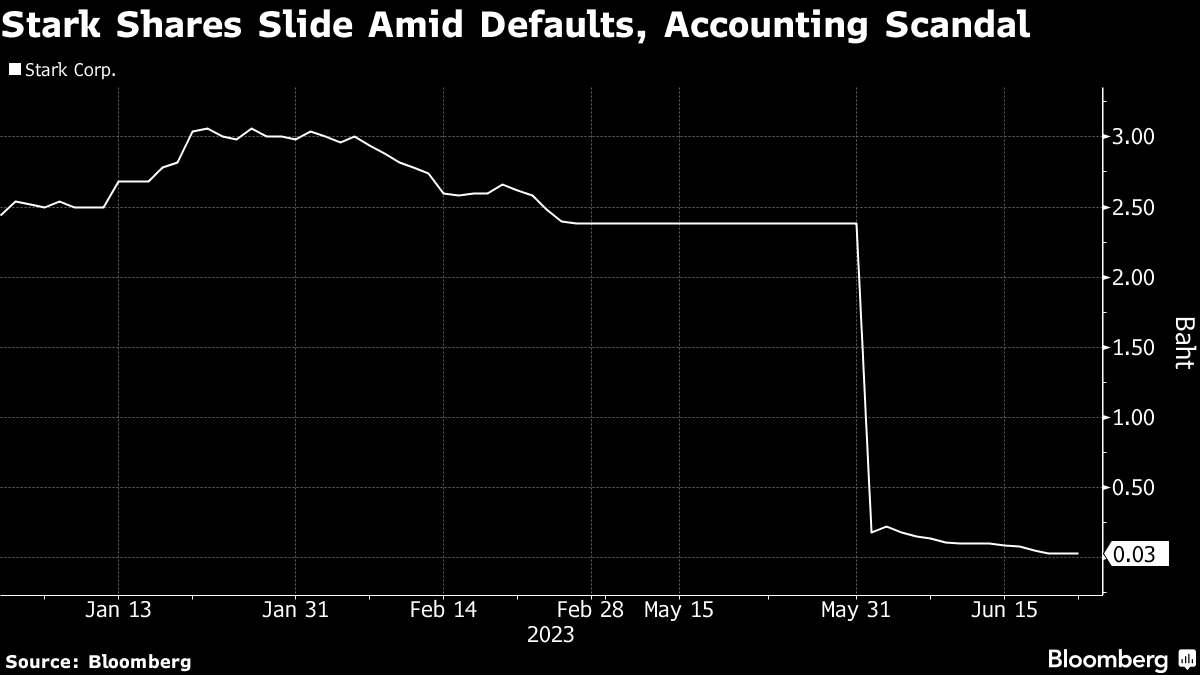
Today, Stark has become one of the biggest financial worries in Southeast Asia's second-largest economy. Mired in an accounting scandal, the company has lost 99% of its market capitalization and defaulted on some of its 39 billion baht ($1.1 billion) in liabilities.
With doubts swirling over the company's survival, money managers have pulled back from bonds issued by lower-rated Thai companies and the country's finance minister has urged regulators to rebuild market confidence.
The episode has heightened scrutiny of hidden financial risks in Thailand at a time of investor uncertainty over a political impasse in the wake of last month's general election. The country's benchmark equity index has fallen around 10% this year to levels last seen in 2021, while foreign investors have pulled more than $3 billion from Thai stocks.
“Stark's incident certainly had an impact on investors' confidence as they're now adopting a very cautious approach on investment decisions. They are less certain on which companies have good or bad governance,” said Niwes Hemvachiravarakorn, investor and founder of Thai Value Investor Club. “Stark was being audited by one of the world's top accounting firms, but the auditors couldn't catch the irregularities before they imploded.”
Acquisition Spree
Stark's origins go back to 1990, when it was founded as a comics publisher and distributor called Siam Inter Multimedia Pcl. It changed its name to Stark Corp. Pcl in 2019 about a year after Vonnarat Tangkaravakoon, a businessman from one of Thailand's wealthiest families, acquired majority control of the company. As of October, Vonnarat was the biggest Stark shareholder with a 45% stake, according to data compiled by Bloomberg.
Vonnarat transformed the media and publishing company into a manufacturer of electrical wires and components through the acquisition of cable maker Phelps Dodge International (Thailand) Ltd., originally the Thai operations of US-based Phelps Dodge International.
Now 51, he is the eldest son of Prachak Tangkaravakoon, who founded TOA Paint Pcl, Thailand's largest paint maker. Vonnarat was executive director at Toa from 1998 until his resignation last month. He also held a 9% stake in TOA, according to its website, although the company denies any relationship with Stark in terms of investment or management.
Under Vonnarat, Stark continued its rapid growth through acquisitions, including industrial products businesses in Vietnam. In May last year, it announced a €560 million deal to buy Leoni Business Group Automotive Cable Solutions, a German maker of automotive cable solutions, its first major expansion outside Asia. He has not replied to Bloomberg's queries to his representative at Stark.
For most investors, the first sign of trouble was in December, when Stark announced that it was backing out of the Leoni deal. While the company raised 5.58 billion baht from investors including Credit Suisse and HSBC Holdings Plc to finance the deal, it said it wanted use the money for other purposes. Leoni AG and Leoni Bordnetz-Systeme GmbH demanded €608 million in compensation.
In February, its chief executive officer suddenly resigned, citing personal reasons. Later that month, the company said it would miss a March 1 deadline for filing its financial statement, citing “some information” being reviewed by its auditor. The shares were suspended, and its Chairman Chanin Yensudchai and other board members soon resigned.
Accounting Scandal
By the time Stark asked its investors in late May to waive a further delay of its financial statement, mistrust ran high. Investors of two bonds worth a combined 2.24 billion baht sought immediate payment of the principal and interest. Stark's shares plunged 92% on June 1, their first day of trading after having been suspended for more than two months. It also led to a cross default on the company's other bonds and loans.
Most investors learned the extent of Stark's problems on June 16 when it finally released its financial statements, which showed a net loss of 6.61 billion baht for 2022, after a restated 5.97 billion baht loss for 2021. The company, which originally reported a profit of 2.78 billion baht for 2021, said it identified “multiple errors” in earlier statements. At the same time, it revealed details of a special audit conducted by PricewaterhouseCoopers, which found various irregularities.
Among the findings were 202 “unusual sale transactions” worth 8 billion baht in 2022 and 3.59 billion baht in 2021. They included fake “payer names and payments on behalf of customers from accounts of the company's former officers.”
On Tuesday, holders of another three series of bonds maturing between 2024 and 2025 totaling 6.95 billion baht called for immediate payment, adding to Stark's financial woes. They demand the company pay the principal and interest by July 20. Adisorn Songkhla Co., a Stark unit, has also defaulted on three notes worth 127 million baht on June 1.
Stark's shares have plummeted to near-zero, slashing its value to about $11 million from last year's peak of over $1.7 billion. Stark last week acknowledged doubts “about the Group's going concern.”
As of Dec. 31, Stark had about 39 billion baht of liabilities, most of which were bonds, loans and trade credit. It also had negative shareholder equity of 4.4 billion baht, as total liabilities exceeded assets.
A list of Stark's securities:
Somjin Sornpaisarn, the president of the Thai Bond Market Association, said Thursday that Stark should be seen as an isolated case, as its troubles stemmed from poor governance.
Yet the largest default since state-controlled Thai Airways International Pcl filed for debt restructuring in 2020 has raised concerns about the broader market, particularly in riskier Thai bonds. Investors are now shunning riskier bond sales on concern issuers may be unable to meet repayments, according to TBMA. Several companies with below investment-grade ratings or without assessed creditability have missed bond-sale targets since Stark's default announcement on June 1.
Thai regulators are now trying to shore up confidence in the market. The Securities & Exchange Commission has ordered Stark to conduct a special audit to investigate the irregularity of its financial statements.
The Stock Exchange of Thailand plans to tightens rules on companies seeking backdoor listings like Stark's 2019 move to list indirectly via Siam Inter Multimedia. The exchange may also issue more warnings for companies with deteriorating financial performances such as continued losses, and when auditors express reservations over financial statements.
Stark, in the meantime, is bracing for more pressure from creditors. Asia Plus Securities Pcl, a representative of investors for bonds due in 2024 with total principal of 3.93b baht, said it will exercise its legal rights if Stark fails to pay on the due date.
Other financial creditors may follow in trying to accelerate repayment, Stark said Wednesday, adding that it was considering negotiating a solution.
More stories like this are available on bloomberg.com
©2023 Bloomberg L.P.

-
Your iPhone Costs 12 Grams Of Gold, A Car About 100. What Does Your Life Weigh?

Measured in rupees, almost everything looks more expensive than it did a generation ago. Measured in grams of gold, a lot of it has become cheaper.
-
Gold Is Rs 22,000 Cheaper Than A Month Ago. Should You Buy Amid The Wedding Season?
Gold's potential slide to $3,500 could save around Rs 4,700 per 10 grams, but a soft inflation print could just as easily push prices back up. One way to split the risk is to buy in parts, some now and the rest after the Fed's Dec. 9 decision.
-
AI Agents Are Gaining Power. Who Governs Them?
Artificial intelligence agents promise to transform productivity by moving machines from assisting decisions to executing them. But as organisations delegate greater authority to these AI-agents, they must first establish who controls that authority and who remains accountable when things go wrong.
-
Why Swapping Your Old Gold Can Trigger A Rs 5 Lakh Tax Bill, And How You Can Avoid It Legally
Swapping old gold for new is taxed as a sale and a fresh purchase. Getting your own gold remade can cut most of that bill, though it has its own costs.
-
The AI Trade is Done. The Real Opportunity for Investors Starts in 2027 | Unhedged Position
As pureplay AI stocks plunge and circular, capex-led financing unwinds, 2027 is set to be a year of reckoning for AI companies. Yet the bust clears the way for a better opportunity for investors in 2027 -- shifting the spotlight from AI builders to the companies using AI.
-
Leadership As Mission: Why The Age Of AI Demands More Human Leadership
Debjani Ghosh examines how AI is changing leadership, arguing that its success must be measured by its impact on people and the accountability of those guiding its use.
-
We May Need Another Tukaram Mundhe To Fight Air Pollution | The Reason Why
Developers may install basic measures such as sprinklers and green nets, resume work, and continue violating rules when this equipment stops working.
-
Extracting Value From Battery Scrap Could Be Challenging For India | The Reason Why
A discarded lithium-ion battery still contains valuable materials such as lithium, nickel and cobalt. These can be recovered and reused. When such batteries are crushed and shredded, they produce a dark powder called black mass.
-
One El Nino, India Can Handle. Two Could Break The Granary
India's grain stocks can absorb one bad year, but a second El Nino could drain the buffer in two to three years, economists say.
-
India's Troika Of Good Luck | Joining The Dots
As Jensen Huang's exit drags Nvidia down, a cooling AI trade and resilient earnings have revived investor interest in India. A likely RBI rate hike looms.









