Currency Turmoil Risks Undermining India’s Debut Green Bond
(Bloomberg) -- India is likely to face an uphill battle if it goes ahead with its first sovereign green bond sale as it aims to issue the securities in rupees, putting off most overseas investors.
Political opposition to borrowing in dollars means the nation will have to largely forsake the global funds that have boosted ethical debt into a $4 trillion market, and rely on local buyers. The absence of Indian ESG funds means the government will be hoping the same banks, insurers and asset managers that it will tap for its record borrowing this year will have enough appetite left over for its green bonds.

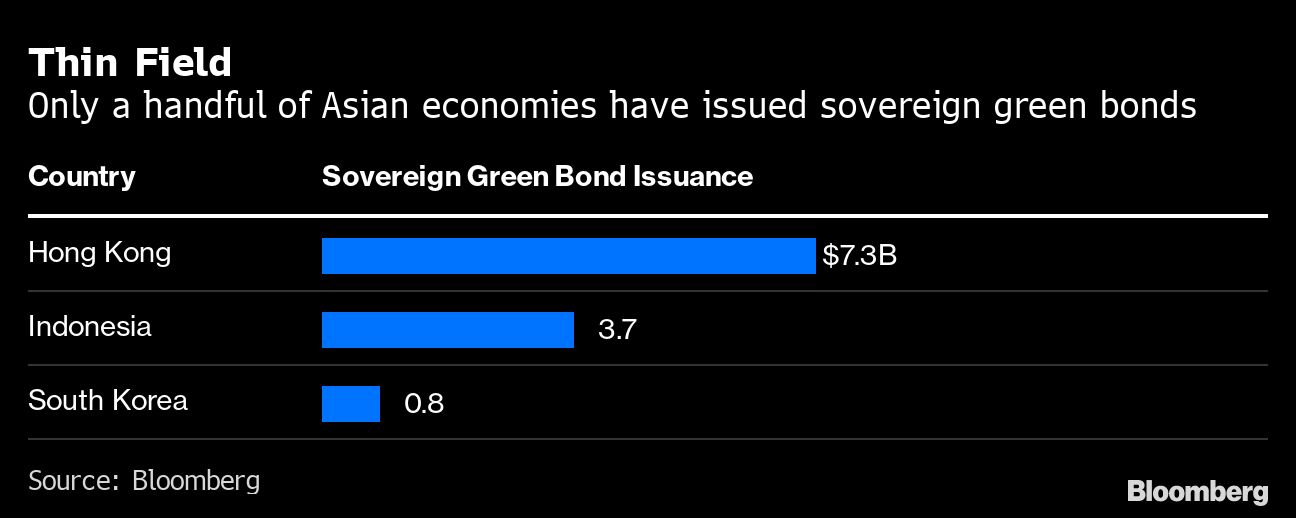
India's Finance Minister Nirmala Sitharaman revealed the government's plan to sell the securities in the second half of the year when announcing the budget on Feb. 1. While a number of companies in the region have issued green debt, only Hong Kong, Indonesia and South Korea have so far sold green sovereign bonds, according to data compiled by Bloomberg.
The timing might not be ideal for India though, especially for a rupee issuance.
The currency has slumped more than 4% this year amid concern the Reserve Bank of India is behind the curve in tackling inflation, with elevated crude oil prices adding to pressures on the net importer. The central bank is forecast to play catch up in coming months, raising its benchmark repurchase rate to 5.5% by year-end from the current level of 4.4%, according to a Bloomberg survey.
“The RBI rate-hiking cycle significantly reduces the appeal of rupee-denominated assets” as tighter policy pushes up local bond yields, said Nivedita Sunil, a fund manager at Lombard Odier Investment Managers in Singapore. “As an off-benchmark item, there would be limited appetite for India's sovereign green bond.”
The absence of Indian funds dedicated to investing in green assets means that local investors will probably treat the issuance the same as conventional bonds, said Sandeep Bhattacharya, India project manager for the Climate Bonds Initiative in Mumbai. That's likely to reduce the potential for any greenium, a premium on sustainable debt, he said.
Part of the reason India may be turning to green bond issuance is to help broaden its funding base as its borrowing needs increase. The government announced in April a record planned issuance of 14.3 trillion rupees ($184 billion) of debt this financial year.
“Given the funding pressures they are facing, they are probably looking for new markets to diversify,” said Kenneth Akintewe, head of Asian sovereign debt at abrdn in Hong Kong. At the same time, “it's good to see a country still on the front foot looking at these markets,” he said.
There's plenty of incentives for India to turn to green bond issuance to fund environmental projects. The country has been gripped by record-breaking heatwaves in recent weeks, adding to concern it's one of the most exposed to climate change. The nation though has been criticized for dragging its feet on commitments to curb emissions, setting the longest deadline for net-zero among the world's biggest economies.
More stories like this are available on bloomberg.com
©2022 Bloomberg L.P.

-
Talking Points This Week: Leadership Shock At Nvidia, Earnings Strength, And The Fog Over Hormuz

The Anthropic IPO pricing and first trading day, Nvidia's upcoming earnings, and any fresh signals from Iran will set the tone for the following week.
-
Signature Play: The Classic Cocktail Is Dead. Or Is It?
Classic cocktails are disappearing from India's cocktail menus. But they're still being ordered, taught to bartenders and borrowed from. So, who's really having the last drink?
-
A New Samvat Wishlist: Inclusive Prosperity And Human Development
India has strengthened its economic foundations through infrastructure, digital access and enterprise. Its next growth chapter must deepen productivity, create better livelihoods and widen participation in prosperity.
-
Love, Sex Aur Dhokha: The Audacious Plot To Spy On Jensen Huang
A Taipei dinner, a Singapore chip buyer and a suspected Chinese asset: inside the alleged spy operation that got close to NVIDIA's Jensen Huang.
-
Ten Things I Learnt This Samvat
Patience can be a trap. Cheap stocks can stay cheap. Leverage can wipe you out. What did Samvat 2082 teach us? Niraj Shah writes on 10 lessons from the year gone by.
-
Talking Points This Week: Tech Nerves, FII Buying, And A Faraway Banking Shock
The global markets are not shining this Diwali. The exception in the large markets is, India.
-
Midterm Rally Lasted A Day. The Hard Reality Of A Divided US May Last Two Years | Opinion
Between a contested AI boom, a debt ceiling that arrives in 2027 and a president with every incentive to act alone, the next two years may prove more volatile than the first day's rally suggests.
-
Blue Wave Will Derail the AI Trade but Won't Dismantle the AI Era | Unhedged Position
The Democrats' sweep of the US Congress will see politics collide with economic forces both over the long and short term.
-
It's Time To Take The GST Council's Bet On Trust Global
Payment records can prove India's services exports, and clear, proportionate rules can bring foreign digital sellers into the tax net.
-
Opinion | India at 38: From Innovation Overperformer to Innovation Powerhouse
India now has 453 VC-backed deep science startups, 18 of them late-stage, after 117 percent growth since 2020. Laurus Labs, at USD 9.3 billion, is the most valuable deep science company in any middle-income economy outside China.









