Chinese Stocks Suffer ‘Panic Selling’ As Tariff War Escalates
Chinese shares and corporate bonds plunged while sovereign yields neared an all-time low as investors braced themselves for the fall-out of a spiraling trade conflict between the world's two largest economies.
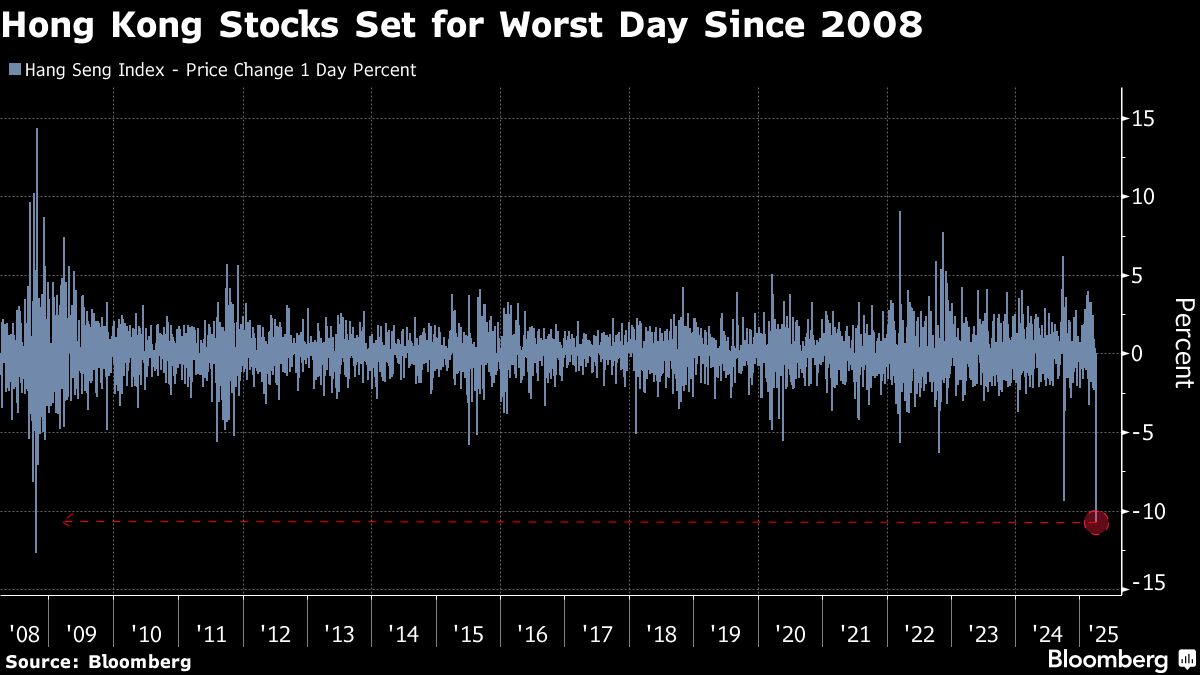
The onshore CSI 300 dropped as much as 7.6%, its biggest decline in over five years. Hong Kong's Hang Seng Index and a separate gauge of Chinese shares listed in the city were both on track for their worst day since the global financial crisis.
China's retaliation against US President Donald Trump's sweeping tariffs is forcing investors to confront the reality that a much-feared trade conflict has entered a new phase. Beijing is now discussing frontloading any sitmulus to offset the damage of tariffs — but so far, investors are focusing on the potential for economic disaster.
“This selloff we see is incredible for all the wrong reasons,” said Sat Duhra, a portfolio manager at Janus Henderson Investors. “There is an element of panic selling, of course; there are margin calls we need to be aware of; funds are selling down to raise cash and China retaliation has introduced more risk with a currency devaluation now on the table in the eyes of investors.”
Exchange-traded funds favored by China's so-called national team of state-linked investors saw heavy trading, a sign that authorities may be working behind the scenes to limit the damage.
The flight from risk cut across all sectors and markets, with all 50 members on the Hang Seng China Enterprises Index in the red. A gauge of Chinese tech stocks in Hong Kong fell more than 15%, putting it on track for a bear market. Chinese issuers were among the names leading losses in Asia on Monday, with spreads on some their investment-grade bonds widening more than 30 basis points, according to traders.
“The global trade system for the past ninety years is collapsing, leaving it difficult for people to forecast the economic impact and tell where the bottom for a market is,” said Vincent Chan, a China strategist at Aletheia Capital Ltd. “If you want to take liquidity out of the system, Hong Kong is the first to hit and there are also a lot of profit to take after this year's rally.”
Government bonds surged as investors flocked to the safest assets available amid fears about how rising tariffs will impact China's economy. The benchmark 10-year yield slid nine basis points to near the lowest level on record, amid a wave of buying at every major maturity.
In the foreign-exchange market, the People's Bank of China weakened its daily reference rate for the yuan to a level unseen since December. That could be a signal that Beijing is willing to support growth by devaluing its currency — and has added fuel to rising speculation about the possibility the yuan will become an important tool in the trade war.
Analysts at Wells Fargo & Co. say there is a risk Beijing could deliberately weaken the yuan by up to 15% over a two-month period, while those at Jefferies Financial Group Inc. has mooted the possibility of a 30% move.
China's offshore yuan weakened around 0.3% against the dollar, even as the People's Bank of China set the currency's daily reference rate at a level much stronger than expected.
‘Strained Voices'
China urged resilience as the selling pressure spread on Monday, with a state-owned newspaper calling for citizens to “turn pressure into motivation.”
But investors appear to be waiting for more action from Beijing, with attention once again turning to the potential for stimulus to help boost the world's second-largest economy. Government officials have discussed frontloading stimulus to reduce the damage of tariffs, according a Bloomberg News report.
Stimulus hopes could ensure the stock rout is quickly followed by a bounce. Retail investors may wade into the market later this week, treating the selloff as an opportunity to buy the dip, said Kenny Wen, head of investment strategy at KGI Asia Ltd.
There are already signs that some investors are ready to load up on stocks. Southbound buying of Chinese stocks listed in Hong Kong was around HK$16 billion ($2 billion) as of mid-day trading break, according to Bloomberg-compiled data.
“We see some bottom fishing now,“ said Andy Maynard, head of equities at China Renaissance. Still, “people are bewildered as to next steps because it's hard to predict what will happen. I think most are exiting their positions and will be extra cautious to add back.”
The sharp moves in Chinese markets came as investors had their first chance to digest Beijing's response to the US tariffs, which were announced during a market holiday on Friday. Chinese officials matched the reciprocal tariffs the US imposed on the country.
The rapid response was a surprise to some investors and has raised concerns that the US might hike its China tariffs again. That could lead to a series of tit-for-tat moves, a potential disaster for the global economy. The retaliation made Beijing an outlier among other Asian nations, with multiple governments in the region expressing their hopes of reaching a deal with the White House. Still, that didn't spare their stock markets on Monday: Equities across the region plummeted amid a broad flight from risk.
“Quite a few shrill and strained voices on the trading floor this morning, and quite honestly I couldn't recall seeing a 8% fall in the normally stable STI, nor a 2000-point fall in HSI in a long time,” said Kok Hoong Wong, head of institutional equities sales trading at Maybank Securities, referring to the Singapore and Hong Kong stock benchmarks. “This level of panic can only be compared to the selloffs in the depth of Covid.”

-
Indians Are Travelling, But Not Every Journey Is A Holiday | The Week In Whys

Pilgrims, patients and working women are the real travellers, and the system hasn't quite caught up with them.
-
Getting To Work Costs Women More | The Reason Why
It is not just about women paying more than men. It is about women paying much more in cities than in villages.
-
AI Bias In Investing Cannot Be Eliminated, But It Can Be Governed
Framing is a particularly important example as identical financial information presented in terms of gains rather than losses can lead an LLM to reach a different assessment.
-
Joining The Dots | Dark Skies, Steady Diya: Why Hope Holds This Diwali
With war, a weak rupee and foreign outflows weighing on sentiment, policymakers at the NDTV World Summit and market veterans at NDTV Profit Ignite: Diwali Edition offered the same advice: stay invested and filter out the noise.
-
The Curious Case of Equitas Small Finance Bank And A CEO Who Quit For Stock
PN Vasudevan believes persistent investor concerns over a perceived conflict of interest had become a governance overhang on Equitas Small Finance Bank's stock, even as the lender improved profitability and asset quality.
-
Talking Points This Week: AI Cash Burn, A Tiger Comeback And An India That Still Finds Its Own Path
India is not immune to higher oil or tighter global liquidity, yet its earnings base is broader, its domestic policy levers are still available.
-
Foreign Investors Own Half Of HDFC Bank and ICICI Bank. An LTCG Cut Could Matter Most Here
Foreign portfolio investors have US$115 billion parked in HDFC Bank, ICICI Bank. If the government cuts long-term capital gains tax, Jefferies says returning foreign money could land here first.
-
'Never Seen This Level Of Negativity': Sandeep Tandon Says The Next Rally May Be Closer Than You Think
Veteran investor Sandeep Tandon says foreign selling is easing, large-caps are due a comeback and mid-caps are crowded, while he turns positive on gold, power and pharma this Diwali.
-
Indians Stay With Family, Not In Hotels | The Reason Why
India still lacks enough clean, reliable and affordable hotels for budget-conscious travellers.
-
The Economic Imperative: Analysing The Material Driving Force Behind India-Canada Strategic Reset
This economic complementarity is further reinforced by deep institutional investment ties and talent mobility, which form the bedrock of the bilateral framework.










